Junji Tanigawa | Series, Part 2: "The Illuminated Scrolls of Yakushiji"
Part 2: "The Illuminated Scrolls of Yakushi-ji" (1)
June 2010, Nishi-no-Kyō, Nara Prefecture. Two years have passed since then. Even now, over 15 million stars sparkle vividly in my memory. A solemn, grand tapestry of time and space, woven from silence and the echoes of antiquity. The "Illuminated Scrolls of Yakushi-ji," a commemorative event for the 1300th anniversary of Heijo-kyo's capital relocation, was a special occasion held at Nara's Yakushi-ji temple, a place that continues to convey something to us across more than 1300 years. I want to revisit that unforgettable space, now that some time has passed.
Text by TANIGAWA JunjiPhotographs by SHIGEMOTO Takashi
~The Origin of the "Illuminated Scrolls of Yakushi-ji" Project~
When I was a child, I heard these words:
A mind that is not biased,
A mind that does not cling,
A mind that is not trapped,
Broad, broad, ever broader,
This is the mind of emptiness (kū) from the Heart Sutra.
These were the words of the former head priest of Yakushi-ji, TAKADA Kōin.
Time flowed on, and it was 2010.
Nara celebrated the 1300th anniversary of its capital's relocation.
After a time so long it defies comprehension,
What has the place called "Yakushi-ji," which continues to live on today,
continued to convey to people?
Gazing at the ancient starry sky spoken of by our predecessors,
I lose myself in thought for a fleeting moment.
The stars released within the "universe" of the National Treasure Tōin-dō
will surely teach us something.
─ I wanted to give form to the mind of emptiness (kū) ─
It was with this feeling that this work was born.
June 4, 2010
Junji Tanigawa
*From materials distributed at the venue
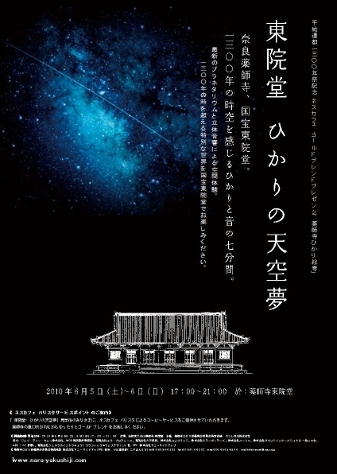
In 2010, Nara was bustling with the 1300th anniversary of the capital's relocation. The Daigokuden hall was restored at the Heijo Palace site, and special viewings were held at various temples and shrines.
Nara is a special place for me, as it was my late father's hometown and holds many memories. When I received an offer from my father's hometown, I visited Yakushi-ji for the first time in a while, and it was beyond my imagination. Beyond imagination in what way? Everything was grander than I remembered. Not just in size, but the presence and energy of the place were clearly different from what I usually encounter.
Every project begins by confronting the "venue, the space." In confronting it, I was both astonished and daunted. What could I possibly create in a place like this? The "power" of this place, where prayers and thoughts have continuously resonated, would surely not yield to my clumsy, superficial creations. Although I tinkered with various ideas at first, I couldn't be satisfied with any of them, and I gambled everything on a final approach.
Part 2: "The Illuminated Scrolls of Yakushi-ji" (2)
Seeking guidance from the space itself. This was my final approach.
I emptied my mind and wandered. I visited the site again and again. Diligently, I kept returning until an image came to me. This is what I call "listening to the place." It was the same during this time. I visited repeatedly for over a year and a half, whenever I had the chance. And the image that finally emerged was of the stars in the desert.
Genjō Sanzō-in. In this temple complex, which enshrines Genjō Sanzō (Note 1), the founder of the Hossō school, one can see the "Great Tang Western Regions Murals" painted by the artist HIRAYAMA Ikuo over 20 years. Genjō Sanzō's journey to India in search of Buddhist scriptures is famously known through the story of "Journey to the West," and the "Great Tang Western Regions Murals" depict his 17-year journey across India in a panoramic style.
During one of my many visits, while looking at the constellations painted on the ceiling, I suddenly wondered: What kind of starry sky did Genjō Sanzō see? I wanted to see the stars of the Taklamakan Desert (Note 6) that Genjō Sanzō truly saw. What was the radiance of the night sky he gazed upon so many times during his long journey? I decided to recreate that. This is how the "Illuminated Scrolls" began.
Visual Direction by YU MARUNO (GLMV)Sound Direction by Hiroaki Ide (EL PRODUCE)
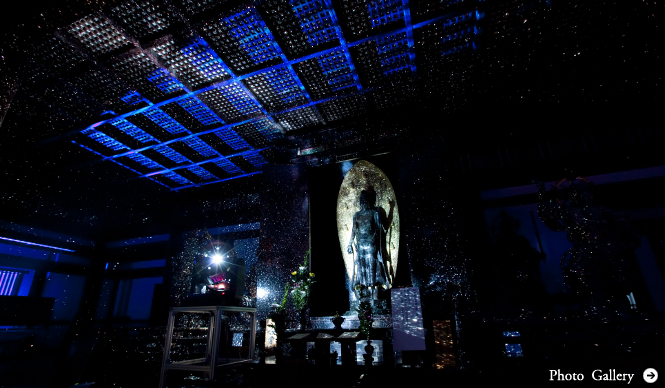
For the stage, I chose the Tōin-dō, the oldest existing building at Yakushi-ji and a National Treasure. Within this hall, which enshrines the National Treasure Bodhisattva of Compassion and the Four Heavenly Kings, we projected the starry sky of the Taklamakan Desert. Using state-of-the-art planetarium technology, we projected it directly into the darkened hall. Harumi Fujimoto created the light, Hiroaki Ide crafted the soundscape, and the planetarium creator Takayuki Ohira brought his MEGASTAR (Note 7). With my addition, a creative team of four was formed, and the work began.
*1 Genjō Sanzō (602–664): A monk of the Tang Dynasty in China. To seek the true meaning of Buddhism, he departed from Chang'an in 627, traveled through the Western Regions to India, studied at Nālandā Monastery, visited Buddhist sites throughout India, and returned to China in 645. His travelogue, "Great Tang Western Regions Record," is an important source for understanding the regions at that time. Also known as Xuanzang.
*2 Garam: The buildings of a large temple.
*3 HIRAYAMA Ikuo (1930–2009): A Japanese painter. Born in Hiroshima Prefecture. Graduated from Tokyo University of the Arts in 1952. Studied under Maeda Seison. His works were selected for the Nihon Art Institute Exhibition. He specialized in Buddhist themes and, in conjunction with this, explored the Silk Road. He was also involved in the preservation movement for world cultural heritage. He served as the president of Tokyo University of the Arts from 1989 to 1995.
*4 Sutra: A book containing the teachings of a sage or wise person.
*5 Seishuku: Constellation. In ancient China, constellations were divided into twenty-eight mansions.
*6 Taklamakan: A desert in the central part of the Tarim Basin in the Xinjiang Uyghur Autonomous Region of China.
*7 MEGASTAR: A super-planetarium created by the personal development of planetarium creator Takayuki Ohira, who has been dedicated to making planetariums since his childhood. While most previous types of planetariums could only reproduce stars up to magnitude 6-7, approximately 6,000 to 30,000 stars, MEGASTAR-I, born in 1998, can project over 1.5 million stars, more than 100 times the previous number.
(Source: "Digital Daijisen" ©Shogakukan, "My Pedia" ©2006 Hitachi Systems & Services, Ltd.)
Part 2: "The Illuminated Scrolls of Yakushi-ji" (3)
From verifying the starry sky of 1300 years ago, how could we make visitors experience a journey beyond time and space? With the idea of appealing not only to sight but also to hearing, we decided to combine the court music "Reigaku," said to have been performed on the continent over 2000 years ago and played on replica instruments from the Shōsōin, with the planetarium projection. The venue was a National Treasure. Of course, no alterations could be made.
We started the event in the evening, using the darkness of night to create a darkened space. The exterior was surrounded by 1300 lanterns, illuminating the ancient atmosphere with candlelight. The Tōin-dō stood deep within the temple grounds, enveloped by guiding lights. Hundreds of mirror balls surrounded the hall, bathed in blue light. We installed custom wooden frames and meticulously attached each ball.
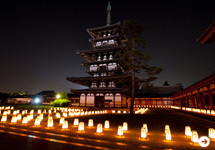
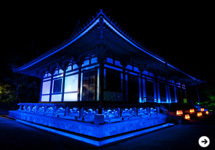
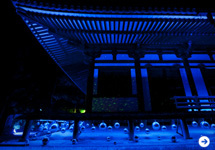
During the rehearsal the night before the performance, all the staff were speechless at the magnificent sight. It was truly a magnificent universe. I have never felt such happiness in silence. The Tōin-dō stood as if it had forgotten gravity. The preparations were complete to welcome everyone into a dreamlike celestial vision floating in a magnificent starry sky.
At times, when the "power" of a place and skill resonate, an atmosphere beyond human comprehension can be born. The Tōin-dō at that moment was precisely that. The energy that continues to live in the space dispels and envelops crude imaginations. Everyone exhales a sigh of awe and feels their existence within the vast universe.
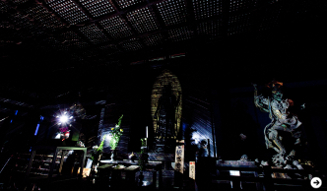
The visible starry sky and the existence of the universe that must lie beyond it. The cycle of life that transcends time and space. Values that have been passed down repeatedly, without end.
Nara Yakushi-ji, National Treasure Tōin-dō. Experiencing these seven minutes that truly transcend time and space, one touches upon the spirit of Genjō Sanzō, which still lives on after thousands of years, and feels the presence of Shakyamuni. The "Illuminated Scrolls of Yakushi-ji" held at Nara Yakushi-ji was a special event that allowed us to feel the certainty that human existence is indeed connected to the universe.
Two years have passed since then. In these two years, each of us has engraved unforgettable memories and experiences. The opportunities to truly wish for peace and health and to seriously consider the inheritance for the next generation have certainly increased. We have changed. And I now feel that the event gave us an opportunity to once again recognize and contemplate the fundamental "something" that we, as we continue to change, must not alter.