May 14, 2015
EVENT | A Light of Hope from Ishinomaki City
EVENT | Light of Hope from Ishinomaki City
Graduation Trophies Made from Rubble Symbolize the Path to Recovery
Some things are impossible to forget. After last year'sGreat East Japan Earthquakewe saw mountains of rubble. Buildings, furniture, cars... everything imaginable was destroyed, swept away by the tsunami, and piled up as debris. Naturally, these towering piles contained the precious memories of the people who lived there. Twenty-five elementary school students in Ishinomaki City, Miyagi Prefecture, confronted this rubble and created graduation trophies imbued with their hopes for recovery. They transformed the debris, which had become a symbol of a tragic event, into works of vibrant color, as if to say, "We are already walking towards the future."
Text by TANAKA Junko (OPENERS)
Children Take a Powerful Step Towards the Future
Great East Japan EarthquakeThe Great East Japan Earthquake resulted in approximately 380,000 homes being completely or partially destroyed, and over a million if partially damaged structures are included. The resulting debris amounted to about 15.7 million tons in Miyagi Prefecture, 4.5 million tons in Iwate Prefecture, and 2.25 million tons in Fukushima Prefecture. While the debris that initially choked the roads has largely been cleared thanks to continuous removal efforts, rubble does not simply disappear without proper processing. It is merely piled up high after being scattered.
Miyagi Prefecture's Ishinomaki City had the largest volume of debris. Even a year after the earthquake, approximately 5.7 million tons of debris were still awaiting processing such as incineration or crushing (as of March 26, 2012, according to Nishinippon Shimbun).
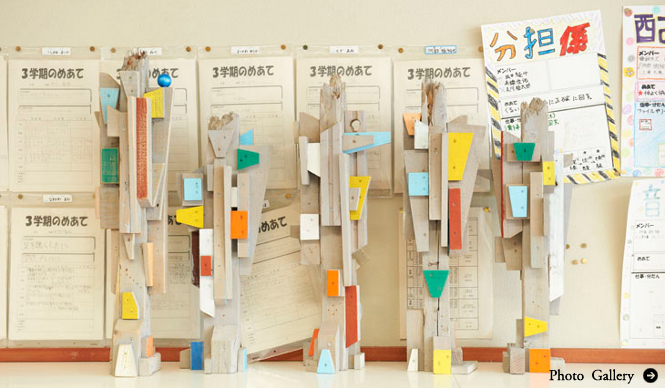
At Minato Elementary School in Ishinomaki City, a unique initiative involving this debris took place. Sixth-graders, nearing graduation, created their own graduation trophies from wood chips found amidst the rubble. The instructor for the 25 children was Kotaro Saito, a wood sculptor from Gunma Prefecture. He explained, "I wanted them to overcome this disaster by confronting the debris, which held so many fragments of life, memories, and happiness." Indeed, confronting the rubble meant confronting the earthquake itself. It was a process of healing the emotional wounds inflicted by the unimaginable experience of the Great East Japan Earthquake.
"The children's earnest efforts surpassed my imagination. Their serious gazes conveyed the magnitude of pent-up emotions hidden deep within their hearts, and as I watched their expressions change throughout the creation process, I became convinced that this was a meaningful endeavor."
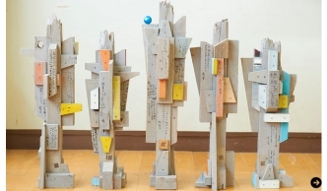
The bright, rich colors and motifs of the completed trophies suggest that the children's hearts are steadily beginning to open. Take, for example, Take Suzuki, who said, "I hoped the trophies would connect the feelings of those looking at them with those in heaven, so I designed a unicorn." Or Aya Kuroda, who poured her wish into her trophy that "people affected by the disaster can live secure and happy lives." And Shunto Okuda, who created a town protected by a dragon, wishing for "the town to be restored to its former state and become even better."—Here, we see children who have overcome their sorrow and taken a powerful step towards the future.
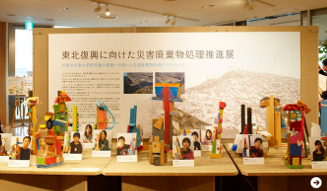
These trophies, each filled with the unique sentiments of 25 children, along with photographic panels documenting their creation, are currently on display at the "Kōshō Rest House" in the Imperial Palace Outer Garden. We hope to renew our commitment to supporting reconstruction alongside these children, whose work warmly embraces the hearts of those affected by the disaster.
Disaster Waste Management Promotion Exhibition
Kōshō Rest House
Dates | March 20 (Tue) - June 30 (Sat), 8:30 - 17:00
Location | 1-1 Kōkyo Gaien, Chiyoda-ku, Tokyo
Organizer | Ministry of the Environment
Cooperation | Ishinomaki City, Ishinomaki City Board of Education, Minato Elementary School, Ishinomaki City
Inquiries
Ministry of the Environment, Waste Management and Recycling Department, Industrial Waste Division
Tel. 03-3581-3351 (Main)