April 15, 2015
Diary-T 216 A Predicament
Around Aoyama Cemetery, reflected in the train window, new green leaves swayed in the spring breeze. The sight of life's strength and cruelty sprouting from the earth towards the heavens filled me with a slight sense of suffocation.
I must have seen this scene for sixty years, but
this year, the repetition of this season seems different.
Regardless of what circumstances befall people, or what unforeseen natural disasters occur, the vitality that surely sprouts in spring felt, cruelly, like a force indifferent to human affairs.
This vitality is indifferent to my own situation and to the nuclear power plant accident. Nature is, in the end, indifferent to humanity.
Excerpt from "The Man Who Resembles Me" by Katsumi Hirakawa
At the time of my mother's enshrinement, the Tokyo Skytree, still under construction and only partially completed, stood tall against the summer sky in its near-finished form. It was certainly a structure symbolizing prosperity, but within the landscape of the winding Oigawa River (Sumida River) flowing to its left, it seemed merely an anomaly.
Humans build such things. No, they are creatures compelled to build. Future generations may accept this structure as a matter of course. By then, I will no longer be in this world. As Nao Sekigawa wrote, we can only go a little way into the future.
Soon, this tower will be illuminated with splendid lights.
Time, sometimes fast, sometimes slow,
passes relentlessly nonetheless.
For a year and a half of caring for my father, time had stopped for me.
Or rather, it might be more accurate to say I was in a dense period of time, governed by various emotions, separate from the neutral time of the outside world.
It was an extremely personal time, unknown to others, and precisely because of that, it was a poignant time. Whatever happened there, no one would look twice, and it would have no impact on the world. Yet,
the world is nothing more than an accumulation of these small moments in time.
To understand this, one must waste much time,
and accumulate difficult experiences.
Excerpt from "The Man Who Resembles Me" by Katsumi Hirakawa
I have reached today without the resolve to become an adult.
Reading this book has made me feel that way again.
Raising children alone is only half the journey,
and one only becomes a true adult after experiencing the care of one's parents.
I feel like I read that somewhere.
Now, if I were to replace "caring for one's parents" with my own experience,
I have never seen a single photograph of my father, so
I have no memory or clue about his face, let alone anything else.
And I first met my mother when I was sixteen.
Although we had some interaction, I never felt a sense of kinship,
nor the unique intimacy or embrace that comes with it.
In the first place, I have no idea what kinship truly means.
I have vague memories of being cared for by several families and others since childhood, but if you ask who raised me,
it would have to be my maternal grandmother.
However, I worked for my grandmother from high school,
so unfortunately, I never developed a sense of affection for her.
It's not that I had a life of being utterly alone, though my life has been quite complex,
I was blessed with wonderful families on several occasions.
But, like Katsumi Hirakawa's "The Man Who Resembles Me," which deeply moved me this time,
I currently lack the resolve, understanding, or sense of responsibility and love required to care for one's parents.
So, I will now bravely reveal a painful and cruel story, perhaps in a self-indulgent way,
my grandmother, who had married several times and was alone in the end, was abandoned by her daughters and me, and passed away in a distant hospital cared for by members of the Soka Gakkai.
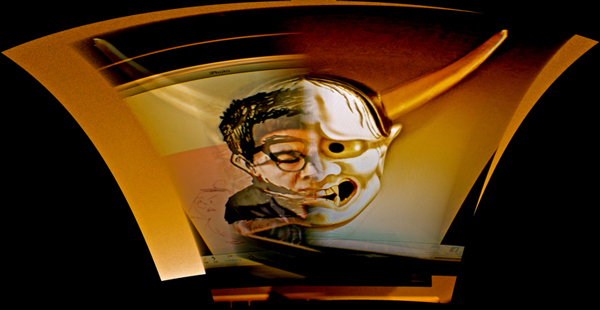
Ah, even as I write this cruel account, there is something I cannot forget. On one occasion, my mother suddenly called me, saying my grandmother was nearing her end, and took me to visit her in that distant hospital. Seeing my grandmother's face, after more than a decade, I gasped involuntarily. Her face had become gaunt, like a terrifying Hannya mask. It was frightening. Truly frightening.
But at that moment, I mustered the courage to smile,
and for some reason, my body moved on its own, and I stroked her bony, skeletal hand.
I probably fled the hospital soon after, but on the way home, I remember tears streaming down my face for no apparent reason. Perhaps it was a feeling of remorse, or a sense of guilt towards my grandmother that brought on the tears. But what struck me most strongly then was the terrifying realization that I would likely meet the same end as my grandmother. They say that when people die, good and evil balance out, but perhaps, at the moment of death, the faces of all people—successful, wealthy, or those crawling at the bottom of society—reveal the memories of the unhappiness they have caused others.
Oh dear, the story has taken quite a meandering turn, but
where does the will or resolve to care for someone arise from?
That was my fundamental question.
Do those who have never been loved ultimately die without knowing how to love?
Or does the blood connection naturally evoke such feelings...?
That is what I want to know. What I want to master.
That is still the
The Long And Winding Road of my life.
Hmm, I seem to be utterly lacking in the awareness of adulthood.
Katsu! Shouting won't help.
← Diary-T 213-218
Purchase here
http://ckstore.shop-pro.jp/?pid=39869774