The Foundation for Global Sustainability: Bringing Together Global Wisdom to Launch
SoftBank Founder Masayoshi Son Establishes Renewable Energy Foundation
Gathering Global Wisdom, It Finally Begins
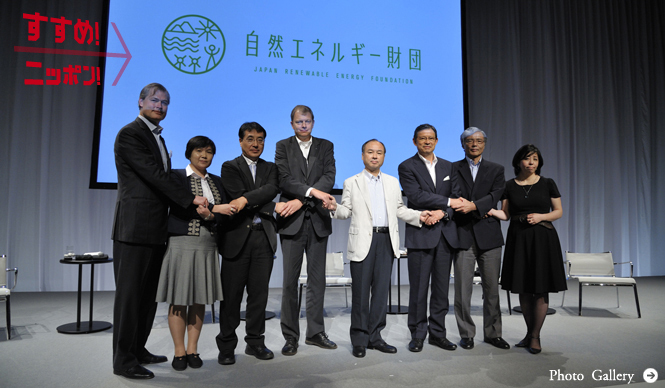
On the morning of September 12th, a quiet intensity swirled within the B7 hall of the Tokyo International Forum in Yurakucho.
A sign read, "Twitter Invitees This Way." The 1,400-square-meter venue was packed. Among the "Twitter invitees" in the back, the number of young people was striking. This was no rock concert, nor a celebrity event. It was a conference on "renewable energy."
By Eiichi Yoshimura
Photos by Tomo Kaitani
Former Swedish Energy Minister Appointed as Representative Director
This event marked the unveiling of the "Renewable Energy Foundation," announced in April of this year by SoftBank President Masayoshi Son. Following the Great East Japan Earthquake of March 11th and the subsequent Fukushima Daiichi nuclear disaster, discussions about the necessity of nuclear power in Japan and the availability of alternative energy sources had reached a fever pitch. Son pledged 1 billion yen of his personal fortune to establish the foundation.
Renewable energy, which was hardly a sensational topic before March 11th, has now become the theme of such a fervent event, drawing a massive crowd, albeit spearheaded by the charismatic CEO Son. This is surely proof of a significant shift in the consciousness of the Japanese people regarding Japan's future, prompted by the events of March 11th.
Furthermore, the fact that participants for this launch event were primarily recruited via Twitter is, I believe, a reflection of the times in Japan.
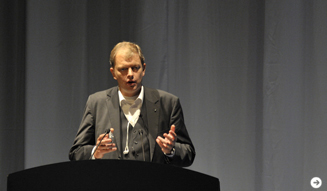
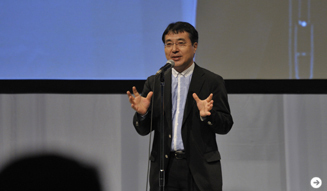
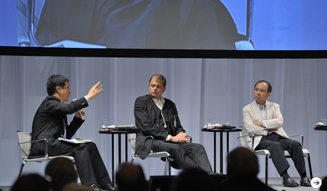
The event's program featured a keynote speech by the foundation's founder, Masayoshi Son. Following this, Thomas Koberg, former Swedish Minister for Energy and a leader in renewable energy, who was headhunted to serve as the foundation's chairman, delivered his address. The program also included presentations from other directors—Takejiro Sueyoshi (Special Advisor to the UN Environment Programme's Finance Initiative), Tetsunari Iida (Director of the Institute for Sustainable Energy Policies), and Yoshihisa Murasawa (Advisor to the President, The University of Tokyo)—each outlining the foundation's initiatives within their respective fields of expertise.
The day also included speeches and presentations from government officials, including the Minister of the Environment, as well as experts and representatives involved in renewable energy from various countries, making for a comprehensive event spanning over six hours.
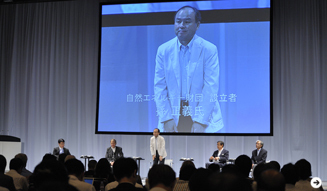
The highlight of the event was undoubtedly the keynote speech by Founder Son. He began by stating, "I was completely unfamiliar with electricity and power generation until now, but the events of March 11th made that stance untenable."
Son, who had considered what was necessary to phase out nuclear power without hindering economic growth, presented three proposals from the Renewable Energy Foundation in his keynote address.
SoftBank Founder Masayoshi Son Establishes Renewable Energy Foundation
Gathering Global Wisdom, It Finally Begins
The "Super Grid" Concept Connecting East Asia's Power Networks
1) Minimizing Nuclear Power
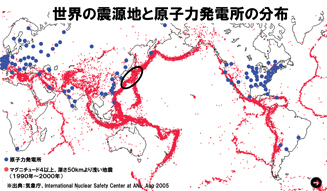
The operation of so many nuclear power plants in Japan, the world's most seismically active country, is extraordinary. We must actively pursue the decommissioning of nuclear plants in high-risk seismic zones and choose renewable energy as their replacement.
2) Liberalizing Electricity Trading
The biggest obstacle to the widespread adoption of renewable energy is that electricity generated from renewable sources cannot enter the free market. By separating power transmission and distribution and promoting feed-in tariffs for renewable energy, we can make renewable energy cost-competitive. Even if it is expensive now, we must expand renewable energy to ensure safe and affordable energy in 20 years. This will ultimately increase Japan's energy self-sufficiency and benefit national security.
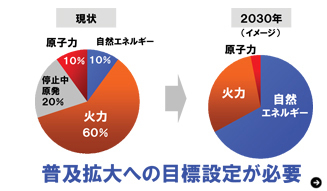
3) Strengthening Transmission Infrastructure
By developing and reinforcing transmission infrastructure across Japan, we can mitigate the intermittency of renewable energy generation by enabling power sharing between regions. This is the Japan Super Grid concept, achievable with a budget of approximately 2 trillion yen. In the future, this transmission infrastructure could be expanded across all of East Asia, forming an East Asia Super Grid to facilitate the exchange of affordable and stable electricity not only within Japan but across the entire region. Historically, conflicts have often arisen over energy resources, but this concept will undoubtedly contribute to peace throughout Asia.
Proposal (3) was presented for the first time at this event and is remarkably bold. While it may seem distant in terms of feasibility at first glance, numerous communication cables already span the seabed connecting Japan and the world, and adding power cables presents few technical challenges. As Founder Son himself mentioned, this is likely an idea born from his expertise in the telecommunications industry. While political challenges may loom larger than technical ones, with international power grids already existing in Europe and gas pipeline networks connecting Russia, the EU, and East Asia becoming realities, this is by no means a pipe dream.
What the East Asia Super Grid Concept Will Bring
Speaking about the potential underpinning this East Asia Super Grid concept was guest Ts. Boldbaatar, Chairman of the Mongolian investment company Newcom. He highlighted the immense potential for renewable energy development in Mongolia, particularly the astonishing prospect that installing solar power plants across the Gobi Desert could meet 60% of the world's electricity demand. If such a vast energy source were connected to Japan and the entire East Asian region via a super grid, the phase-out of nuclear power across East Asia could accelerate dramatically, and the economic growth spurred by the development of this massive infrastructure would be equally substantial.
Alongside these grand visions of potential, the foundation's directors and international guests discussed the possibilities of further energy conservation through technological advancements, innovative ideas, and the parallel development of smart and small grids alongside the mega super grid, as well as environmental issues. The Minister and Parliamentary Vice-Minister of the Environment were also in attendance, addressing the importance of a paradigm shift in Japan's energy policy and the issue of decontamination in radioactive contamination zones.
This was a profound and substantive event, blending grounded, pragmatic discussions with the first large-scale dreams and hopes articulated in the post-March 11th era.
Everyone present understood that realizing these proposals faces numerous hurdles and that overcoming them will not be easy. Yet, they are determined to move forward. The resounding applause at the event's conclusion seemed to embody this collective resolve.