April 23, 2015
more trees | Japan, Aomori, Monozukuri: An Art Project Realized by Sanyo Shokai and More Trees!
Sanyo Shokai and more trees Collaborate on an Art Project!
Japan, Aomori, Monozukuri (1)
In July 2011, Sanyo Shokai, a major apparel manufacturer, issued a press release. It featured charming penguin art. In fact, a similar release had been distributed in early March. While this latest release is slightly updated, the content remains largely the same. It details Sanyo Shokai's collaboration with more trees on an art piece as part of their social contribution activities, to be presented at "Art Fair Tokyo." Due to the recent earthquake, "Art Fair Tokyo" was postponed to the end of July, necessitating a new announcement.
Text by OPENERS
The Potential of Social Contribution Activities Expanded by Art
The project's theme is Sanyo Shokai, with its high-level sewing technology in Japan, engaging in social contribution activities. The highlight is the collaboration with more trees, known for its forest conservation efforts. Another notable aspect is the participation of artist Takashi Kuribayashi. While perhaps not widely known in Japan, he is an artist highly acclaimed internationally. His permanent installation is at the Towada Art Center in Aomori Prefecture, and he participated in the Mori Art Museum's "Nature Sense" exhibition in 2010. In 2011, he actively exhibited in museums in Singapore and South Korea.
This piqued my interest in the project anew. Sanyo Shokai is a major apparel manufacturer with nearly 40 brands, including overseas labels. While an art project might seem plausible, it still feels somewhat unusual. Globally, numerous apparel companies have deep ties with art houses and support the arts, which is not uncommon. Apparel and art share a high affinity. However, why "create art" rather than "support art"? And why "collaborate" with the forest conservation group more trees?
Sanyo Shokai and more trees Collaborate on an Art Project!
Japan, Aomori, Monozukuri (2)
Sanyo Shokai x more trees x Takashi Kuribayashi
Sanyo Shokai and more trees first met in October 2010. Sanyo Shokai originally had five production bases in Japan, all boasting high sewing technology. These were located in Niigata, Fukushima, Miyagi, Iwate, and Aomori. They aimed to leverage these assets to build a project that would simultaneously revitalize regions in Japan and contribute to society. It was then that they encountered more trees, an organization focused on forest conservation and regional revitalization in Japan.
However, the project didn't start immediately. Finding a connection between sewing technology and forest resources proved difficult and led to setbacks. While many products on the market utilize sewing techniques combining wood and leather, simply replicating this held no meaning. Furthermore, Sanyo Shokai's cultivated sewing expertise truly shines when stitching fabrics. Building the project required a small amount of time. The conclusion they reached was "art." Art can be considered a form of "information" rather than just a "thing."
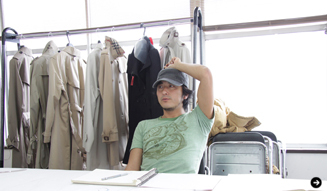
Artist Takashi Kuribayashi
It is a medium that provides viewers with information through novel ideas, bringing new value. For both parties seeking new connections and value between sewing technology and wood, it was the perfect conclusion.
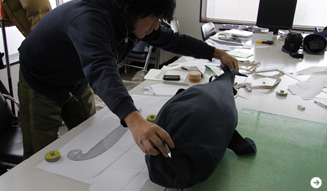
The project gained significant momentum with the participation of artist Takashi Kuribayashi. Unusually for a prominent artist in Japan, Kuribayashi is not affiliated with a gallery, allowing him the freedom to pursue a wide range of artistic activities at his own discretion. Furthermore, at this time, Kuribayashi was exploring various approaches to pursue his artistic expression. Artists who translate their philosophies into their work often face rejection when collaborating with companies operating on a commercial basis. This collaboration was fortunate in its timing.
And so, in December 2010, the art project themed "Creating art utilizing sewing technology and forest resources" officially began. This was achieved in just two months.
Sanyo Shokai and more trees Collaborate on an Art Project!
Japan, Aomori, Monozukuri (3)
The Artisans' Motivation
Among Sanyo Shokai's domestic factories, the "Sanyo Sewing Aomori Factory," renowned globally for its coat-making techniques, was chosen to fully cooperate with this project. Sanyo Shokai, an apparel manufacturer that grew from its core business of producing raincoats starting in 1946, has a deep and strong connection to coat making. It would be hard to find a more fitting choice for a social contribution project.
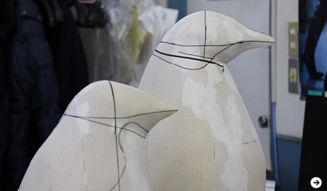
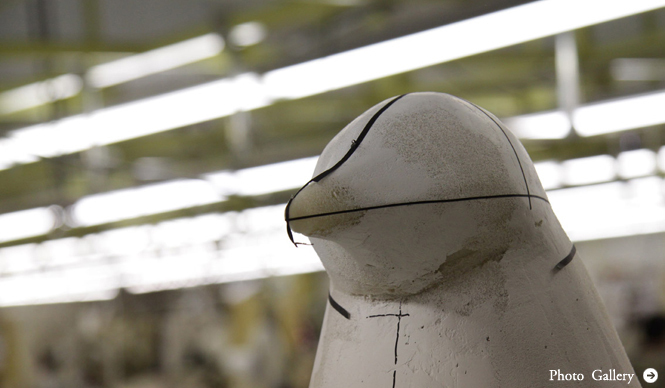
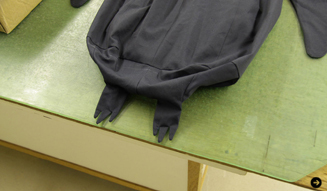
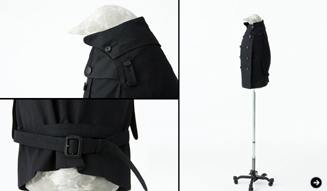
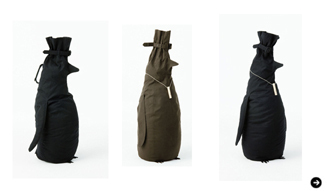
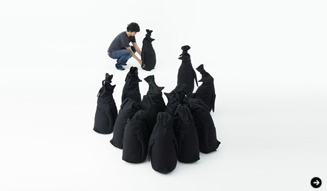
Crossing into the new year, the art concept was finalized in February 2011. Kuribayashi is known for his ongoing artistic exploration of "boundaries," and his iconic works often feature penguins and seals as motifs. Both are animals that live on the border between air (land) and sea. This time, penguins were chosen as the motif. The specifications for the artworks were also decided. Two types of art pieces were to be created: one a penguin-shaped torso made of wood, dressed in a custom coat, and the other a bag-shaped penguin art piece.
Both would utilize "gabardine," the fabric the Aomori factory excels at for coat material, and wood provided by more trees. This was the moment art beautifully connected sewing technology and the forest. However, even with the Aomori factory's advanced skills, sewing something other than a coat, especially an "art" piece in the shape of a penguin, was a first. Yet, faced with a theme they had never tackled before, the artisans' motivation actually increased.
The factory is located in Shichinohe-Towada, a station on the Tohoku Shinkansen line, which had just opened. The distance is so short it's visible from the Shinkansen station. Despite the challenges, production proceeded smoothly. Kuribayashi and the involved parties visited the Aomori factory multiple times, refining the initial sketches through trial and error. February and March in Aomori are cold and snowy, but the Aomori factory must have been buzzing with energy.
A Result of This Project
Here, we can see one of the outcomes of Sanyo Shokai's social contribution activities. The people working at the Aomori factory are mostly local residents. The penguins placed casually beside the finishing coats reportedly sparked the interest of the factory workers and lightened the atmosphere.
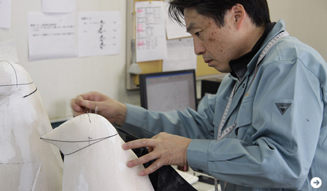
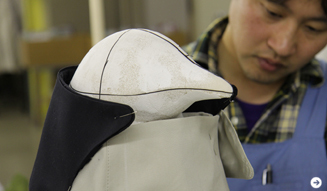
Furthermore, the Aomori factory in Shichinohe-Towada is also close to the Towada Art Center. Incidentally, Kuribayashi's work is permanently exhibited there, and many locals were already familiar with him. The novelty of working on a project with an artist whose name they recognized likely boosted the motivation not only of the factory workers but of Sanyo Shokai as a whole. It's not hard to imagine.
This passion imbues the objects. It will surely be conveyed to many people. What this project has materialized goes beyond mere social contribution. It is an excellent example of elevating Japanese technology into art and further into social contribution activities.
Sanyo Shokai and more trees Collaborate on an Art Project!
Japan, Aomori, Monozukuri (4)
After the Earthquake──
On March 11th, the Great East Japan Earthquake struck while work was progressing smoothly. The entire Tohoku region was affected, and the Aomori factory was no exception. Fortunately, there were no collapses or casualties, but the employees suffered emotional distress, and energy procurement became difficult due to the isolation of the Tohoku region, leading to a halt in operations. Meanwhile, "Art Fair Tokyo," which was proceeding as planned until March 22nd, saw Tokyo Metropolitan Government announce the acceptance of evacuees. The venue, Tokyo International Forum, prohibited event usage, and the fair was canceled.
In this situation, an atmosphere of resignation regarding the art piece production began to emerge. However, the Aomori factory was the first to express its determination to see the project through to completion. As if to support this, on March 29th, "Art Fair Tokyo" decided to proceed from July 29th to 31st, with the venue remaining Tokyo International Forum. Thus, the creation of the art pieces resumed. Initially, all sales revenue was planned to be donated to more trees for forest conservation. However, following the earthquake, it was decided that the funds would be directed to "LIFE311," a project by more trees to support the construction of wooden temporary housing in Sumita Town, Iwate Prefecture, launched in response to the disaster.
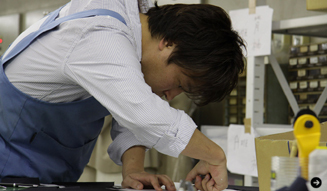
The ability to contribute to the recovery of the Tohoku region from Aomori, a place less affected by the disaster, must have had a significant impact on the people at the Aomori factory. The art pieces are still in production and are said to continue right up until the exhibition. The more one learns about the development story, the more one looks forward to finding the penguin art at "Art Fair Tokyo."
Conclusion
Since the earthquake, I feel that the perception of "things" in Japan has changed significantly. However, the signs were there before. The noticeable decline in overall retail sales over the past few years is a prime example. The way people buy "things" has drastically changed compared to a decade ago. The criteria for purchasing "things" are shifting from mere "functionality" to how much "value" they provide. The Great Earthquake may accelerate this trend.
Since the bubble economy of the 1980s, many "things" produced in Japan have prioritized "function" and "quality." As a result, Japanese "things" have dominated the world, but it feels as though the culture, history, craftsmanship, and dedication that nurture essential value have been excessively stripped away. That is why the Great Earthquake has significantly shaken the "function" and "quality" that Japan prides itself on. People are once again turning their attention to manufacturing that inherits culture and to local craftsmanship. In this era, as Japan's value is being re-evaluated, this small art project seems to hold various implications.