April 23, 2015
more trees | Launches Disaster Relief Project "LIFE311"
more trees | Wooden Temporary Housing for Disaster Areas
Launching the Disaster Relief Project "LIFE311"
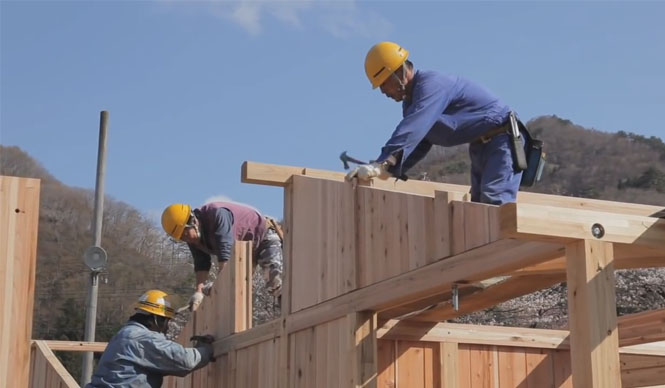
Ryuichi SakamotoMore Trees, a forest conservation organization headed by Ryuichi Sakamoto, has launched "LIFE311" as a disaster relief project for the areas affected by the Great East Japan Earthquake. In collaboration with the people of the affected regions, they will build wooden temporary housing using timber from Tohoku's forests to support reconstruction.
By Tomomi Yanaka
Donations Accepted to Support the Project
The recent earthquake and tsunami claimed many lives, and simultaneously, a vast number of people lost their "homes," which serve as both the foundation of their lives and a source of spiritual comfort. More Trees initiated this project to contribute to the economic revitalization of the disaster-stricken areas and to provide comfortable living spaces by constructing temporary housing using local timber in cooperation with local residents.
The base for this project is Sumita Town in Iwate Prefecture, located inland and adjacent to heavily devastated areas like Rikuzentakata City. The town has long aimed to be "Number One in Forests and Forestry," and even after the earthquake, it was quick to begin construction of wooden temporary housing. They had been seeking financial support from the outset, and this project aligns perfectly with More Trees' policy and Sumita Town's needs.
Wooden temporary housing offers numerous benefits to disaster-stricken areas and their residents. Firstly, it excels in humidity control, remaining cool in summer and warm in winter. Additionally, to withstand the harsh winter cold, pellet stoves fueled by thinned wood have been installed, enabling local energy self-sufficiency. Furthermore, the "warmth of wood" can provide a comfortable living environment for those affected.
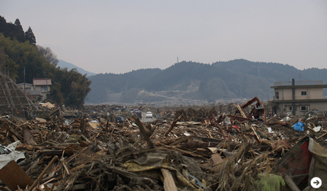
Rikuzentakata City, which suffered immense damage. Based in the adjacent Sumita Town.
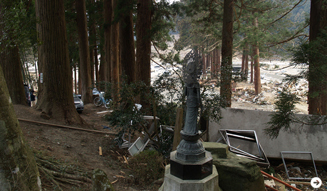
Minamisanriku Town. Damage to the forests was relatively minor.
This initiative not only provides shelter but also creates jobs and contributes to economic activity for those who lost their livelihoods or workplaces due to the disaster, thereby aiding in recovery. The use of local timber also promotes better forest management, revitalizes the mountains, and ensures profits are returned to the local community. The wood used in the temporary housing can be repurposed for other construction after its two-year term and can be fully utilized by being ground into pellets, ensuring no waste.
The construction cost for each wooden temporary house is 3 million yen. Sumita Town currently plans to build 110 units. More Trees is requesting nearby municipalities in the affected areas to provide land for the construction of temporary housing and is widely seeking financial support to build as many wooden temporary houses as possible.
"Since the earthquake on March 11th, we at More Trees, as a forest conservation organization, have been contemplating what we could do. As a result, we arrived at this wooden temporary housing project as a means of supporting recovery through forestry. While the fishing industry has been severely impacted, fortunately, the damage to forestry was minimal. By using local timber and having local construction companies take the lead, we hope to revitalize the forestry industry and create employment opportunities. We would be grateful if more individuals and companies could participate in building these temporary houses with your goodwill," said Shin-kichi Mizutani, Secretary-General of More Trees.
"LIFE311" creates "work," builds "homes," and regenerates lost "LIFE." This project, with its medium- to long-term perspective, will support the recovery of many people and regions.
Click here for the LIFE311 homepage