more trees | A Report on the More Trees Night Vol. 4: Fine Drinks, Exquisite Food, and Inspiring Stories
more trees | A Forest Feast in the City: Fine Drinks, Food, and Stories
more trees night vol.4 Event Report (1)
TOUCH WOOD: A Development Documentary
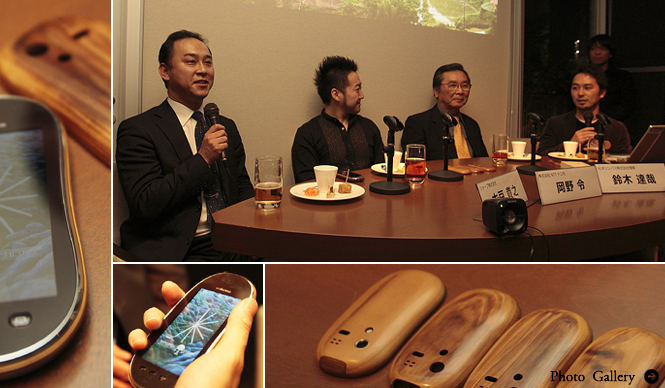
Developers are a curious breed. They are the most passionate individuals in product creation, yet they rarely appear in the spotlight. They are always behind the scenes. While a company's advertising and marketing efforts should convey this passion to a wider audience, the focus is currently on sales, obscuring the dedication involved. In an era where developers' passion struggles to reach people, the "TOUCH WOOD SH-08C" stands out. Announced by NTT DOCOMO (hereafter DOCOMO) in November, this wooden mobile phone seems to directly convey the developers' passion. The more trees night Vol.4 brought together the developers of the TOUCH WOOD SH-08C. The talks that unfolded that day were, without exaggeration, a development documentary.
Text by OPENERS
We Want to Make a Phone Out of Wood
In the summer of 2008, Mr. Osamu Kano of NTT DOCOMO was reportedly wrestling with a challenge. Having successfully created buzz with collaborative mobile phones featuring various fashion brands and renowned designers as part of a strategy to cater to fragmented needs, moving away from mass-produced, "greatest common denominator" products, he was now focusing on using natural materials, specifically "wood," for the next mobile phone, not for mass production. He wanted to use a material familiar to Japanese people, given that a mobile phone is always held in hand. However, the path forward was unclear.
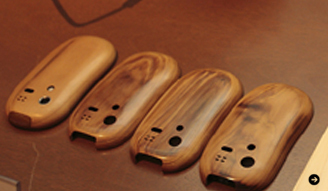
"Making a phone out of wood might seem simple, but it's actually incredibly difficult. Beyond durability, antibacterial properties, and rot resistance, controlling the shape is a major hurdle. While we can create various forms by carving, this compromises strength, and producing even one unit requires immense cost and time. Changes in size due to temperature and humidity are also completely unsuitable for precision machinery. We faced a thick wall."
It was then that Mr. Kano learned about more trees through a mutual acquaintance. "I met Mr. Nobuyoshi Mizutani, the executive director, around August 2008. Through him, I learned about the current state of Japanese forests and strongly recognized the necessity of circulating domestic thinned wood into the economy. I believed that using thinned wood to create a mobile phone would send a powerful message to both consumers and corporations, so I resolved to face the difficulties and launched the project." He then discovered that Olympus possessed specialized wood processing technology.
Discovering the Potential of Wood Processing
Around the same time, Mr. Tatsuya Suzuki of Olympus was striving to realize the wood processing technology he had been developing for many years, he explained.
"For quite some time, I had questioned products that become obsolete within a few years and felt a desire to develop products that could be cherished and used for a long time. That's why I focused on wood, a material that develops more character with use. I began serious research in 2003."
He mentioned that the initial development was fraught with difficulties and struggles. "We tried every method, but none worked. It was the most challenging material I had ever encountered. Finally, we arrived at three-dimensional compression molding."
Unlike plastic or metal, wood cannot be stretched or bent. To achieve the desired shape, carving is the only option. However, carving thins the material, making it impossible to maintain the strength required for an industrial product. Therefore, Mr. Suzuki focused on wood compression technology. This method involves compressing wood to make it thinner without altering its mass, significantly increasing its strength. Applying this technology, Mr. Suzuki developed three-dimensional compression molding. A mold is created for the desired shape, and this mold is used to compress and form the wood.
"We presented a prototype digital camera made using three-dimensional compression molding at 'photokina,' a camera show held every two years in Germany in 2006, and it received high praise. In 2008, we also received an award in Japan, and although the company suggested starting with in-house products, I was determined to utilize this technology in various products for the market. It was at that time that Mr. Kano and Mr. Mizutani approached me with their desire to create a wooden mobile phone and asked for my cooperation. I thought it was quite timely that such young individuals came to us."
more trees | Fine Drinks, Food, and Stories: A Forest Feast in the City
more trees night vol.4 Event Report (2)
TOUCH WOOD: A Development Documentary
The Final Piece for Creating a Wooden Mobile Phone
Upon seeing Mr. Suzuki's technology, Mr. Kano reportedly felt a sense of conviction. "I intuitively thought, 'This will work!' It was that impressive." Mr. Mizutani of more trees agreed. "more trees has connections with companies in Hida-Takayama, Gifu Prefecture, known as a center for woodworking. There, wood compression processing technology is utilized in furniture making, among other applications. I had already experienced the potential of compression molding firsthand."
Olympus's technology was particularly suitable for mobile phones, not only achieving durability, water resistance, antibacterial properties, and rot resistance but also being ideal for precision machinery requiring fine control. It was decided that thinned wood from "more trees' forests" would be supplied, DOCOMO began planning prototypes, and the wood processing technology was in place. Only one piece was missing: a manufacturer to actually build the phone. In early 2009, a company stepped forward: Sharp, the king of mobile phone manufacturers.
Launching the Wooden Mobile Phone Project and Product Development
"At first, when I heard about this idea, I thought it was impossible. There was no way it could be done. We are also aware of the difficulties of using wood. Even when dried, wood contains moisture and oils, making it difficult to combine with precision machinery. If dried too much, the wood will crack."
Mr. Takayuki Kido recalled this sentiment. As the head of product planning at Sharp, he had been solely responsible for product development for DOCOMO for over a decade. Mr. Kido continued, "Nevertheless, after seeing Olympus's technology, I truly felt it was remarkable. I thought there might be a possibility. However, I still believed it was impossible to turn it into a product. Verification would be difficult, mass production would be difficult, and using wood for the phone's casing itself was unprecedented. My honest feeling was that we should just make a prototype and be done with it, or at least aim for that (laughs)."
However, Mr. Kido, being a developer himself, felt a passion for bringing even a sliver of possibility to life. Thus, the creation of a wooden mobile phone prototype began. Approximately ten months later, in October 2009, the "TOUCH WOOD," a mobile phone made from domestic thinned wood, was exhibited at DOCOMO's booth at CEATEC JAPAN 2009, receiving a significant response. This event prompted DOCOMO to decide on the productization of TOUCH WOOD.
Announcement of TOUCH WOOD SH-08C
On November 8, 2010, the TOUCH WOOD SH-08C was officially announced at NTT DOCOMO's 2010-2011 Winter/Spring New Product Launch Event. It garnered widespread media attention and became a hot topic online. OPENERS also featured itas an article.
And so, on November 29th, at the more trees night event, the developers gathered.
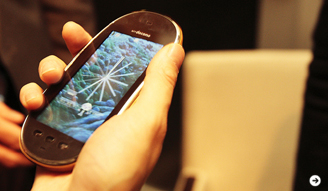
In fact, there was a big surprise that evening. Mr. Kido brought the newly manufactured TOUCH WOOD SH-08C unit from the Hiroshima factory. Holding the actual device, Mr. Kido said with deep emotion, "Producing a limited edition of 15,000 units from scratch is extremely rare. Normally, for limited editions like this, an existing model is used as a base, but this is a completely original design. Everything was designed solely for this purpose."
Good products have good stories. There is no doubt that the TOUCH WOOD SH-08C is a masterpiece infused with Japan's manufacturing technology and passion. However, the developers are not resting easy. They understand the immense difficulty of the road to its release. The path ahead is still fraught with challenges. The tension was palpable throughout the talks. Of course, it goes without saying that attendees had the opportunity to touch and operate the TOUCH WOOD SH-08C that evening, and to savor its woody aroma.
The TOUCH WOOD SH-08C is scheduled for release in February-March 2011. While the exact release date has not yet been announced, it has been a long time since a mobile phone was so eagerly anticipated.
The passion of the developers, glimpsed at the more trees night, will undoubtedly continue to spread to many more people in the future.