Hiroko Takahashi | #007 Hiroko Takahashi's Circles and Lines: First Visit to Korea (Part 1)
Crafting Hanbok for the First Time: Fresh Surprise and Discovery
Riko Takahashi's Circles and Lines: First Time in Korea (Part 1)
Last autumn, I was invited to hold a solo exhibition at a new gallery that had just opened in Seoul. Simultaneously, I was asked to present a brief show of Japanese kimono and Korean hanbok at the opening party. Of course, I had never worn or made a hanbok before. Despite having learned about and cherished my own country's traditional attire, I felt I couldn't casually engage with another culture's traditions. I agonized, feeling the task was too great for me. However, I reasoned that I would likely never learn about hanbok if not for such an opportunity, and so I decided to take on the challenge.
Text by Riko TakahashiPhotos by Shiori Kawamoto
Capturing the Essence: Creating My Hanbok for Today
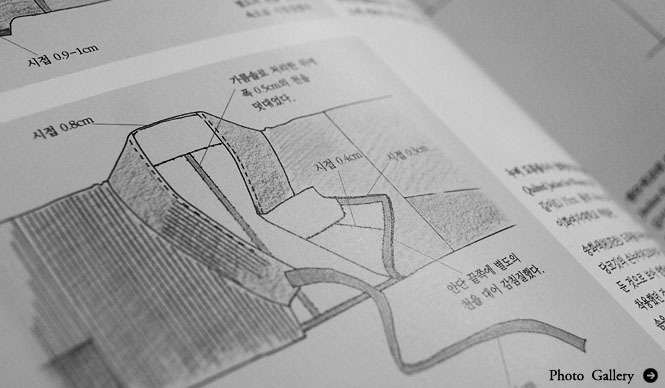
First, I began by acquiring basic knowledge of Korean clothing history and daily life culture. With that foundation, I studied various photographs of hanbok, contemplating designs while also deconstructing actual hanbok to examine their structure and tailoring methods. Furthermore, when drafting patterns to fit the models' measurements, I found that much remained unclear even when looking at finished garments. I ordered books on how to make hanbok. There were times I thought it might be impossible, struggling with Korean characters I couldn't read. But as I followed the numbers, the logic behind the patterns began to emerge. Although it has a soft, curved silhouette, unlike a kimono, the cutting is done in straight lines, and after sewing along the curved seam lines, the excess fabric is trimmed away. I had thought the collar shape and overlap of the *chogori* (jacket) were similar to a kimono, but I was greatly surprised to find how closely the underlying construction, invisible in the finished garment, resembled it. The structure, different from both Western clothing construction I had studied and from kimono making, repeatedly brought me to the brink of despair. Yet, the more I learned, the more I saw similarities with kimono, and it was these fresh surprises and discoveries that kept me engaged.
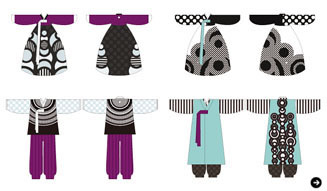
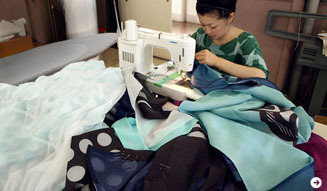
Capturing the essence: creating my hanbok for today. Otherwise, it would become a mere imitation, mimicking only superficial colors and shapes. I considered its history, evolution, and T.P.O. (time, place, occasion), and also needed to understand the current state of hanbok in Korea. I took the utmost care to ensure that the hanbok I created would not tarnish its history or existence, and I sought opinions from experts in Korean costume research, individuals who frequently wear hanbok, and even from a hanbok shop in Japan. Over its long history, it has gradually changed, and today, its colors, patterns, and shapes have become quite free. This is remarkably similar to the presence of kimono in modern Japan, which I found to be a particularly fascinating point.
HIROCOLEDGE
http://www.hirocoledge.com/