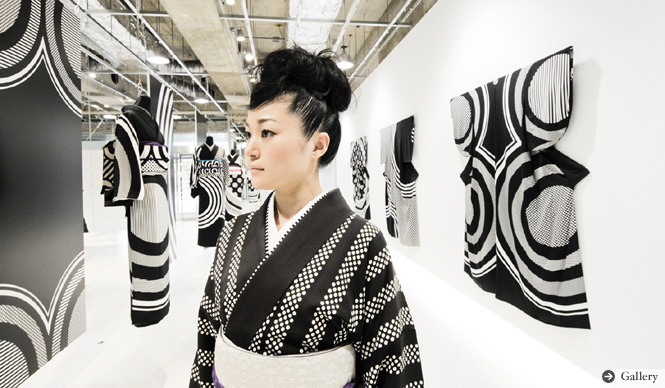
#001 Wearable Art: Art You Can Wear
# 001 Wearable Art ─ The Art of Adornment ─
You might be curious as to why I create kimonos, and why someone who primarily deals with Japanese traditional clothing is featured in OPENERS' fashion category.
Text by HIROKO TAKAHASHIPhotos by SHIORI KAWAMOTO
It's Too Soon For Me
I've been interested in clothing since childhood, and have studied in various environments, from dressmaking to material creation. Among these, I was most profoundly influenced by the traditional Japanese dyeing and weaving culture I studied at university. It is no exaggeration to say that Japan's dyeing and weaving techniques developed to create beautiful kimonos.
While at university, I created "Yuzen-dyed jackets" and "Kata-dyed shirts," simply combining the dressmaking techniques I had with the traditional dyeing and weaving skills I newly acquired. When deciding what to create for my graduation project, I objectively looked at my previous work and realized something: it was too soon for me to casually adapt kimono dyeing and weaving techniques to Western clothing. Without understanding why these techniques were born, I couldn't effectively utilize them in dressmaking. Believing I needed to understand the fundamentals, I decided to create kimonos exactly 10 years ago.
I dyed my first kimono in the spring of my fourth year of university. From then began my days of grappling with kimonos. This wasn't just about the production of kimonos, but also about confronting the fixed notions surrounding kimonos in recent years. Images of kimonos being troublesome to care for or put on, and the preconception that only those adorned with patterns of flowers, birds, wind, and moon—generally called 'Wagara' (Japanese patterns)—are kimonos, lead them to be perceived as entirely separate from Western clothing.
Even today, it shouldn't be difficult for Japanese people to consider kimonos, which are closer to everyday wear than ethnic costumes, as simply clothing. Especially in the world of fashion, where so many things are created, overflow, and are accepted, this seems like a simple matter. Creating things that leverage one's Japanese identity should be a natural, stress-free endeavor, yet due to nostalgic images of Japan, kimonos are elevated to a different stage than Western clothing. In an era where kimonos and Western clothes are equally accessible and can be freely chosen, this is truly regrettable.
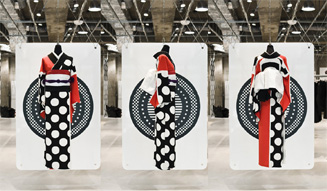
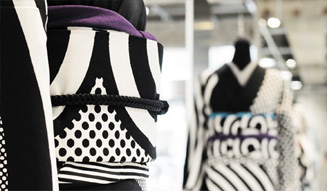
Kimonos as Equal to Western Clothing
Kimono is a shortened form of 'kimono,' meaning 'thing to wear.' 'Wafuku' (Japanese clothing) is said to have emerged as a distinction after Western clothing was introduced. In the Edo period, there were 'Hinagata-bon,' sample books of kosode patterns (similar to style books today), and even idol-like figures who disseminated trends in styling and coordination. Although the forms of clothing differ, the desire to present oneself beautifully remains unchanged, from ancient times to the present. It is the same as modern fashion.
So, what kind of kimono allows us to view Japanese clothing as equal to Western clothing? Being equal doesn't mean the same as T-shirts or jeans. My kimonos are created with the aim of being something special, like a Chanel suit, that one cherishes for a long time. A Chanel suit has history and tradition. And behind it lie various elements: the artisans and their techniques, the tools and materials that support them. Kimonos are similar. Japanese techniques, the spirit of cherishing and continuing to use things, unique designs, materials, structures, and functions—there are countless elements involved.
By flattening our perspective on all things, not just Japanese and Western clothing, we come to think and learn more than ever before. To convey such ideas, I believe it is crucial not only to create novel kimonos but also to express and present them through the kimono as a medium.
One of the exhibitions I held this summer was at ELTTOB TEP ISSEY MIYAKE in Osaka. Naturally, the shop only carries Western clothing. I wondered how my kimonos would look in that setting. It was an experimental endeavor.
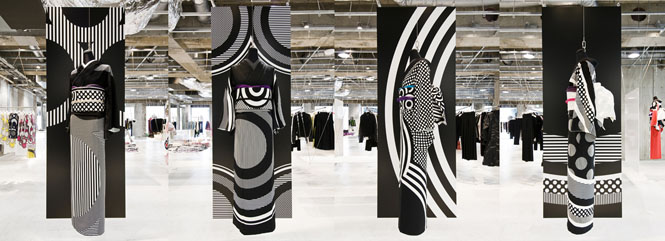
Black and white. Circles and straight lines. And the traditional kimono form. To what extent can originality be expressed with minimal elements? In an era of creative freedom, I am attempting to limit elements and pursue minimalist craftsmanship that is possible precisely because it is this era. I believe there is much that can be challenged precisely because clothing is large and flat.
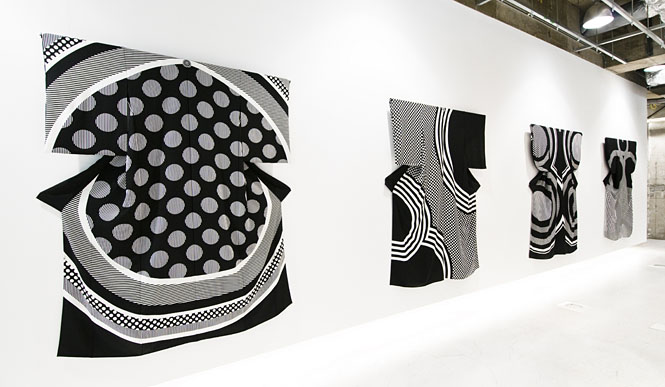
The kimonos, arranged painterly on the wall, are worn by identical torsos facing them.
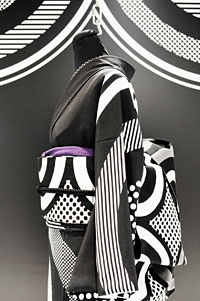
The kimonos, which also resemble tapestries, become functional garments the moment they are worn. And they reveal different faces depending on the space they inhabit.
They blend seamlessly into both historical wooden architecture and modern, inorganic structures, adapting to each space. Is it the power of the kimono's form? The strength of circular patterns, which have existed in every era? Or is it because they were made by Japanese people that they do not repel each other and can coexist across time? I intend to continue conducting various experiments and verifications.
Perhaps it is because they were born in the same era that, when I placed these kimonos in the ELTTOB TEP ISSEY MIYAKE space, I realized that this, too, was a form of completion.
My kimonos are not mere garments; they are interactive works that transcend the boundaries of Japanese and Western clothing, fashion, art, design, and crafts, influenced by the wearer and the space they inhabit. I aim to continue creating kimonos with rich backgrounds that serve as a medium to evoke the spirit and sensibility born in Japan's past.