
JOHN LAWRENCE SULLIVAN | What is "Japanese Craftsmanship" That Captivates the World
Designer Arashi Yanagawa, Who Captivates the World with His Meticulous Products, Appears
The "Japanese Craftsmanship" Behind His Creations (1)
JOHN LAWRENCE SULLIVAN depicts a modern, strong, and beautiful image of masculinity. Even after moving its show venue to Paris, the brand continues to receive high praise from global buyers and fashionistas. This time, we asked designer Arashi Yanagawa about the meticulous attention to his products, which cannot be conveyed on the runway alone, through his representative works from Spring/Summer 2014.
Photographs by JAMANDFIXText by KAWASE Takuro
A Collection That Reveals New Charms Through Light
The Paris runway shows, where renowned luxury brands unveil new collections with emerging designers on dazzling catwalks. On that stage, JOHN LAWRENCE SULLIVAN competes with creations from Tokyo, maintaining an independent stance. This season, we spoke with designer Arashi Yanagawa about the meticulous attention to his products, which cannot be conveyed on the runway alone, through his representative works from Spring/Summer 2014.
The brand develops a modern and clean aesthetic, centered on the tailoring that influences designer Yanagawa. Its signature is sharp, powerful silhouettes. This season's collection draws inspiration from modern art, such as James Turrell and Donald Judd, and the architecture of Tadao Ando.

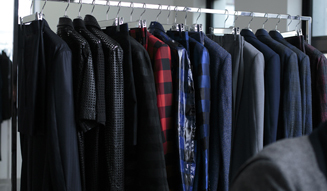
"Inspired by the play of light and shadow in modern art and stained glass, I particularly pursued material texture and cutting this season. Specifically, I used lightweight, ultra-thin paper nylon as a material that allows light to pass through, and bonded black organza over block-checked cotton fabric, devising ways to create variations in appearance depending on the light."
"For jackets and coats made from paper nylon, which is difficult to sew, I used the same fabric as the interlining to create a crisp collar line. Additionally, I commissioned a factory that usually produces silk for ties to create a block-checked fabric with a lustrous sheen and firmness, which I used for jackets and suits. The tweed I've been using for the past few seasons is also an original fabric woven with different fibers, linen and silk."
Today, even many famous international brands use readily available fabrics and rarely use different original fabrics for each item. This is because using original fabrics requires ordering a substantial quantity at once, leading to enormous costs. In Europe, in particular, there are fewer and fewer factories that can handle small lot orders.
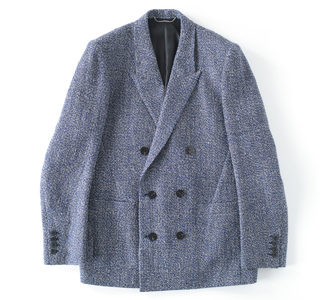
An original summer tweed woven with silk and linen threads of different colors. It features a unique textured surface and firmness. Through skillful patternmaking, dart positions are guided to create a cocoon silhouette, unusual for menswear. (Sample item)
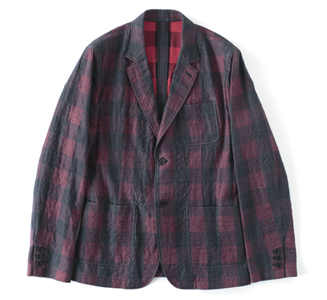
The block check, a distinctive feature of this season's collection, is used here in a jacket made from a fabric combining cotton with silk organza. Using a technique called 'setsu-ketsu' (bonding), two different fabrics are joined face-to-face and woven by artisans on a beam loom.
"While the impression of the runway and the reception there are important, I'm delighted when overseas buyers who see the samples at the exhibition praise the high quality. They often inquire about the fabrics. In overseas markets, the hurdle for ordering fabrics is high. However, Japan still has many factories that can handle small lots. For designers like me who create in Japan, this is a significant advantage."
"In my case, I first consider the silhouette based on the concept, and then I build the collection with a certain calculation in mind regarding how to achieve the fabric's firmness and drape. Therefore, having original fabrics is extremely important. I try to visit as many factories as possible and communicate with the artisans on-site. This sparks many ideas, like 'Could we do this or that?' I use different factories for different materials: Niigata and Yamagata for silk, and Aomori for wool and melton. Thanks to these artisans, we've gained recognition overseas. I always feel sorry for asking them to do difficult things (laughs)."
Designer Arashi Yanagawa, Who Captivates the World with His Meticulous Products, Appears
The "Japanese Craftsmanship" Behind His Creations (2)
Photographs by JAMANDFIXText by KAWASE Takuro
As Real Clothes and Aiming for the Next Tailoring
Jacket design is inherently traditional, and its construction methods have remained largely unchanged. While there has been an evolution, such as the Italian sartoria's approach to making British-born tailoring lighter and softer, it is still based on classic principles. For Yanagawa, for whom tailoring is the core of his brand, what is the future of tailoring?
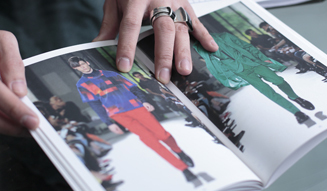
"It's not about making things lighter or softer. I love the feeling of my back straightening when I put on a jacket. That's why I use substantial interlining and don't mind if it's a bit heavy. However, I'm not solely focused on British tailoring. This season, I challenged myself by pursuing new forms. For example, the jacket that expresses a cocoon silhouette, which is often used in womenswear, for menswear."
"This jacket has a rather daring design, but I was pleased that it was well-received by our existing customers and praised by journalists. Of course, the collection itself is important, but I really want buyers and journalists to visit the exhibitions. Even if the reception there doesn't immediately translate into business, it leads to future sales. Perhaps it's unavoidable, but Japanese journalists tend to be swayed by the atmosphere. Paris journalists have a more direct reaction. Their words make me feel that our evaluation is steadily improving."
The word "sharp" is often used when discussing JOHN LAWRENCE SULLIVAN. Cutting is a crucial element in bringing out the appeal of its structured jackets.
"Domestically, our brand is often described as 'slim,' but overseas, it's frequently called 'sharp' or 'edgy.' It's not just about being slim; it's important that it fits the body's lines properly."
"In fact, you'll understand once you try it on, but even though it looks structured, it's comfortable to wear. I'd also be happy if people realized that it's easy to mix and match as a standalone piece."
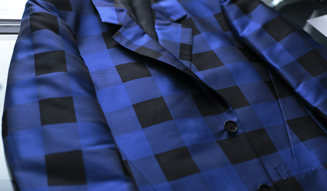
Many of our customers enjoy pairing JOHN LAWRENCE SULLIVAN's Chester coats or jackets with their own jeans or sweatshirts. I especially want men in their 30s and older, who have experienced various trends, to try them on first. Because we focus on materials and tailoring, they should last for a long time."
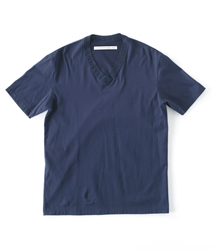
Yanagawa recommends a T-shirt with a knit neck binder from the brand's standard items. The body and neck are connected not by sewing knit fabric, but through a special weaving technique.
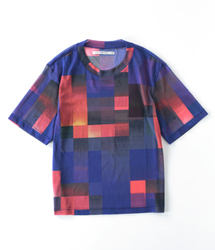
Artistic graphics inspired by architecture are printed on this item. It is one of the signature pieces of the season, showcased in various layered looks on the runway.
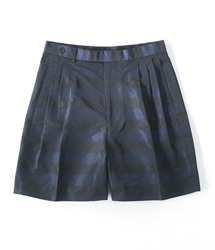
Shorts featuring stripes created with a fabric woven with silk for the warp and polyester for the weft. By varying the fiber structure of the two types of yarn during weaving, an original fabric is produced that exhibits a beautiful sheen depending on the light.
In addition to the tailoring items that are the main focus of this interview, the collection also includes cut-and-sew pieces and women's shorts. The brand's philosophy is consistently applied to all aspects: materials, silhouettes, and design.
JOHN LAWRENCE SULLIVAN receives fervent support from the fashion industry and creators alike. The reason why discerning connoisseurs favor wearing Yanagawa's creations is that they are not merely runway showpieces but true real clothes that bring out the wearer's personality.
JOHN LAWRENCE SULLIVAN
Tel. 03-5428-0068