AS by atsuko sano | Accessible Art in Popular Theater and Art Aquarium
AS by atsuko sano
Familiar Art Seen in Popular Theater and Art Aquarium
The designer of AS by atsuko sano, AS, was greatly influenced by Japanese "popular culture" in creating new works. She focused on "popular theater" by the Koryo Troupe and "Art Aquarium." Here, we present a dialogue between Shingo Araki, the troupe leader of Koryo Troupe, and Hidetomo Kimura, the representative of Office Aquarium Creators, who each represent these forms.
Photographs by MORI KouskeText by ITO Yuji (OPENERS)
The Essence of Popular Culture as Seen by Creators
Popular theater and Art Aquarium. At first glance, they seem like unrelated combinations, but AS found several common elements, leading to this discussion. Although meeting for the first time, both had already experienced each other's work. While their forms differ, we asked these two active creators to share the appeal of popular culture as they perceive it.
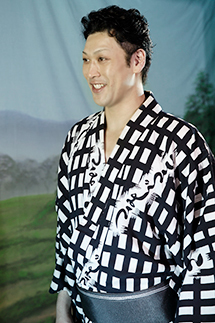
Mr. Araki (hereinafter, "Leader")Even before this discussion was proposed, I saw a poster at a convenience store and my family and I were talking about how beautiful it was. I felt an immediate connection to the focus on goldfish. Then, I actually visited the Art Aquarium in Nihonbashi. After enjoying it purely as a guest, I was able to appreciate it from two perspectives: one as an attendee, and the other considering what could be incorporated into popular theater. What struck me was that the art was alive. As I watched, the goldfish began to resemble a single woman. It felt like walking through a pleasure district, and I noticed the meticulous attention to detail that stimulated all five senses, from the scents to the music and the clarity of the water. And the fact that we could freely take photos gave me a sense similar to popular theater. We also allow photography other than video, and our performances, even of the same play, are never identical. Similarly, goldfish don't move the same way. I felt a resonance with that kind of expression, capturing a single moment.
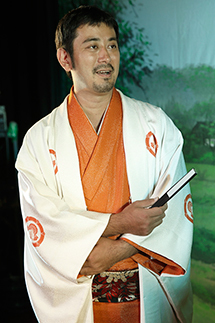
Mr. Kimura (hereinafter, "Kimura")I'm very happy that what I wanted to convey has been so well understood. The basic concept of Art Aquarium is the modern-day Edo pleasure district. And I'm grateful that you felt the essence of experiencing it with all five senses in just one visit. Your interpretation has taught me that what I'm doing is not wrong.
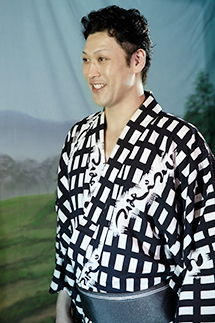
I also saw a performance by the Koryo Troupe, and I was amazed. After thinking it was wonderful, I realized it might be a uniquely Japanese culture. In other countries, it's not common for men to play female roles in a way that's accepted. That's what caught my attention the most. I often work in places like Nihonbashi and Kyoto these days, so I mostly meet people skilled in traditional crafts and arts. However, I don't have a deep background in such traditional culture or crafts myself. Rather, I'm only just beginning to explore them. But I believe what I feel now is very important. Without anyone teaching me, the only criteria for judging good or bad is my own feeling, so I can accept things neutrally and honestly.
LeaderPopular theater also has a world without a strong background, without constraints. It's not traditional culture or performing arts; it's for the masses to enjoy, so perhaps that allows for freer ideas.
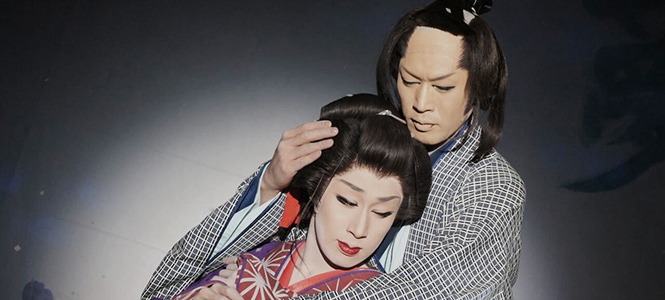
The stage of the Koryo Troupe captivates audiences with its energetic live performance <(Left photo) Young Leader Kantaro Araki, (Right photo) Leader Shingo Araki>
KimuraIn Kabuki, for example, you start by learning the established forms. Compared to that, I felt that popular theater requires very free thinking.
LeaderThat's right. We are conscious of being free and constantly evolving. Sometimes evolution can be devolution (laughs). If we think the way the previous generation did was good, we might return to that method. Everyone in the Koryo Troupe is both an actor and a backstage crew member. We learn a lot in that environment, but it's important for everyone to put in the effort. I believe each person's dance should be performed freely; there are no set boundaries. It would be easier to learn set forms, but we maintain a line so that the audience doesn't perceive it as disjointed.
KimuraSo, it's about being free yet maintaining coherence. Even with the same title, the performance isn't the same each time.
LeaderI believe we can do that because the Koryo Troupe has a core foundation. What we value is that there are things that must be broken and things that must not be broken. We maintain that line and emphasize teamwork to create the performance together. And above all, if we performers aren't enjoying ourselves, the audience won't either.
KimuraIn Art Aquarium, the most important thing is to keep the goldfish alive. There's no room for error. Of course, we evolve the presentation each time, but the core principle is to prioritize the well-being of the living creatures. In the exhibition, we use 5,000 goldfish, but fundamentally, none of them die because of that. Many people think goldfish live in the wild, but they were created to be admired and cannot survive in the wild; if they were to breed, they would revert to carp. Therefore, it's not cruel to keep them in tanks. We invest heavily in systems to keep them alive, and they eat high-quality food. As a result, they grow healthily and are in perfect condition by the end of the exhibition. I believe they are the happiest goldfish, healthy enough to be confidently sold.
LeaderA theater troupe is people interacting with people, so communication is easier than with goldfish. However, I am very strict about managing their physical condition. The troupe is like a family, and we see each other almost all day, every day, 24/7. So, I imagine there are times when it feels bothersome. In such situations, how we nurture them differs depending on individual personalities and learning styles, so it's hard to generalize. It often becomes a matter of spirit, like 'Imagine you are the waves.'
KimuraOurs is also much like a circus troupe. We travel to various locations for art exhibitions, but the staff must be devoted to the goldfish. Therefore, a condition for selecting a venue is being able to be near the goldfish 24 hours a day. So, you can't succeed in this job without blurring the lines between work and personal life. It suits people who can enjoy it as a life's work rather than just a job. The lack of fixed hours or days off is something we have in common.
LeaderMr. Kimura, are you considering expanding overseas?
KimuraWe receive many invitations from overseas. Unfortunately, our schedule is fully booked until fiscal year 2016. Therefore, all schedules after that are left blank, and we plan to embark on a world tour starting in fiscal year 2017.
When we first held Art Aquarium in Roppongi, goldfish were only a quarter of the exhibit, and we proposed various themes. Goldfish were just one part of that. But Art Aquarium uses all kinds of marine life: sea fish, coral, jellyfish, and tropical fish. However, the current focus on expressions like folding screens and lanterns with Japanese motifs is preparation for going overseas. By thoroughly experiencing and embodying Japan, we aim to present a completely authentic "Real Japan" worldview when we go global.
LeaderFortunately, the Koryo Troupe also receives inquiries from overseas, and if the timing of our schedules aligns, we would like to try it someday. However, if we present it as is, it will inevitably be called Kabuki. So, if we were to do it, to appeal overseas not as Kabuki but as popular theater, I'm considering that the costume of a traveling performer from the old days, wearing a straw hat and a raincoat, would be perfect. Then, perhaps walking the streets. From there, I hope people will ask, "What is that?" and learn, "This is popular theater." From there, if they visit us, I would be happy if they could appreciate the charm of popular theater, with its oiran performances and humorous stories.
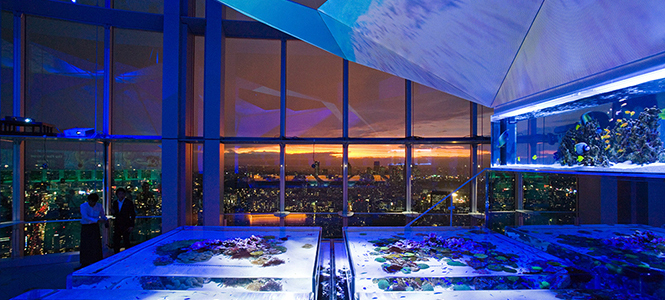
A scene from the Art Aquarium held at Roppongi Hills, created by Mr. Kimura
KimuraIt's very important for something to be "conveyed." Art Aquarium is art that uses aquatic ecosystems and living creatures. As art, it carries some kind of message. It's not necessarily about asking people to think about environmental issues, but rather to simply appreciate the beauty of the underwater world. Art can often become complicated, but if it's going to be difficult, I'd rather it be entertainment that makes people smile.
LeaderFor those who will see our performances from now on, I first want them to recognize that this world exists. From there, if they become repeat visitors, they can experience the live energy, the emotions that arise from it, and the sense of unity between the stage and the audience. That sense of immediacy and impact is something that only popular theater can provide.
Through the dialogue between these two, we sense that in a world where most things can be researched and understood, they are living lives that emphasize the live experience. This is art that cannot be replicated, and the same thing cannot be copied and pasted. For the Koryo Troupe, their very way of life, continuing to express themselves in a close proximity that cannot be experienced in large venues, is filled with live energy. And Art Aquarium, through the familiar goldfish, removes the seemingly difficult concept of art and elevates it into something approachable. In that sense, perhaps popular culture can be called the art that is closest to us.
Read Vol. 1 "Stimulation to Freely Traverse Past, Present, and Future"
Read Vol. 3 "Koryo Troupe's Tsutaro Araki: The Future Hope and Resolve of Performance"
AS by atsuko sano
Tel. 03-5466-0502
http://www.as-by-atsuko-sano.com
