Hidetoshi Nakata Connects Artisans from John Lobb and Gion Nai-tō (1) | JOHN LOBB
JOHN LOBB
Hidetoshi Nakata Connects John Lobb and a Japanese Traditional Craftsman
François Orders Zori at Gion Naitoh (1)
The meeting between French and Japanese artisans, facilitated by Hidetoshi Nakata, finally comes to fruition.──The day after his bespoke order event in Osaka, François Madelaine, John Lobb's Master Last Maker, visited Gion Naitoh, a long-established footwear artisan in Kyoto. It was François's first time in Kyoto, and Seiji Naito, the fifth-generation owner, welcomed him with a smile.
Hidetoshi Nakata Visits John Lobb's Bespoke Atelier in Paris (Tryon-2)
Photographs by HOZUMI HitomiText by KAJII Makoto (OPENERS)
Connecting Skilled Artisans
A five-minute walk from Gion-Shijo Station on the Keihan Line leads you to a building on the Yamatooji Street, distinguished by its cage-like windows and udatsu, designated as a "Historic Architectural Monument" by the City of Kyoto. This is Gion Naitoh, a place Hidetoshi Nakata wanted to bring the John Lobb craftsman to. Founded in 1875, it is currently headed by Seiji Naito, the fifth-generation owner.
Nakata explains, "When I commissioned a kimono from Fukumi Shimura, a Living National Treasure and a master of silk weaving and dyeing, she introduced me to Mr. Naito of Gion Naitoh, who makes zori and geta. Mr. Naito, in turn, introduced me to a craftsman who makes tabi socks.
Having experienced such connections myself, I thought it would be interesting for François, a footwear specialist, to meet and talk with a Japanese footwear expert, so I asked Mr. Naito. I believe seeing the creation of Japan's finest zori will be mutually stimulating. I want to act as an intermediary and connect various people."

François Learns About Zori
At Gion Naitoh, they customarily write geta as 'kiboku' (wooden footwear), zori as 'sōri' (attire footwear), and the straps as 'hanao' (flower straps). As stated on their website, "This is because we imbue our daily lives and the tools we use with profound sentiment through the power of words."
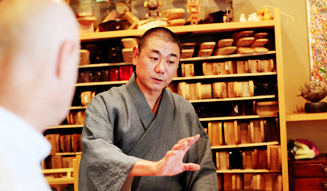
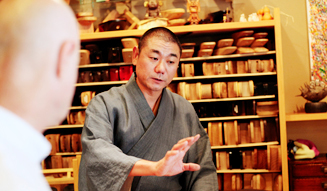
Mr. Naito began explaining to François, who had never worn geta or setta before and was visiting Kyoto for the first time.
"Currently, zori are more common, but in the samurai era, geta were the formal footwear," Naito said, presenting a pair of geta to François. Surprised by their lightness, François inquired about the material. "That's Paulownia," replied Naito.
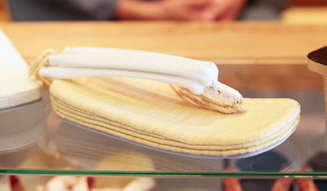
"After the Meiji era, as roads became more developed, zori became the standard footwear for men. The part you step on, which was once made of tough water buffalo leather, is now made of soft cowhide. The straps, or 'hanao,' come in a variety of colors and patterns, from white to black. White is the most formal, worn on special occasions, while black is for everyday use. Darker colored straps are not suitable for formal events. For example, at ceremonies, high-ranking Shinto priests wear white straps, while assistants do not. It's not about class, but the straps can indicate the wearer's role for the day," he explained.
Why Japanese Zori and Kimono Make People Look Elegant
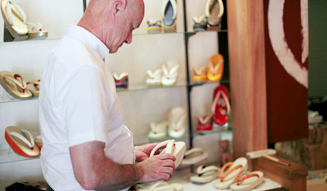
When François asked about the difference between the narrower and wider geta platforms, Naito chuckled, "The narrow ones are delicate, Kyoto-style; they make one's movements look graceful. The wider ones are more rustic, like those worn by Saigo Takamori, allowing for a more robust stride."
Hearing this, François laughed in turn, "At John Lobb in Paris, we prioritize comfort while paying meticulous attention to how elegant the shoes look. In London, however, John Lobb's bespoke shoes are made to fit the foot precisely, resulting in shoes that can look somewhat boxy."
Naito continued, holding a pair of zori, "With zori, a smaller stepping surface makes the wearer's movements appear more elegant, just as a wider kimono sleeve, the 'furisode,' looks more graceful. It's fascinating how Japanese people's movements are often constrained by the objects they use. Also, similar to the color of the straps, the choice of attire—what to wear for a particular occasion—acts as a switch, leading to appropriate movements for that setting. The material is crucial here. For instance, I feel the quality of movement changes subtly depending on whether a kimono is made of cotton or linen."
Hidetoshi Nakata Connects John Lobb and Gion Naitoh Artisans (2)To be continued
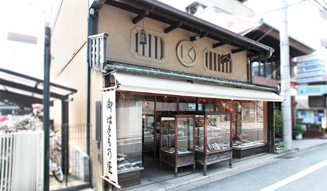
Gion Naitoh
Gion Nawate, Shijo Sagaru, Higashiyama-ku, Kyoto City
Tel. 075-541-7110
Business Hours | 10:30–18:00
Closed | Irregular holidays
http://gion-naitou.com/
John Lobb Japan
Tel. 03-6267-6010
http://www.johnlobb.com/jp