JOHN LOBB | The Making of a Perfect Pair of John Lobb Shoes (4)
JOHN LOBB | The Quintessence of John Lobb
Exclusive Factory Tour: From Lasting to Completion
The Making of a Masterpiece (4)
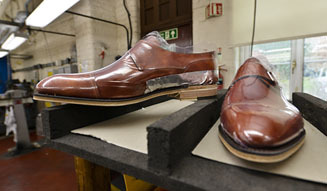
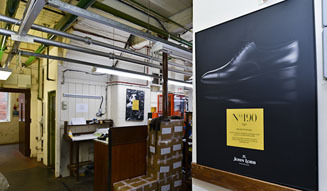
Often discussed, yet rarely understood, 'lasting'—the process of stretching the upper over the last—is perhaps the most enigmatic stage of shoemaking. While the details are elaborated upon in the main text below, the photographs captured here convey the essence of the Goodyear welt construction, the hallmark of John Lobb, highlighting the presence of cork—the 'stuffing'—as well as the sole attachment process and the meticulous finishing touches.John LobbWith 190 distinct steps in the creation of its ready-to-wear shoes, John Lobb's commitment to craftsmanship and heritage is palpable. This series offers a glimpse into that dedication, from the initial stages to the final polish.
John Lobb | The Making of a Masterpiece (3)
Text by KAJII Makoto (OPENERS)Photographs by ARAKI Ryuji
Drying Time is Key to Comfort
PreviousWhile the previous installment detailed a full day dedicated to drying the stiffener, this marks the second day within the manufacturing section.
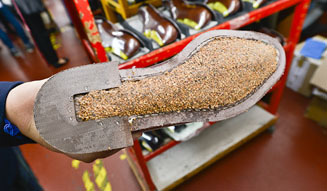
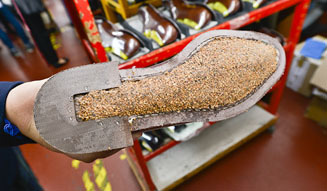
The welt, a crucial component of the Goodyear welt construction, is sewn to the insole using a 'Goodyear stitching' technique. Subsequently, cork, serving as the 'stuffing,' is meticulously packed into the space created by the ribbing on the underside of the insole. This cork is then left to dry and set overnight.
The cork, acting as a cushioning material between the insole and the outsole, directly influences the comfort of shoes made with the Goodyear welt method. As the shoes are worn, the cork gradually molds to the wearer's foot shape, enhancing the fit through a subtle 'settling' process.
Day Three: The Third Stage of Sole Attachment
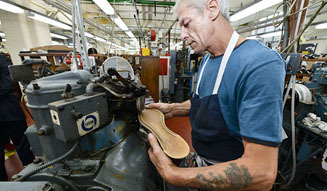
Once the cork stuffing has dried, the outsole is adhered. Following this, the excess material of the outsole, which extends beyond the shoe's edge, is trimmed. The outsole is then stitched to the welt in a process known as 'outsole stitching' or 'channel stitching.'
The sole leather is moistened before stitching, a technique identical to that used in the bespoke workshop in Paris. 'Although it's machine-stitched, it's a process we cannot compromise on,' explains the craftsman.
High-quality leather possesses excellent water resistance. When dried on the last, the full-grain leather sole retains its shape.
The Final Stages of Completion
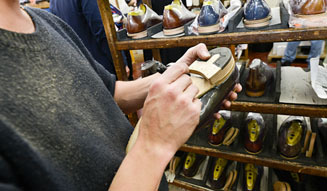
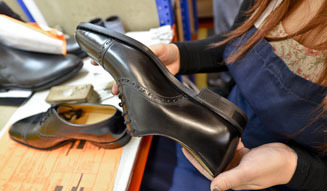
After the sole has dried and is finished, the heel is attached. The craftsman meticulously adjusts each heel, shaping it as it's affixed. Once the last is removed, the edges of the sole are refined, completing the shoe's aesthetic.
In the final finishing section, further fine-tuning occurs, followed by hand-polishing, application of cream, and a thorough inspection. The shoes are then packed into the signature yellow box, ready to be dispatched worldwide.
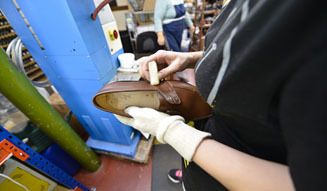
'While the upper will naturally conform to the wearer's foot over time, the shape of the toe must remain unchanged from its original form,' explains a craftsman, polishing the iconic, mirror-like toe of a John Lobb shoe with evident affection. 'That's why the toe is made exceptionally firm.'
John Lobb Japan
Tel. 03-6267-6010
http://www.johnlobb.com/jp