JOHN LOBB | The Making of a Perfect Pair of John Lobb Shoes (3)
JOHN LOBB | The John Lobb Way
Exclusive Factory Tour: From Sewing to Lasting
The Making of a Masterpiece (3)
In this factory tour,John Lobbwe showcase the entire process of shoemaking. After learning about the leather parts and work steps that are usually hidden from view, you'll surely find your own John Lobb shoes even more endearing. In this third installment, we move from the sewing section to the crucial stage of 'lasting'.
John Lobb | The Making of a Masterpiece (2)
Text by KAJII Makoto (OPENERS)Photographs by ARAKI Ryuji
The Last Two Digits Indicate the Year the Last Was Created
One of the most critical elements in shoemaking is the last (the wooden mold). The John Lobb articles published on OPENERS always include the last number, which we encourage you to refer to.
John Lobb's ready-to-wear lasts are made of plastic. When asked why, the answer was, "Plastic is the most durable and unaffected by environmental factors like humidity, especially since it goes through machinery." Ready-to-wear sizes range from 5 to 12, and among the existing lasts, the 7000 series is the most frequently used.
Last number '8896' was created in 1996, '7000' in 2000, and '2511', used for the year model 'JOHN LOBB 2013', was made in 2011, making it the newest last for ready-to-wear shoes.
In other words, the last two digits of the four-digit number indicate the year the last was made. Knowing these little details makes choosing your shoes even more enjoyable.
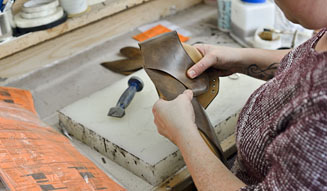
Lasting with the Latest Machines
A stark contrast to the quiet atmosphere of the leather cutting and sewing sections, the manufacturing area buzzes with the sounds typical of a shoe factory. Though the noises are intermittent, the smell of adhesive is barely perceptible.
In shoemaking, 'lasting' is the most crucial process. It's the first stage of sole attachment, where the upper, fitted with a stiffener (heel counter), is placed over the temporarily secured insole. The edges of the upper are then pulled around the last and secured to the rib of the insole.
Similar to bespoke shoemaking, they employ a technique of moistening the stiffener to achieve the optimal level of dryness.
The latest machines, introduced with the factory expansion, are currently used for lasting the toe of the 'JOHN LOBB 2013' year model. The moistened stiffener is pliable, allowing it to be shaped into any form.
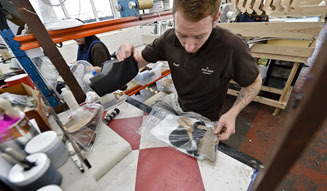
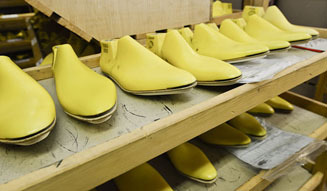
Leather Remembers its Shape
Furthermore, at John Lobb, the upper leather and the lining are attached separately. This is because "the independent movement of the upper leather and lining directly impacts comfort," a theory akin to how "the separation of the outer fabric and lining in a suit affects its wearability." This is another detail inherited from bespoke shoemaking.
There is no end to the reasons why John Lobb shoes are considered expensive, but they include incorporating bespoke techniques into ready-to-wear production and using full-grain leather even in unseen parts like the insole and stiffener.
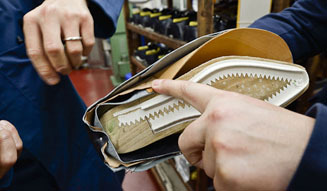
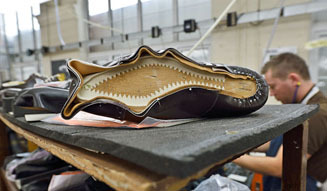
In the manufacturing section, using well-worn machinery, the process of pulling and securing the separately prepared upper and lining parts was underway. Observing the sequence of pulling the lining, then the upper, and lasting the heel, we were told, "Do you know about the top line? When you look at John Lobb shoes from behind, the heel is enveloped; this form is created by the full-grain leather stiffener retaining its shape."
The reasons for using generous amounts of full-grain leather throughout the shoe are detailed in the first part of this feature.Part 1Please refer to it.
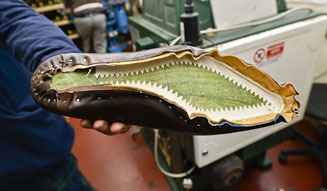
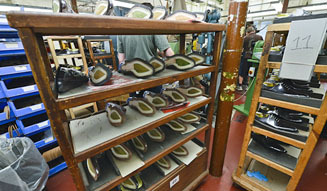
We also received an explanation of processes that are considered difficult in ready-to-wear factories, such as securing the upper with wire to prevent loosening. When asked why the shoes are wrapped during manufacturing, the response was, "John Lobb leather is akin to bare skin for humans, easily absorbing dust and oils, so it's thoroughly protected during production."
In the manufacturing section, the stiffeners are left to dry for a full day.
The Making of a Masterpiece John Lobb Shoe (4 - Final)to be continued
John Lobb Japan
Tel. 03-6267-6010
http://www.johnlobb.com/jp