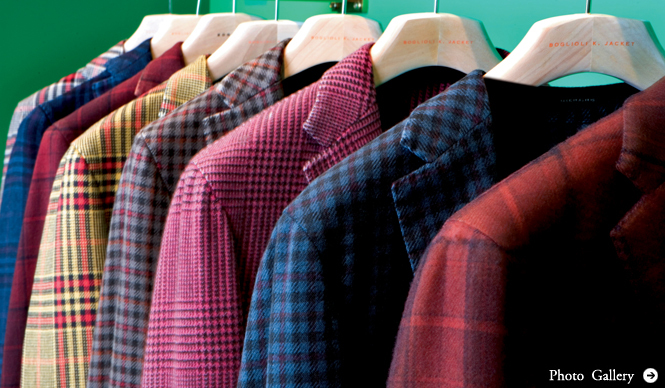
BOGLIOLI—Past, Present, and Future
BOGLIOLI
Free and flexible ideas create the platform of the times!
BOGLIOLI—Past, Present, and Future
The work of a tailor who made a name for himself in Northern Italy expanded through generations of sons and grandsons. Before long, it grew into a great maison, surpassing 100 years. Touching upon its history, we look back at Boglioli's journey from the past to the present, and explore its future vision.
Text by IKEDA YasuyukiPhoto by YOSHIZAWA KentaPhoto cooperation by BOGLIOLI

Boglioli's innovation that transformed its classical origins
Boglioli's legacy has been passed down through three generations over 100 years. Mario Boglioli established himself as a tailor in the early 20th century. By the war years, he was already widely known as a skilled tailor. His method of visiting clients to take measurements was the mainstream business practice at the time, as there were no physical stores.
His son, Giuseppe, followed in his father's footsteps, but inherited the business not as a tailor, but by transforming the atelier into a factory. By welcoming many artisans and providing a workspace, he aimed to create a next-generation tailor that combined manufacturing with sartorial craftsmanship.
Eventually, when Giuseppe's three sons took over the management of the factory, the business expanded further. The tailoring factory matured into a company. Lucas Moda, which handled its own planning and manufacturing (now Boglioli), developed into a high-quality maison that crafted superior jackets.
The model that achieved explosive popularity was the "K-Jacket," introduced in the 1990s. This lightweight cotton jacket was finished with a then-uncommon "tinto in capo" garment dyeing process, giving it a texture that resembled that of a well-worn item. Later, Pierluigi, the youngest brother and current designer for Boglioli, affectionately known as Gigi, reflected on the birth of this K-Jacket:
"Seeing the washed shirts, denim, and pants that were popular at the time, I wondered why there weren't any jackets like that. Structured shoulder jackets couldn't achieve that soft, unique texture. That's why I opted for 'senza spallina' (unstructured shoulders)."
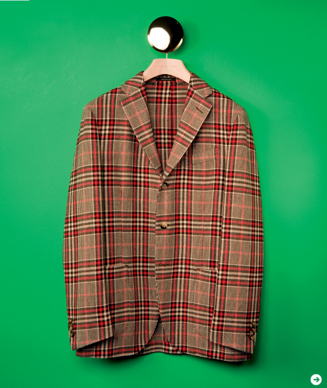
The era caught up with Boglioli, making it the eye of the storm in men's fashion
With the advent of the "K-Jacket," Boglioli solidified its position in Italy, and the next tailwind began to blow. The maison boldly applied the same washing process used for the "K-Jacket" to high-quality cashmere jackets, creating the now-iconic "K-Jacket." In 2003, this "K-Jacket" brought Boglioli's name to the world.
Around this time, its reputation reached Japan. However, perhaps the essence of its fame didn't quite travel to the Far East, so far from its home country; Boglioli was perceived as merely a "recently popular classic brand." A buyer confided that most shops stocked the "Hampton" model, which had a more structured construction, over the "K-Jacket."
But once the genuine popularity of the "K-Jacket" became apparent, the tide turned dramatically. As Boglioli's name began to be featured in the media, the fever intensified with the launch of the "Dover" in 2008, followed by the frenzy surrounding the "Wight" in 2010. The subsequent enthusiastic movement makes Boglioli a standout presence in the men's fashion world, which has been said to be stagnant for the past few years.
Today, Boglioli offers not only popular models like the "K-Jacket," "Dover," and "Wight," but has also expanded its lineup. This is more than just a trend; it's a revolution. Brands are following suit, as if to say that jackets are best when they lack interlining and padding.
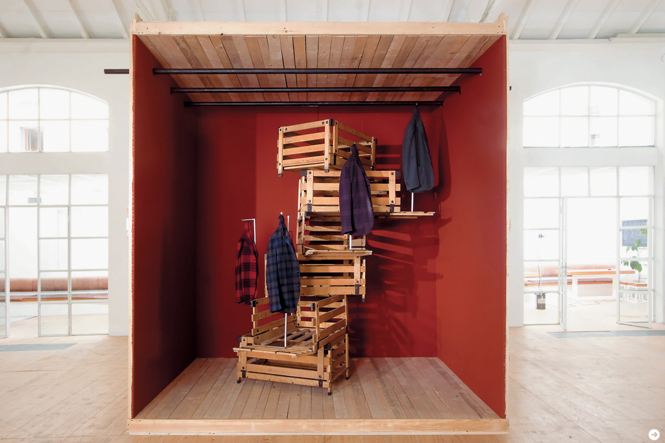
However, Boglioli is not resting on its laurels by mass-producing popular jackets. Two years ago, they launched a full collection including shirts, knits, and pants, evolving into a maison that can propose total looks. For the next season, they have even decided to completely redesign the "Wight," their current top-selling model. Roberto Farchi, who previously held positions at Dior and Prada, has been brought in as management, already looking towards the next era. From a tailor's work expanded into a factory, it has grown into a maison that now leads trends, and it is seeking further change. Its journey has not stopped. Specific details will be shared by Pierluigi himself in the fourth installment of his interview.
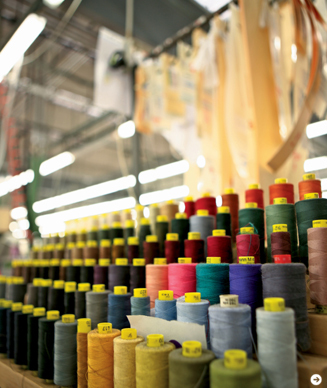
The visuals introduced here are from a Boglioli company booklet, iconically expressing that Boglioli is not merely a classical sartorial house. The beautiful green is Boglioli's corporate color. It possesses a state-of-the-art factory and is filled with an artistic sensibility in its displays. Indeed, what Boglioli creates is not just clothing. It is the very platform of men's fashion for the times. We invite you to fully experience the world of Boglioli.

Chairman of Boglioli
Mario Boglioli
Mario Boglioli

Designer, Boglioli
Pierluigi Boglioli
Pierluigi Boglioli
BUYER'S RECOMMENDATION OF BOGLIOLI!
Classic maisons are often out of touch with the times. In that sense, Boglioli is a very rare existence. It evolves, sustains, and still hasn't reached its ceiling. It lacks that Italian characteristic of "this is good enough" (laughs). For the K-Jacket's tinto in capo, they don't wash the finished product completely; instead, they wash it midway through the process and then attach the sleeve lining, a very troublesome procedure. This is done to achieve comfort, but they choose to do it. They can even casually decide to remove their most popular model, the Wight, from the catalog next season. When Ise Isetan requested a special order, they accepted it with interest, and it seems to be their first special order worldwide. It's strange it hasn't happened before, but it's also a reflection of how attractive their products are, making special orders unnecessary. Unlike stubborn, rigid craftsmen or merely skilled factories, this free spirit is one of Boglioli's charms.
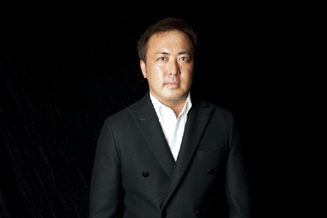
Ei KANEFUJI
Isetan Shinjuku Store Buyer
Since 2002 in his current role. Well-versed in the distinguished classic maisons that dominate the 5th floor of Isetan Men's. He is one of Japan's leading buyers, capable of deeply analyzing contemporary men's fashion from both a department store's flat perspective and a trend-setting viewpoint.
