M・A・R・S: Yoji Yoneyama x Takayuki Kijima - A Special Conversation on the Path of Fashion Accessories
M·A·R·S
Yoji Yoneyama x Takayuki Kijima: A Special Conversation
The Path of Fashion Accessories
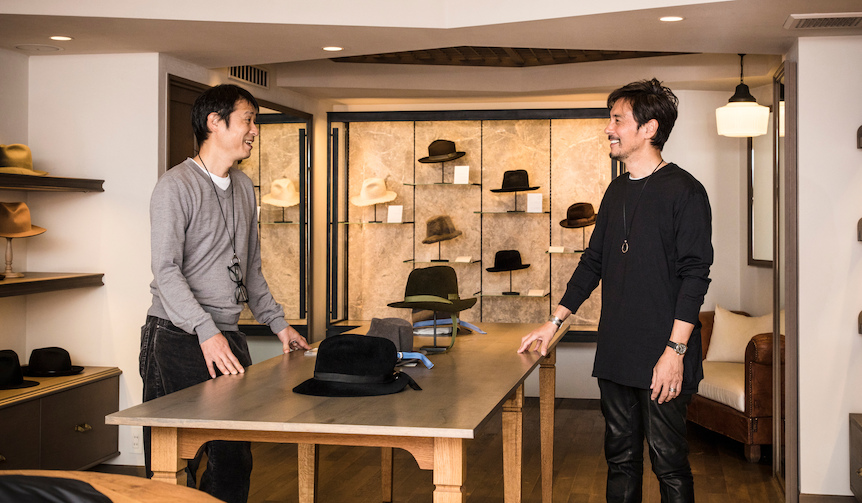
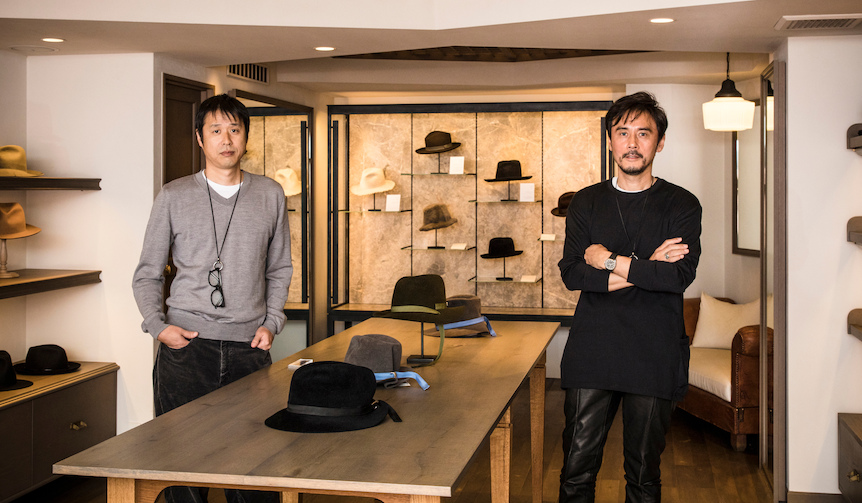
To commemorate its 25th anniversary, we launch a special interview series with Yoji Yoneyama, the designer of "M·A·R·S." Our guest this time is Takayuki Kijima, the designer of the hat brand "KIJIMA TAKAYUKI." As both designers specialize in fashion accessories, the conversation was lively and engaging.
Photographs by NAGAO MasashiText by TOMIYAMA Eizaburo
Hats Born from a Sense of Touch
YoneyamaMr. Kijima's shop (KIJIMA TAKAYUKI) is just about a minute's walk from M·A·R·S, so we used to see each other on the street often. But it was just a casual greeting. Then, at an event for Mr. Takeo Kikuchi's shop, we were given the opportunity to collaborate on an item with three invited designers. Both of us being chosen was the catalyst for our friendship.
KijimaThat's right. For a while, we even lived in the same apartment building and went to the gym together.
YoneyamaMr. Kijima's hats have a softness and a relaxed feel, both in appearance and when worn. I own several myself. When I was younger, I mostly wore flat caps and pork pie hats, but after meeting Mr. Kijima, I started wearing fedoras too. How do you come up with those captivating designs?
KijimaThere are two approaches. One is to start with the silhouette and then decide on the fabric. The other is to begin with the material.
We start by considering clothing trends, so we gather information about what materials will be emerging in the next collection. Lately, more and more is born from street style than from high fashion, so we increasingly think about what materials we want to use next, keeping that atmosphere in mind.
YoneyamaI see.
KijimaIf oversized silhouettes are trending, we create items that match them. We consider what balance and volume would fit. That's how we design.
YoneyamaWith jewelry, the material is hard, so the design is almost complete at the drawing stage. It's like creating a blueprint. But with your soft hats, Mr. Kijima, I feel like you can't express them with just lines unless you have a clear image in your mind. I imagine they are made with a great deal of attention to the feel of your hands.
KijimaThat's certainly true. We have our own atelier, so we don't draw many design sketches; we can start making samples right away. I can create the patterns myself, work on the sewing machine, and consider the sewing methods and the use of interlinings.
Entering a World of Imagination for the Final Check
YoneyamaI once heard you say that "the impression of a hat changes with just a 5mm difference in brim length."
I'm so indecisive, I don't think I could ever make that kind of decision.
Do you do the final check yourself? Or do you have your staff try them on?
KijimaI basically try them on myself for both men's and women's hats to decide. At that point, whether they suit me or not has already disappeared, and I've entered a world of imagination. This is because each item has a story from the beginning. I have an image of a woman wearing certain clothes. I do the final check while visualizing that image.
YoneyamaThat's the same for us. Since we deal with accessories, we have an image of the kind of person we want to wear it from the initial stage. In my case, the shape is decided before the sample is completed. However, if I want to change the size, I have to remake the mold.
KijimaThat must be difficult. In my case, I can make corrections immediately after seeing the sample. I can just try making it.
YoneyamaEven though we have similar challenges, I feel like we both admire something about the other. I might think, "Hats have so many options for materials and shapes, that's great."
KijimaFrom my perspective, I think, "Jewelry has a high unit price, which is great," or "It's enviable that they are compact and easy to carry, and can be displayed in a small space" (laughs).
YoneyamaHahaha. But in fashion, clothing is the main focus, and accessories like jewelry and hats are added to that.
Within that context, how can we make customers think it's cool? How can we catch their eye? Is being outlandish good? Is matching well enough? The balance of these questions is an eternal dilemma for accessory designers.
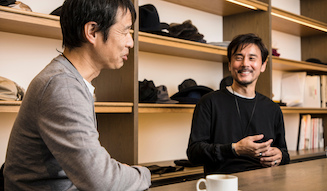
KijimaThey are items that fashion can exist without. If being outlandish is the goal, they become unnecessary if they don't fit the times. We have to propose something that completes the overall look, rather than being absent. Shoes are essential, but hats are not, and that fear is always present.
YoneyamaDo you decide each season, "I'm going to sell this item" or "I'm going to play around with this one"? I tend to miss the mark, so I don't do that much anymore.
KijimaI do enjoy myself in my own way. I'm prepared for the playful items not to sell, but if they end up being popular, I start to wonder if I made the wrong choice. If something I created for my own satisfaction is widely understood, I reflect that maybe my own sensibilities are leaning too much towards the mainstream. I prefer to be met with a cold reception, like "What is this?" (laughs).
YoneyamaI completely understand that contrarian feeling. Like, "It didn't sell, but I love it anyway."
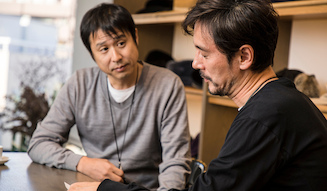
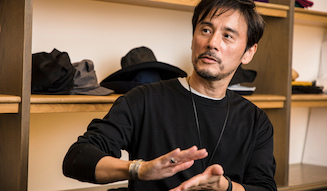
KijimaIt's precisely because we are professionals that we can play around like that. It's because we are one or two steps ahead in our field that we can be satisfied with "I like it, even if you don't understand." Normally, if something doesn't sell, you'd wonder why. But to be able to accept it with "I like it anyway" is a sign of professionalism.
YoneyamaIf you don't release it at that moment, the feeling of unease lingers. Then, after a while, you want to release it again. That's why I want to give form to my ideas when I have them. Don't you feel that way?
KijimaYes, I do. Especially with hats, there was a boom about two years ago, and the trend cycle has accelerated since then. If you're six months late, people think, "Isn't that old news?" So, I try to act on my ideas as soon as they come to me.
Page02.The most important thing is that it suits the person.
M·A·R·S
Yoji Yoneyama x Takayuki Kijima: A Special Conversation
The Path of Fashion Accessories (Part 2)
The most important thing is that it suits the person.
YoneyamaThe popularity of hats has been enduring, hasn't it?
KijimaPreviously, hats were worn by those who liked them, but not by those who weren't interested. Now, it's become one of the trends.
YoneyamaWhen we watch movies, we tend to focus on the accessories, don't we? Do you have any movie recommendations or record jackets that you like, Mr. Kijima?
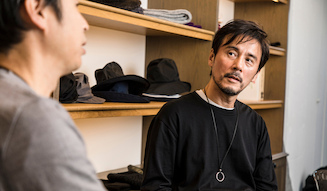
KijimaHmm, I can't think of anything off the top of my head... However, rather than perfectly crafted worlds like in movies, I'm more inspired by people casually wearing hats on the street. Stylish people are predictable, so I'm more drawn to those who wear the same hat every day.
YoneyamaSometimes, a farmer's hat looks incredibly cool, doesn't it?
KijimaExactly. That means it suits the person. Our brand's lookbook aims for precisely that. We hunt for ordinary people on the street and photograph them wearing our hats with their existing outfits, without any styling. That was the suggestion of stylist Tetsuro Nagase. He said, "The fact that it's easy for anyone to wear is what makes it KIJIMA TAKAYUKI."
YoneyamaWhat becomes part of a person's 'persona' is captivating, isn't it?
KijimaThe softness of our hats, which you mentioned at the beginning, Mr. Yoneyama, is intentional to make them blend in. When people try on hats in stores, they make a decision in less than a second. I was the same before becoming a hat maker, but stiff hats, like fedoras, are difficult to break in when they're new. So, even though they should look cool, people see themselves in the mirror and think, "Huh, that's not right." To solve this, I started removing interlinings and experimenting with sewing techniques.
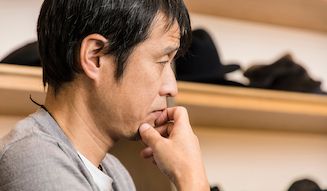
YoneyamaIndeed, when I try on a fine hat from a long-established brand, I'm confronted with a version of myself that looks terribly ill-suited. But to achieve that softness, you must also have devised ways to adjust the silhouette, right?
KijimaNo, the silhouettes are made conventionally. Also, we avoid using hat factories. When hats are sewn in a hat factory, they turn out like hats. But when sewn in an apparel factory, they have a more clothing-like finish.
Perhaps I Continue Because Hats Don't Suit Me
YoneyamaI see. So, why did you decide to become a hat maker in the first place, Mr. Kijima?
KijimaLately, I've been answering honestly... I originally liked shoes and didn't particularly like hats. After graduating high school, I worked various part-time jobs and thought about attending a shoe design school, but I found out it cost about 1.2 million yen per year. I couldn't ask my parents to pay for school at my age, so I was wondering what to do. Then, my then-girlfriend saw an ad for a hat-making class in a magazine and told me about it. It cost 250,000 yen per year, so I signed up immediately.
YoneyamaBut ultimately, you became deeply involved in the world of hats.
KijimaI enjoyed making things, and I was interested in all kinds of clothing. I felt that with fashion accessories, I could engage with any style. That's why I still don't wear hats much myself; they don't really suit me.
YoneyamaI don't believe that. Besides, many people in the world give up, thinking, "Hats don't suit me." You should challenge that notion (laughs).
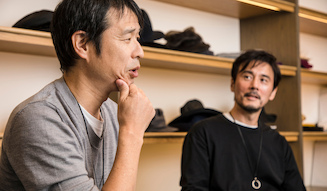
KijimaI don't want to be misunderstood, but I do challenge that. On the contrary, I consider my brand to be for people who think hats don't suit them or find them difficult. I've come to think that I am the prime example of that. That's probably why I'm constantly thinking about how to make them suit people and how to create something cool. Tomoki Yuzawa, also known as the "Editing Demon King," also told me about 20 years ago when he first visited, "Hats don't suit me." Since then, he's ordered many, and thanks to that, the brand has spread.
YoneyamaIt's interesting that "hats not suiting me" is your motivation. We've both been in this business for a long time, haven't we? That's why I was curious about how you maintain your motivation. Perhaps if I create the perfect hat that suits me, I might quit this job.
KijimaThat might be true.
—Finally, could you tell us about the appeal of M·A·R·S products from your perspective, Mr. Kijima?
KijimaThe products are meticulously crafted. Even when using subjects like insects and animals, they focus on the details! It's meticulous, almost obsessive. Theこだわり (kodawari - commitment/passion) of a designer who is also a craftsman shines through, even in parts like the clasps. I believe they are first-class jewelry.