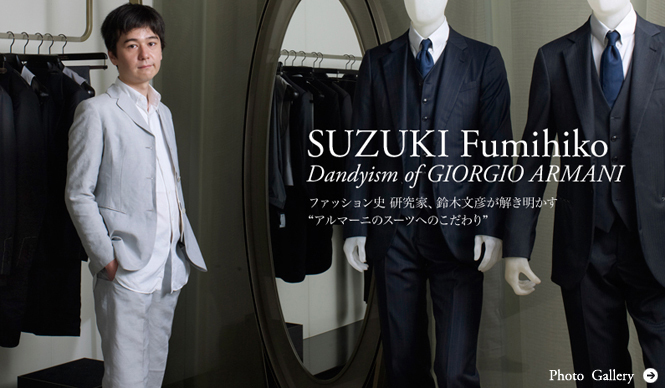
GIORGIO ARMANI | Fumihiko Suzuki, Fashion Historian, Discusses Giorgio Armani's Dandyism
GIORGIO ARMANI | Giorgio Armani
A Revolution in Suit Style: A Commitment to Individuality and Comfort
Dandyism According to Giorgio Armani: A Conversation with Fashion Historian Fumihiko Suzuki (Part 1)
What do modern dandies choose to wear?—It requires a distinct style, born from the fusion of design, material, and cut. Reconstructing the tradition and history of the suit, bringing forth innovation,Giorgio ArmaniThis is the dandyism of Armani, as told by fashion historian Fumihiko Suzuki.
Photographs by Kenta Yoshizawa (photos 1-8), JAMANDFIX (photos 9-15)Text by Fumihiko Suzuki (OPENERS)
The Essentials for a Unique and Personal Style
"Armani gradually began to choose softer fabrics and cooler colors, and removed the rigid internal structure of the suit. The buttons were intentionally misplaced, the shoulder pads were thin. He succeeded in giving men's jackets, which had previously been formal and stiff, a soft, comfortable, and youthful image, regardless of age."
This is a quote from Lucia Mariani, a fashion journalist, featured in Renata M. Morho's biography of Giorgio Armani, "Giorgio Armani: The Aesthetics of an Emperor" (Nikkei Publishing). It is noteworthy that this assessment was made of a young Giorgio Armani, who worked in menswear for eight years as a stylist and designer for "Hitman," a brand founded in 1970 with the concept of ready-to-wear tailored menswear.
Armani, born in 1934, began his career working at La Rinascente, a major department store in Milan, from 1954 to 1963. Initially, Armani was part of the department responsible for show window decorations and image creation. His professional experience in fashion design began when he eventually became a buyer for La Rinascente.
"When I was a buyer, I struggled to satisfy wealthy customers who spared no expense on clothes."
Armani analyzes that period as follows:
"All the clothes were too stiff, and everyone looked the same no matter who wore them. I wondered if there wasn't a garment that would highlight the wearer's individuality and fit each person's body. So, when I became independent and started making clothes I liked, I decided to dismantle the entire structure of the traditional menswear jacket. This was because the rigid structure made everyone look the same. I tried draping a single piece of fabric very naturally over the male body and experimented. I paid attention to the parts that were previously considered flaws. The idea was to dismantle the existing structure and allow for greater freedom of movement. I believe this is essential for men to dress individually and express their own style."
The Unconstructed Jacket—A Revolution in Suits
While it may be stating the obvious, Armani's jackets, often called unconstructed jackets, are characterized by their use of soft materials and freedom from rigid construction. This also often characterizes Italian jackets that gained global attention in the 1980s, and Armani had a penchant for the unconstructed jacket from the very beginning of his career. If the aesthetic of British menswear, born from a unique male society, is characterized by functionality and stoicism—in other words, fidelity to tradition—then Armani's revolution in menswear lies first in his complete disregard for these, and second, in his pioneering establishment of the materials and techniques necessary to deconstruct menswear and handle it as a product.
Furthermore, among the modes created by designers who can be called masters still present in fashion brands since the 1980s, Armani's brand has maintained its backbone to this day by remaining true to his origins as a designer of clothes that are not overly colorful or ornate, but that gently follow the shape and movement of the body for working people. His understated colors create a gradation that follows the body's movements, the construction with stitches hidden on the inside, or even buttons sometimes concealed, are all part of Armani's style, which is still passed down in collections today, making the shape of each individual's bare body look beautiful and proud.


GIORGIO ARMANI | Giorgio Armani
A Revolution in Suit Style: A Commitment to Individuality and Comfort
Dandyism According to Giorgio Armani: A Conversation with Fashion Historian Fumihiko Suzuki (Part 2)
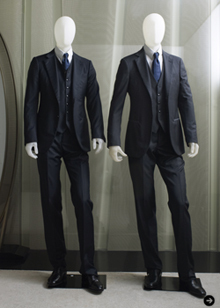
Specifically, when looking at Armani's jackets, the waistline is a prime example of his philosophy. When viewed from the back, the line forming the waist is cinched from the same position as the waistline begins to form in womenswear, starting from the area under the armpits. Of course, men have a wider back than women. Therefore, the back width is made larger, making the back appear broad. On the other hand, when viewed from the front, the waistline is slightly lower than when viewed from the back. In current Armani jackets, although the button placement is relatively high, the waist is positioned higher at the back and slightly lower at the front, giving the overall garment a slightly forward-sloping silhouette. This stems from the recognition that the human body is shaped this way. It is a three-dimensional cut, not a straight line. Consequently, the shoulders are also slightly forward.


This might lead to the question of whether the armhole circumference is reduced, restricting arm movement. The answer is "quite the opposite." Because the garment fits the body perfectly, it moves as if it were the wearer's own skin. "Even if it's a suit jacket, it must feel as comfortable as relaxing at home for the wearer" is Armani's conviction, and those who wear Armani suits can relax as if they were wearing a cardigan. And perhaps, precisely because they are relaxed and don't have to worry about how they look, the men who wear them gain confidence and dignity.
What is interesting is that even if such a conviction comes from experience for Armani, it ultimately remains extremely faithful to the tradition of tailoring. While a detailed explanation would deviate too far from the main topic here, it is worth noting that in Britain, from the late 18th to the 19th century, men's fashion shifted from favoring the flamboyant aristocratic taste that competed in complexity of color and decoration, to idealizing the practical attire of working men, the dress of dandies who refined it to an extreme. While the influence of this British style on menswear worldwide was due to political and economic reasons such as democratization and imperial expansion, it cannot be ignored that the attire of dandies, which abandoned color and decoration in favor of pursuing fit and cut to follow the body's lines and movements, was considered more beautiful in its taste and elegance than aristocratic attire. In the pursuit of fit and cut, the sleeve attachment, which prevents restriction of arm movement, was the specialty and mastery of a limited number of craftsmen, the ancestors of today's Savile Row tailors.
Looking at the sleeves of Armani's jackets, which are slim yet allow for freedom of movement, it is likely that techniques very similar to those of Savile Row are considered essential in the sleeve attachment of Armani's jackets. Although a century apart, Armani likely found himself in an environment and made choices similar to those of the men who revolutionized menswear in the past. Therefore, Armani's jackets give an impression of being both innovative and traditional. While the rules of British style seem to be completely ignored, the dignity of the jacket is not lost, likely because, at their core, the perceptions of both are not significantly different.
A Special Garment Made for You: "Made to Measure"
If Armani had access to the environment with many high-tech materials available today, his concept might not have materialized into the Armani jackets we see now. Today, the Armani brand possesses a tradition that has been consistently upheld through the turbulent eras of fashion since its inception, and it has its own history. The "Made to Measure" service, which has been in concept since around 2000, is a service that can only exist upon the established worldview of Armani.
Armani's unique materials, represented by a wide variety of jersey fabrics, are not suited for millimeter-precise measurements. Therefore, the concept of "Made to Measure," which involves fitting each individual perfectly, cannot be realized in the same way as Armani's ready-to-wear clothing up to that point. The techniques of Armani's menswear, where artisans assemble garments by hand, even changing the material of the threads according to the fabric used, do not perfectly align with the techniques of the British bespoke tradition, even if they are equally advanced. Armani's "Made to Measure" is not exactly the same as Armani's ready-to-wear. However, the reason why the garments produced through "Made to Measure" are still unmistakably Armani suits is that they do not betray Armani's established worldview.
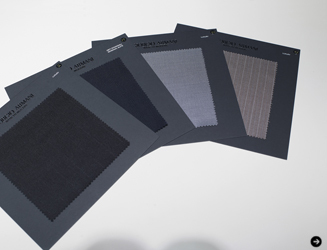
The suits created through "Made to Measure" are based on two types of models: Armani's signature soft model and a more structured model. However, both are lightweight suits that use only a canvas made from a complex combination of horsehair and goat hair for their internal structure. With this as a base, we can create our own unique Armani suit by combining lapels, buttons, and pockets.
To conclude the explanation of "Made to Measure," it is best to use Armani's own words.
"I realized that there were customers who genuinely desired unique products, made especially for them. So, I decided to launch the Made to Measure service. Through this service, customers can enjoy all the benefits of tailored garments—— a unique fit, fabric, lining, buttons, and details—— and at the same time,Giorgio Armanican also achieve the look guaranteed by the Armani signature. This collection truly combines tradition and modernity, integrating the origins of artisanal tailoring with the innovation of a contemporary design studio."
—Fumihiko Suzuki—
Fumihiko Suzuki | SUZUKI Fumihiko
Editor at OPENERS, responsible for the CAR/FASHION category. Holds a Master's degree from Hitotsubashi University and a Master's degree in French Literature from Paris-Sorbonne University. Translator. Currently researching dandyism from multiple perspectives, drawing from European literature, painting, and intellectual history. Also contributes fashion columns to "GQ JAPAN" and "MEN'S Precious."