February 5, 2015
ato | An Interview with Designer Yo Matsumoto
ato
Appealing to those who buy clothes, clothes that resonate with consumer reality
ato: Designer Yo Matsumoto Interview
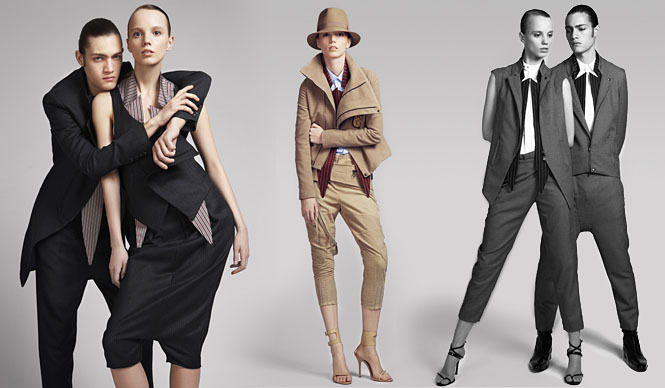
ato, which held shows in a large venue in Ebisu until the Spring/Summer 2010 collection, has shifted to an exhibition format for Autumn/Winter 2010-11. We explore what has changed in designer Yo Matsumoto's creative process since the Spring/Summer 2010 season. Plus, an early look at the visuals for the Autumn/Winter 2010-11 collection!
Text by OPENERSPhoto by TAKA MAYUMI(SEPT)

I want to be able to fight in the current situation
—The last time we spoke with OPENERS was for the Autumn/Winter 2007-08 collection. Since then, the situation surrounding fashion has changed dramatically, with the Lehman shock and the rise of fast fashion.
Indeed. I feel that women are becoming more cautious when buying things, and I think men are too. Nowadays, good quality is a given, and people are looking for the story behind it, such as celebrities wearing it or collaborations – things that are easy to understand. Conversely, it means they can't judge for themselves, and I think there's a growing tendency to jump on things that someone else endorses.
—Given that, has your creative process changed?
First of all, the very foundation of 'ato' is that the wearer is the protagonist, and that hasn't wavered. Wearing clothes is fun, and my core principle of liking what I find cool hasn't changed. However, it's also true that when Kanye West wears 'ato' sneakers, they sell out, and seeing phenomena like that makes me wonder about what I'm doing.
—What is influencing your design process now?
It's the same as always: everyday life. I read economic news in the papers, listen to music, look at art. Before being a designer, I'm a person living my life, so I think my daily life influences my designs.
—Does that also reflect in the colors and materials?
Yes. For example, I need to be aware of why sneakers are popular, or how denim is selling well in the trend towards casualization, and consider what factors are behind these changes – mood, the times, whether it's a combination of factors, and how things will evolve.
—If you don't perceive these things, you can't adapt either.
Fashion is also business, so there's the creator (seller) side and the buyer side. Rather than waiting for the surrounding situation, including the economy, to change, I need to change myself to change my surroundings. I simply have to create things that are appealing to them – things that are cool, or at a certain price point. If they find H&M appealing, there's nothing I can do about it, so I have to be able to compete with them.
ato
Appealing to those who buy clothes, clothes that resonate with consumer reality
ato: Designer Yo Matsumoto Interview (2)
Spring/Summer 2010 collection linked to the atmosphere of the early 90s
—The theme for the Spring/Summer 2010 collection was "Biker." The show was also a grand event, packed with people.
We used the same venue in Ebisu for about three seasons for the collections because we wanted people to see the show properly and feel the reality of it.
—What was your impression of Spring/Summer 2010?
The pants were well-received. I've always liked mechanical things, and this season I focused on bringing realism to biker pants, while proposing simple T-shirts for the tops. I wanted to use color in the bottoms this time and create versatile pieces. Also, I felt that the nuances of the times were similar to the early 90s, so I incorporated an atmosphere using music by Suzanne Vega and others.
—'ato' is often associated with the color black.
Of course, black is my color, but I thought it would be good to incorporate color this time. Also, since last season, I've wanted to maintain a consistent taste between men's and women's lines.
—What do you mean by versatility?
In the fashion calendar, there are major divisions between Spring/Summer and Autumn/Winter, but I think it's okay to have items that continue across seasons. These are products that don't need to be consumed entirely within a single season. Previously, there was a sense that items lost value after a season, but now, consumer reality outweighs that. Therefore, I consciously create pieces that can be coordinated with items from previous seasons.
—I see. But 'ato' feels like it's at the forefront of the Tokyo fashion scene.
Image is important, but I also feel a bit embarrassed by doing overly cutting-edge things. Lately, I've felt it's wiser to create from a position slightly removed from the trends.
ato
Appealing to those who buy clothes, clothes that resonate with consumer reality
ato: Designer Yo Matsumoto Interview (3)
My philosophy is that the body is individuality, so I don't want to hide it
—It's refreshing to hear you say that.
I don't have the consciousness of leading the fashion world; I want to focus on making things from my own standpoint. I want to pursue materials and designs until I'm satisfied. As a creator, I want to sow many seeds until they bear fruit. I want to sow many seeds of ideas and designs, and ideally, choose from them.
—Are you too busy right now?
Yes. Large corporations all have R&D departments where they constantly research, and then commercialize when the time is right. I think it would be good for apparel companies to do the same, and I want to focus on that. If I can design, I want to design anything – furniture, watches, anything.
—Is this related to shifting to an exhibition format for the Autumn/Winter 2010-11 collection?
Actually, the reason we didn't hold overseas exhibitions for Spring/Summer and didn't do a show for Autumn/Winter was my desire to concentrate on the creative process.
—What are you focusing on for the Autumn/Winter 2010-11 collection?
This season, I want to express classic tailoring and trad elements with a twist. By incorporating standard trad items like simple Ivy-style shirts, hoodies, and hats, I'm removing the formal image of tailoring and proposing a realistic style. Also, for the women's line, I'm incorporating many menswear-like materials. I'm interested in classic styles.
—Please tell us the theme for the Autumn/Winter 2010-11 collection.
The main theme is "UNISEX." This season, the goal is to minimize gender differences in clothing, and the designs and styling incorporate elements of tailoring, trad, and minimalism. In particular, with minimalism, we focus on items that can be shared by both men and women, creating a fusion of formal and casual wear. We're designing clothes that are most needed now and can be worn in any situation, and expressing this through styling. Another characteristic is the incorporation of design elements in pants, such as militaryテイスト, wrap pants, and sarouel pants.
—The silhouette is, of course, slim, isn't it?
The sizing is slim. My philosophy is that the body is individuality, so I don't want to hide it. I think it's fine for someone with a larger body to wear an 'ato' jacket tightly. Oversized clothes with large shoulders don't reveal the body, but I feel that hides individuality. Therefore, I don't want my clothes to hide the body.
—Could you tell us about creators you are currently paying attention to?
I like photography, so I feel a connection with photographer Rinko Kawauchi right now. I'm drawn to her motifs related to 'life.' I also have expectations that something new, something that can break through existing systems, will emerge from photographers like Ryan McGinley. When I encounter good music, it lifts my spirits, and when I experience creative works from outside, it makes me want to be involved.
—Thank you very much.
ato
http://www.ato.jp/