March 13, 2015
Yasuhiro Mihara | Japanese Craftsmanship: "The 4th Installment: Wada Meriyasu x Shin Naigai Cotton Sweat Parka" (4/Final)
MIHARAYASUHIRO × Wada Meriyasu × Shinnaigai Textile
Part 4: The Sweatshirt Hoodie from Wada Meriyasu × Shinnaigai Textile (Final Installment)
Introducing "MEANING MADE IN JAPAN MIHARAYASUHIRO (MMM)", a groundbreaking series where fashion designer Yasuhiro Mihara visits Japan's proud factories and artisans to create new products that can only be made in Japan. Shinnaigai Textile has navigated a tumultuous history with its unique development capabilities. Witnessing their technical prowess firsthand, Mihara has crafted a sweatshirt hoodie of unparalleled Japanese quality, truly one-of-a-kind in the world.
Composition & Text: Yasuhiro Takeishi (City Lights)Photos: jamandfix

World-Class Quality Woven into Every Thread
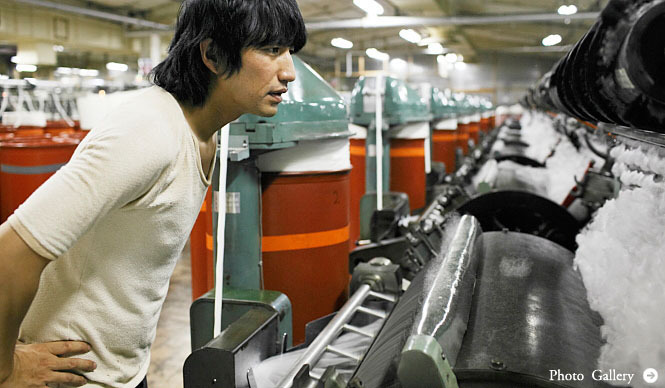
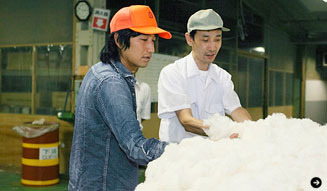
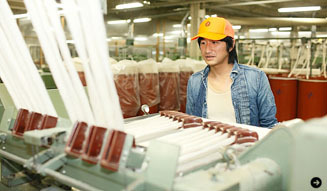
Spinning is the process of turning fibers into yarn. This involves numerous steps such as blending cotton, carding (combing), combing (fine combing), slivering, roving, spinning, and winding. Even to produce a single strand of yarn, a multitude of equipment and considerable time are essential. Shinnaigai Textile's factory is equipped for all these processes, with a particularly robust setup for blending fibers to create mélange yarns.
Mélange yarns, made by blending two or more types of fibers, are broadly categorized into three types based on the blend: mixed materials (different raw materials), shape variations (different shapes), and color variations (different colors). Few manufacturers can produce all these types of mélange yarns, but Shinnaigai Textile is one of them. After observing all these spinning processes, Mihara was deeply impressed by Shinnaigai Textile's high level of technical expertise.
MiharaThis is my first time visiting a spinning factory, and I never imagined that producing yarn would require such an effort. The high quality of the yarn must be a result of this meticulous process. Seeing each stage reveals various possibilities, and it has changed how I view a single thread.
Ogawa (Shinnaigai Textile Factory Manager)It takes about a week for each process alone to create a single mélange yarn. We previously did not open these spinning processes to the public. In any case, it's unprecedented for a designer to visit and observe this closely.
A Unique Sweatshirt Hoodie, Uniquely Made in Japan
MiharaAs far as I know, Japanese yarns are highly regarded among overseas designers, and they come to Japan to source them. I've heard that cotton, in particular, is praised for its comfort and durability after washing.
OgawaFor apparel yarns, knitting and weaving performance are paramount. The quality of a yarn is determined by how smoothly it knits or weaves into fabric. In that regard, Japanese yarns have strict standards and are truly excellent.
MiharaEven with yarns, there's still a tendency in Japan towards a 'foreign-made is best' mentality, a sort of worship of imported goods. We should re-examine Japanese manufacturing. Currently, brands offer a wide range, from inexpensive to high-end foreign products, and there's a significant price difference for items of similar quality depending on the brand. This is a result of the 'brand' being exploited, and I believe it erodes consumer trust. That's why I intend to stay true to my brand's purpose and create products that don't betray consumers. In that sense, this experience has been incredibly educational.
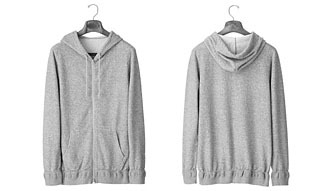
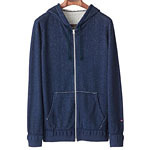
After concluding his visit to Shinnaigai Textile, Mihara selected the company's specialty, cotton "mélange yarn," for this sweatshirt. The yarn was created by evenly blending 12% each of cotton fibers dyed gray and navy. This mélange yarn from Shinnaigai Textile was then sent to Wada Meriyasu in Wakayama, where it was slowly knitted into a double-sided pile fabric using a loopwheel machine.
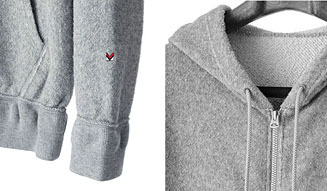
The resulting sweatshirt fabric achieved a unique texture, combining a beautiful heathered appearance with the surprisingly soft and gentle feel of the double-sided pile. Thus, the sweatshirt hoodie, made possible only in Japan by fully leveraging the skills of Japan's proud spinning and knitting factories, was finally completed.