March 9, 2015
Masamichi Katayama of Wonderwall on the Appeal of MACKINTOSH
Wonderwall's Masamichi Katayama on the Appeal of Mackintosh
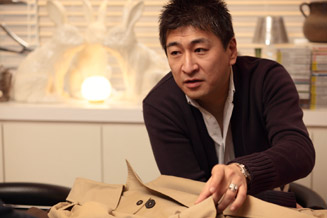
Interior designer Masamichi Katayama shared his thoughts on Mackintosh. He spoke not only about the inherent appeal of Mackintosh products but also about his own profession: 'designing.'
Photo by Jamandfix

— A 'gear' that rustles and adorns the body
My image of Mackintosh was that of a timeless brand, and at the same time, a 'superior product that also offers functionality.'
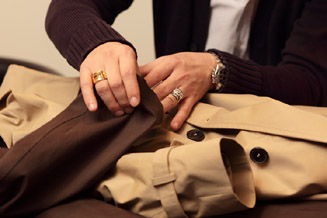
I like the unique rubberized feel that makes a rustling sound when worn. Whether it's clothing or a product, I prefer things with a 'sense of substance' rather than just 'lightness.' Mackintosh feels like a 'thing' rather than just clothes. You could say it's functional gear. It feels like wearing 'gear.' That's why I believe the explosive power when contemporary essence is added to functionality is immense.

I believe that even traditional things must have the flexibility to change with the times. The values of basics evolve with each era. In that sense, Mackintosh's flexibility might be inevitable.
Basic items, like a white shirt that seems unchanged, actually evolve through subtle modifications of mere millimeters. I think it's the same with Mackintosh. If you neglect that effort, it just becomes old. Yet, there's no forced attempt to add excessive modifications to create a trendy feel. I find that appealing.
It's the same with the coat I'm wearing today. It's likely evolved considerably from its original design, but it retains the aura of 'this must be a style that has continued for a long time.' In that, I feel a serious commitment to their brand value.
— An 'adult' item that straightens your posture and sharpens your presence
With a Mackintosh coat, I currently feel like casually wearing a simple style. Since it was even worn for horseback riding, I'd rather wear it daily and let it develop character, rather than treating it with excessive care. In that sense, I think it's clothing meant to be 'worn out.'
Because it's rubberized, it's fine even on rainy days. That's the advantage of integrated functionality. These aspects might be why I perceive Mackintosh as 'gear.'
For me, a coat is an item for adults. Wearing a coat makes one feel dignified. While I admire the dressy styling of wearing a trench coat with a suit, I feel more suited to wearing it in a casual style. Therefore, I tend to pair it with denim more often. The depth to allow for either choice is also wonderful.
When you're wearing something steeped in tradition, your posture naturally straightens. So, even with casual styling, your bearing unconsciously becomes more refined.
— In Scotland, Mackintosh is synonymous with raincoats
I feel a sense of gratitude when I can sense the philosophy of the brand's founder and the spirit of those who inherit it. With a brand like Mackintosh, even if there isn't a constantly visible designer, everyone who carries on the brand is a designer, and naturally, design is present. In that sense, I feel a certain 'strength' in Mackintosh.
The fact that in Scotland, Mackintosh is so ingrained in daily life that it's synonymous with raincoats is a testament to its long history.
Lately, I feel the definition of the word 'design' has become ambiguous. I believe design encompasses not only creating eye-catching 'forms' but also how to edit and communicate. Mackintosh is similar; they seem to use the word 'design' not as a trendy buzzword but as a means to convey the brand's core.
In fact, Mackintosh seems to have a 'what about design?' attitude. I found that focus on substance over superficial design to be characteristically British. Even now, artisans meticulously craft each piece by hand. They refine it slightly while preserving its strengths. They choose evolution over dramatic change. I consider this design as well.
I admire Mackintosh's approach to design. I believe design is a form of functionality. Shouldn't design be one aspect of superior performance? That's why I think Mackintosh has evolved correctly. Brands like that are surprisingly rare.
I am a designer, not an artist. In a boutique, I express the product, the customer base, and the brand's direction and message through my own filter. Therefore, I don't aim to impose my personal style. The clearer the message and philosophy you want to convey, the more strongly it will emanate through the design.
— Mackintosh, where aging also adds character
Depending on the concept, I sometimes intentionally create an atmosphere of 'having existed here for many years.' I myself appreciate vintage and antiques as much as contemporary items, so when expressing the passage of time through design, I pay close attention, using reclaimed wood from actual old structures or specifying detailed aging processes. However, the overall balance is ultimately crucial. It's like planting trees while envisioning a forest.
European cityscapes possess a beauty cultivated over centuries. Simultaneously, Japan also has many things that transcend time and remain cool.

I believe things that endure have their reasons for doing so. The beauty born from being used, not just admired, is the same for architecture and objects.
It takes time to become authentic. I truly believe 'persistence is power.' Mackintosh is a prime example of this. Even in my children's generation, it will likely exist just as it does now. That is the greatness of Mackintosh.
— Here are Mackintosh's new Spring/Summer 2009 collections

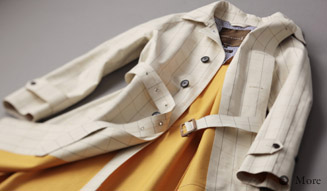
Fresh colors suitable for the spring and summer season in the men's collection.


Women's items with detailed accents like buckles.

KATAYAMA Masamichi
Interior designer and representative of Wonderwall.
Born in Okayama Prefecture in 1966. Established his own office, Wonderwall, in 2000. His free-thinking approach to embodying client concepts, along with his ability to incorporate contemporary elements while respecting tradition and established styles, is highly regarded not only in design-rich Japan but also internationally. He has since expanded his activities to architectural design direction and product design.
In 2008, his second collection of works, 'Wonderwall Masamichi Katayama Projects No.2' (Frame Publishers, Netherlands), was published. Following its preview release at Colette in Paris, for which he handled the complete renovation, it was released in Europe, the United States, and other regions.
Wonderwall
www.wonder-wall.com