April 13, 2015
ONE GRAVITY Designer Hiroki Inomata: Third Interview
“ONE GRAVITY” Designer
Hiroki Inomata Interview: Part 3
The final installment of our FASHION DESIGNER'S FILE interview series.
We spoke with Hiroki Inomata, designer of “ONE GRAVITY,” about the people and things that have influenced his design, the concept behind the new 08 SPRING/SUMMER collection, and the future of “ONE GRAVITY.”
Text by Hitoshi Kaneko (This magazine)
—Are there any people or things that have influenced your design?
That would beall uniforms.I believe military uniforms and denim pants are uniforms in a broad sense. The uniforms of American laborers.
Also, vintage clothing—things that have been continuously produced, refined by history. These are, for me,uniformsin three senses.
And then there are the things that reach the pinnacle of my imagination—all the designers creating fashion, architecture, and products. Naturally, I am influenced by what I have seen and experienced.
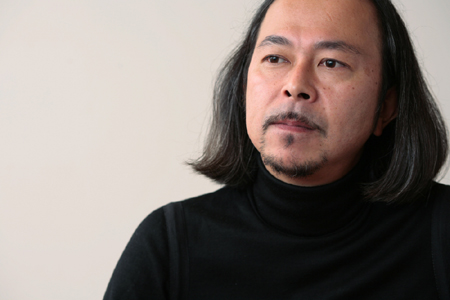
—I see. The point about uniforms really struck me as “ONE GRAVITY.” That’s because I thought uniforms possess both the “public sphere” and the “worksite,” combining ease of movement with a formal feel, which was something we discussed at the beginning.
I do think those elements appear in the design. However, if it were too direct, it wouldn’t be comfortable. That’s why we don’t just make replicas or place special orders with renowned factories. Ultimately, that’s something that can be done anywhere, not just here. “ONE GRAVITY” is about taking an original and thinking about how to evolve it further.
—Now, regarding the 08 SPRING/SUMMER collection, could you tell us about the concept?
Actually, there isn'ta season conceptevery season.
However, the atmosphere of the city is always changing, so I try to absorb that. In that sense, for this spring and summer collection, the underlying themes are “American casual” and “preppy.” This season is about balancing these influences, feeling them while avoiding the sloppiness of “American casual” and the excessive neatness of “preppy.”
—Each season, you use interesting processing and materials. For example, this season you’ve applied persimmon tannin to the denim jacket, twisted it, or coated denim fabric with a glossy material. Where do you draw inspiration for these?
That’s because I amthe ultimate consumer who wants what they don't have.I always ask myself if I can do something I haven't seen before, and I pose these questions to the production team. Of course, not everything is possible, but sometimes the production side offers a starting point, saying, “Maybe we can do this.”
After that, it’s just about how to pursue that lead. So, in that sense,I think it’s simply about encounters.Rather than being inspired by something specific, I’m constantly pursuing what I don’t have.
Also, I believe everyone has an image associated with different types of clothing. For example, with denim pants, you don’t worry about them getting dirty if you sit on the floor, or about your knees showing, and you don’t mind washing them in the machine. But with wool pants, you’re conscious of your knees showing or sitting on the floor. Personally, I don’t think it’s necessary to overturn these images. Because I believe they represent the wearer’s image in a good way, I focus on finding different ways to express them without destroying that.
—I see. While this season retains the usual formality, it feels a bit more street-oriented. Is that largely due to the “preppy” influence from the city’s atmosphere?
The “preppy” element is quite significant. However, what I was conscious of within that was wanting to retain a sense of purity, more so than usual. I would call itpure, rather than simply clean.
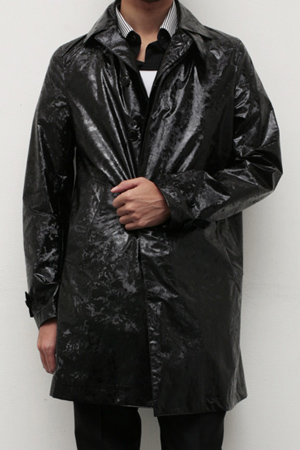
—This coat features a black-on-black camouflage pattern, and it’s made of nylon, isn’t it?
I haven’t seen many coats like this. Is this a raincoat, essentially?
Yes, it is.
With this material, I wanted to create a windbreaker interpreted through the lens of “ONE GRAVITY.” The Ivy League style includes the convenient item of a “windbreaker,” which originally was probably just a simple nylon piece with a water-repellent finish and school prints. But I wanted to create a windbreaker that felt like “ONE GRAVITY,” and this fabric is the result.
—What kind of fabric is this?
The base is polyester, but the camouflage part has a thin film applied to the surface. This is a material called laminate, attached to the back of the fabric for functional purposes like windproofing, waterproofing, and water repellency.
Normally, such materials aren’t used for patterned designs, but I wanted to apply it to the front and further incorporate a design. It’s aplayful elementapplied to a functional film. Furthermore, it’s not printed; it’s embossed.
—So that’s why it has a raised texture when you touch it?
Exactly. This coat, at first glance, looks like a shiny, patterned solid color, doesn’t it?
But,it’s surprisingly functional, with a pure origin.It was born from that kind of thinking.
—And these gold half-pants, the material and texture are also interesting, aren’t they?
These are coated with gold.
—It’s a beautiful gold, not gaudy, and it’s expressed very well.
These are cargo pants, a staple street item, but I’ve made them with a very refined material, creating a gap that I thought would be appealing. That’s why I made them.
—Personally, I’m not a big fan of gold, but this is a shade that makes me think, “I might actually wear this.”
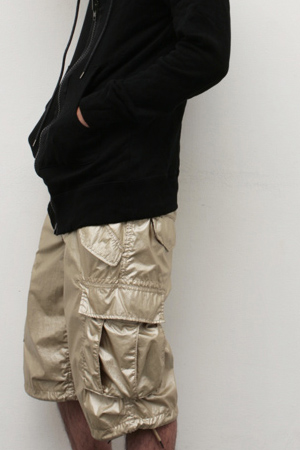
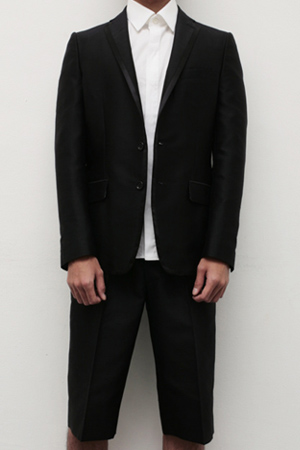
Following this, is the set-up with these shorts also part of the “preppy” influence?
Yes. When it comes to bottoms, I felt that the “preppy” look is best represented by the image of a “nerdy kid” (laughs). So this time, I deliberately chose shorts.
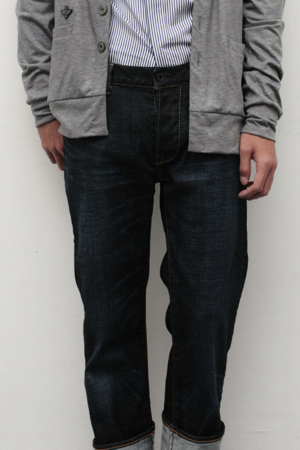
—Each season, you seem to have a particular focus on denim pants, not just the materials. Is that correct?
It’s not that I’m particularly focusing on them or have a special commitment, but denim is always there as a base within the casual category. Plus, denim pants are comfortable for the wearer. Stains aren’t noticeable, and it’s okay if the knees show. Depending on what you pair them with, you can even wear them to a high-class hotel.
They embody both casual and formal aspects, aligning with the concept, which is why we end up making them every season.
—Other apparel brands seem to have what you’d call basic design items, but “ONE GRAVITY” doesn’t seem to have many of those.
That’s true. If I had to pick something that could be called a staple, it would probably bea wrinkled denim jacket.
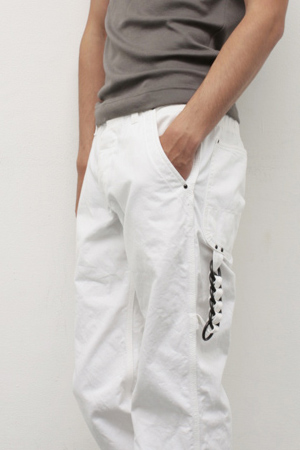
—These work pants have a very large ring attached. What inspired this particular shape?
The ring itself is quite large and has a strong presence.
This started from wanting to create painter pants that weren’t made of denim. With denim, you can create a certain look through processing, but I wanted to make something different. Painter pants inherently have a specific shape, so simply replicating it wouldn’t be interesting, so I thought about various things.
For me, painter pants have a neat image—rolled up hems, worn with loafers and no socks. However, they are originally work pants, so that image is the opposite of their origin. But because they have a “cute” image, I wanted to maintain that outward appearance while subverting the image at the back. The point where that happened to fall this time was the ring.
It’s a statement that says, “We’re not just elegant!”
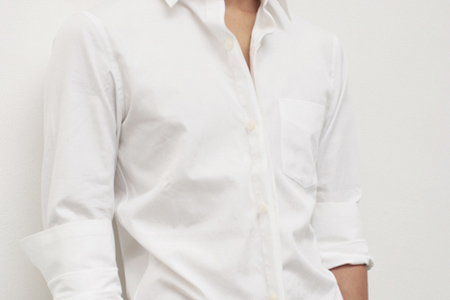
—This shirt, with its stand-up center placket, is a remarkable design. It has buttons on both sides, allowing it to be fastened upright or laid flat. It’s a shirt that can be worn either way, but what inspired this form?
I personally enjoy wearing formal shirts in a more relaxed way. Formal shirts, represented by the pleated front, are often seen as quite dressy. But if you make them too straightforward, I think many men might feel hesitant to wear them.
Therefore, I wanted to create a shirt that retains that essence but can be worn without hesitation, so I incorporated the frill detail only on the button placket.
—Finally, could you tell us about your goals for the brand moving forward?
It’s essential to continue the brand, butI want to continue existing as a niche brand forever.I know that sounds contradictory. As larger entities become dominant, niche things tend to disappear, and in that sense, waste is eliminated.
To remain niche amidst that might not be economically viable, but I would be happy if I could stay there and continue to exist.
Whether that’s the ultimate goal or simply a goal, I hope to continue existing in that way. Of course, it won’t be easy.
—Thank you very much.
<END>