
For this second installment, I'd like to talk a little about my profession: shoes.
I started "CAUSE" in 1996. I didn't attend any special shoe-making school; I was self-taught. My passion for shoes led me into the field.
The catalyst was my time as a buyer in my youth, in the early 80s. I used to travel to Northampton, a town in the suburbs of London, to source brands like "Patrick Cox" and "John Moore." During those trips, I had opportunities to see the manufacturing process firsthand, shown to me by designers and craftsmen at the factories.
The distinct smell of leather and the sound of sewing machines at the factories back then left a strong impression, one I still recall vividly. Looking back, I believe that experience was what allowed me to transition smoothly into the world of footwear.
John Moore had a shop called "House of Beauty and Culture" at the time, which was incredibly cool. It was always closed, and you'd have to press the intercom for him to come down from the second floor and open up. The door had a large padlock, and the floor was inlaid with coins from around the world. It was a wonderful shop. He would carefully take out shoes and explain them to me.
London in the early 80s was a place where new things were constantly emerging in fashion and music, and it deeply influenced me. My friends and I would stay in cheap B&Bs, visit Camden Lock and clubs every day, and go to live shows. Everything I saw was fresh, and I feel my origins lie in that period.
Initially, I pondered what kind of shoes to release. My first thought was to contact the shoe factories I frequented and ask them to create the shoes I envisioned. In 1996, I headed to Europe to prepare for this endeavor.
For about a year, I examined shoe construction, manufacturing methods, and materials. My sole focus was finding factories that could produce my imagined shoes with greater clarity. I traveled through various countries (the UK, France, Spain, Germany, Japan), exploring them extensively. I truly walked a lot.
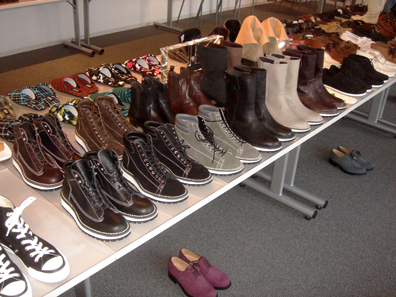
From the 2007 S/S CAUSE Exhibition
And now, 11 years later, here I am. Only recently have I begun to feel truly comfortable and settled in my role.
My first shoes were created in collaboration with Loake in the UK and Paraboot in France. I conveyed my ideas, and the result was a tassel loafer and a deck shoe. I was overjoyed when they were completed. I will cherish those shoes forever.
At the time, I thought that Japanese people, accustomed to American and European cultures from a young age, were familiar with both sneakers and leather shoes. I wanted to combine that sensibility with the tradition and history of overseas shoe factories, filtered through "CAUSE," to create something new. Thus, I have continued to produce shoes, leveraging the unique characteristics of factories both domestically and internationally.
For instance, Italy excels in leather processing, while Japan's dexterity is superior for sneakers. My approach is to apply the design to the best possible execution based on these strengths, which I believe is the hallmark of "CAUSE."
As I continued, I came to understand the history and traditions of shoemaking.
There is a 400-year tradition, and craftsmen have upheld it for generations.
I came to appreciate the strength of conviction within this long history, maintained regardless of circumstances. My aim is to create new things while respecting that heritage. Through shoemaking, I've learned far more than just the craft itself.

SHOEVENT MICAM in Milan
Europe has a unique sense of rhythm and an appreciation for leisure within daily life. It's a simple concept, but in the hustle of work, it's difficult to find time for things like enjoying tea while listening to music. Yet, that environment values such moments.
Calculating how to make the foot appear elegant when worn, researching the nuances of leather, and considering functional details—these aspects are fascinating. Before I knew it, a long time had passed.
Furthermore, the interplay with the craftsmen at the factories is engaging. Understanding the structure of a shoe and then proceeding with the construction process is incredibly enjoyable.
To exaggerate, it's akin to designing a motorcycle or a car.
Shoe design is not flat but three-dimensional. Before considering aesthetics for walking, functionality and comfort are paramount.
Moreover, the subtle positioning of the last (the wooden mold) and the stitching, which are not easily perceived by the eye, dramatically alter the shoe's expression.
Through shoemaking, I've met a diverse range of people, learned many things, and been influenced by them.
The more I do, the more I realize there's still so much to accomplish; it feels endless.