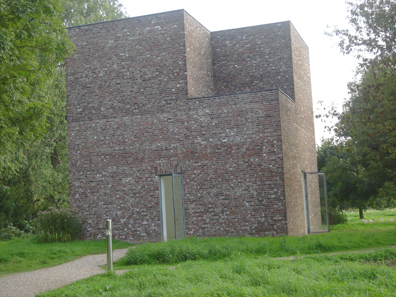
A First Introduction
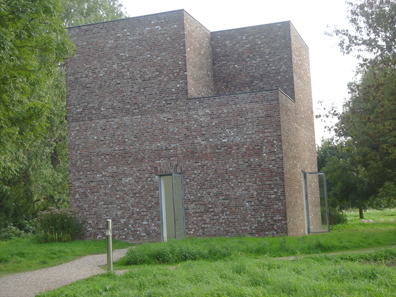
At Insel Hombroich Museum • photo by MASUDA Hiroaki
At Insel Hombroich Museum
Congratulations on the launch of "openers".
I recently traveled to Milan and Düsseldorf for work, in preparation for an exhibition in November.
This time, I'd like to share a museum I visited in between work engagements.
A friend in Düsseldorf told me, "There's a wonderful place nearby." What left a particular impression was the Insel Hombroich museum (http://www.inselhombroich.de/), located in the small town of Neuss, on the outskirts of Düsseldorf.
The museum, initiated in 1986 by Düsseldorf-based art collector Karl Heinrich Müller to showcase his collection, is conceived as a single artwork comprising the museum and the surrounding forest. It features outdoor installations and artist studios, along with minimalist, pavilion-like exhibition spaces, all harmoniously integrated into the natural landscape. The buildings themselves utilize reclaimed bricks. What was particularly interesting and memorable was the vast site, approximately 5 km in area, with 17 courses to walk. Upon reaching the very first gallery, there was no artwork to be seen. The concept, I learned, is to first enter an empty space, shed preconceived notions, and calm the mind before proceeding to the next gallery.
At Insel Hombroich Museum • photo by MASUDA Hiroaki
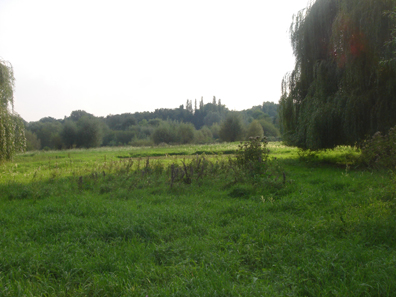
When tired, one can rest on a bench, enjoy the scenery, or listen to the birdsong.
Walking at one's own pace, in a tranquil flow of time.
There's an organic cafe along the way for further relaxation.
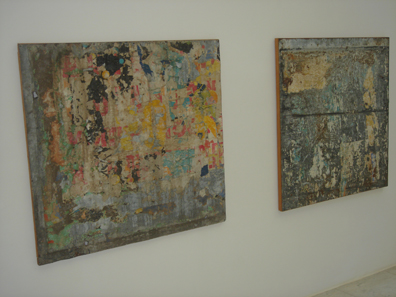
Moving through the deep green forest, one arrives at another building where artworks are displayed. However, there are no lights, climate control, or labels indicating titles or artists. The intention is to experience the art in natural light, in a relaxed state, allowing for personal interpretation and a sense of spaciousness.
While I understand there might be concerns regarding the preservation of the artworks, from the perspective of appreciation, I believe this approach offers an unparalleled way to engage purely with the art. The idea of shedding preconceptions and experiencing art purely within nature deeply resonated with me.
At Insel Hombroich Museum • photo by MASUDA Hiroaki
At Insel Hombroich Museum
Congratulation for the opening of "openers".
Preparing my upcoming exhibition of November, I went to MILANO and DRUSELL for a business trip.
This time I am introducing you a museum which i had the chance to visit in between this trip.
While visiting DRUSELL with a friend of mine from that area, I particularly found interest in this particular museum located in the suburb area of DRUSELDORF called Neuss.
The museum is the Insel Hombroich (http://www.inselhombroich.de/)
This museum had been founded by a art collector for DRUSELL, called CARLS HAINRIH MULLER, exposing his private art collection in 1986.
His concept is the harmony with nature. he program’s emphasis on nature and creativity, the interactions between landscape - park and buildings - the general spatial effect, and the dialog with the works of art exhibited.
Most of the buildings are built with recycled red bricks.
One of my favorites, was this walk separated in 17 trails, around this vast approx. 5 km natural landscape. First, you reach a gallery space with no art work at all. The idea is to clear any kind of emotion and presumption toward artwork in general before proceeding to the amazing collection.
When you feel like a pose, you sit down outside within nature and listed to the bird singing, or enjoy if you like, a drink at the organic cafe.
After a long walk in the deep forest, you reach another gallery, but this time you will find work of art exhibited although, with no name label or any explanation to guide the viewer.
The idea here is to let you involve with each piece, with you own perception and conception about the work itself. All of the pieces are not held in particular conditions or under particular lighting system like you would expect, but exposed under natural sunlight.
In terms of preservation, obviously the condition are not proper to maintain the pieces to last long, but I feel you wont find any other purer and truer way to express the artist approach to his work of art. I was really impressed by this whole
approach to nature, culture and art. Really if you have the occasion, a must-go.