Exploring the Allure of Kodo: Part 3
Exploring the Charms of Kodo: An Interview with Yoshihiro Inasaka
Part 3: Actually 'Listening' to the Incense
photo by FUKUDA Emiko
Slices of 'Kyara' in the foreground, 'Sandalwood' in the background
Putting the Scents of Sandalwood and Kyara into Words
Yoshida TokihitoLooking at the materials you provided, Mr. Inasaka, it says 'Monko' here.
Yoshihiro InasakaThat's right. Incense is something to be 'listened' to, not smelled. That's why it's called 'Monko.' Shall we start by 'listening' to sandalwood?
— The Monko-ro for burning sandalwood is brought out.
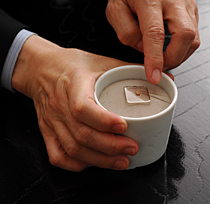
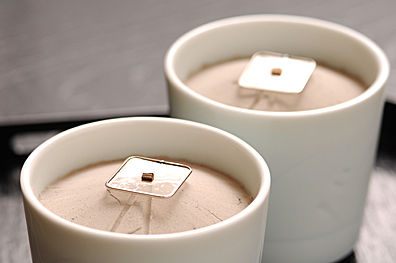
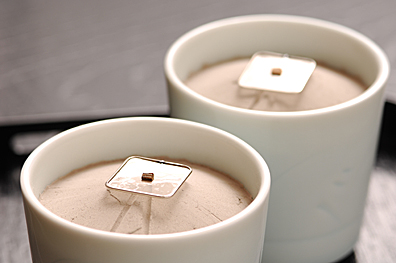
InasakaWith incense sticks, you light them and they burn. But with this Monko-ro, a heated charcoal tablet is buried in the ash. A small hole is made in the ash, a mica plate called 'gin-yo' is placed on top, and then a piece of incense wood is laid on it.
YoshidaSo the heat releases the aroma.
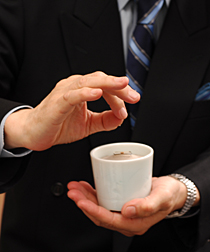
InasakaHold the Monko-ro firmly in your palm, in a relaxed posture. Then, form your index finger and thumb into a 'tsu' shape, and cover the Monko-ro as if to create a lid. A faint aroma will gather in the hollow of your hand. In Kodo, we call this 'listening with three breaths,' inhaling with both nostrils. There's no strict order, though. Try holding it until your hands feel warm.
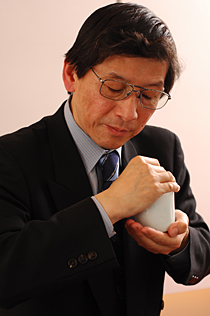
YoshidaIt's a wonderful scent, so sweet. It's luxurious. A scent unlike any other.
InasakaThe pieces of incense wood used in this Monko-ro are of high quality, a different grade from the materials used for common incense sticks or coils.
YoshidaThe way the ash is arranged is very beautiful.
— Next, we 'listen' to Kyara.
InasakaNow, let's 'listen' to Kyara.
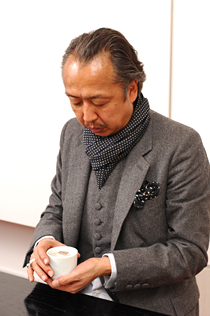
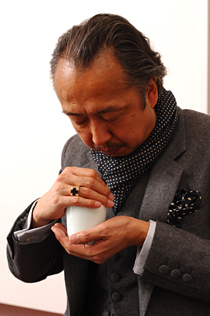
YoshidaIt's a completely different scent from sandalwood. So complex... it has a sort of tartness.
InasakaYou're quite perceptive, Yoshida-san. In the past, people devised ways to describe scents, and they discovered that using analogies to human taste is effective. For example, sweet or sour notes. This Kyara scent is very complex; it has a hidden sweetness, but also a hint of spiciness or tartness, an indescribable aroma where the five tastes—spicy, sweet, sour, salty, and bitter—are blended into one.
YoshidaThat's certainly true. When did the method of 'listening' with the Monko-ro become established?
InasakaThe method of appreciating incense wood indirectly through gentle heat dates back to the Muromachi period. The incense woods used in Kodo, such as 'Kyara' and 'Jinko,' are classified by names from six different regions, known as 'Rikoku.' Distinguishing between these became a source of pleasure. This discernment is a kind of intellectual game. There's a practice called 'Kumiko,' where one listens to a sequence of incense and tries to identify the differences. A prime example of this is 'Genji-ko.'
YoshidaSo, our predecessors elevated even their pastimes to such a level. It's remarkable.
InasakaThey must have been individuals with a level of cultivation that cannot be compared to modern people.
YoshidaMay I 'listen' to the Kyara one more time?