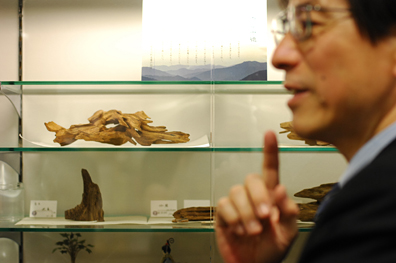
Exploring the Allure of Kodo: Part 2
Exploring the Charms of Kodo: An Interview with Yoshihiro Inasaka
Part 2: Incense as a Samurai's Pursuit
photo by FUKUDA Emiko
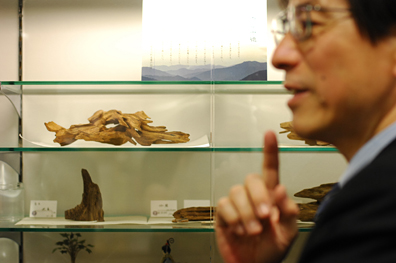
Warriors Incense Their Helmets
Yoshida TokitoIt's often said that scents can calm the mind or enhance concentration, but are there scents that can, conversely, invigorate the spirit?
Yoshihiro InasakaPrecisely. The origins of incense lie in both 'serenity' and 'excitement.' In the Middle East, it was apparently used as an aphrodisiac. The same type of incense can have different effects depending on its concentration and how it's used.
YoshidaFor example, what kind of states do you mean by 'invigoration' or 'calming'?
InasakaThe Kamakura period saw the largest import of incense woods that release fragrance when burned. Powerful samurai families vied to acquire the finest jinko, particularly kyara.
YoshidaThat incredibly precious kyara? How did they use it?
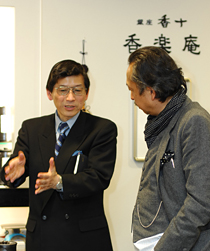
Inside the "Koraku-an" shop
InasakaThey would burn incense in their helmets. This served as both a stimulant and a sedative. In battle, if a warrior were unfortunately beheaded, it would be said, 'Indeed, a renowned general, to have burned such kyara,' passed down as a testament to a warrior's aesthetic. However, it's also plausible that the scent provided the practical benefit of a sedative, allowing for calm combat.
YoshidaI see. That's a fascinating story.
InasakaThe culture of incense is often discussed from a feminine perspective, but historically, it was men who shaped this culture. Samurai, in particular, embraced incense as a means of self-expression, self-realization, a symbol of power, and as a refinement for the warrior.
YoshidaDoes Kodo, like the tea ceremony or flower arranging, have different schools or styles?
InasakaYes, it does. Historically, the Muromachi period was characterized by a culture born from the fusion of court nobles and samurai in Kyoto. Kodo is precisely that. The culture of the Heian aristocracy took on new forms under samurai rule. In the mid-Muromachi period, Kodo was systematized by Sanjonishi Sanetaka, a Minister close to the Imperial family, and he is revered as the 'Ancestor of Incense.' The court noble's style of Kodo is known as 'Oie-ryu,' while the samurai developed 'Shino-ryu,' founded by Shino Soshin. Both continue to the present day.
Yoshida'Oie-ryu' is a unique name.
InasakaIt reflects the fact that prominent court noble families ('Oie') have inherited the forms of aristocratic culture since the Heian period. It's believed to have been shaped with this shared heritage in mind.
YoshidaHow do the court noble and samurai styles differ?
InasakaSimply put, if the courtly ideal is 'natural spirit accompanied by beautiful form,' then the samurai approach is 'beautiful spirit begins with beautiful form.' These distinct characteristics are evident in the two schools.
YoshidaWonderful! But both use incense wood, don't they?
InasakaJapan is a country that crafts the finest incense products using incense woods, rare treasures not found domestically and unparalleled in the world. While we call it 'incense wood,' the only wood that grows naturally and is considered a top-grade source is 'sandalwood,' primarily from India. Its growth is also extremely slow.
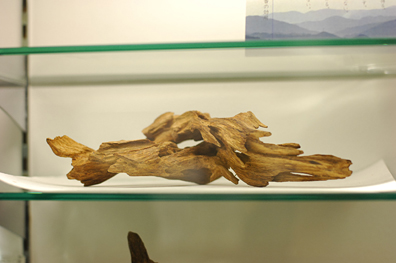
Kyara in the "Koraku-an" shop
YoshidaWhat exactly is 'kyara'?
InasakaI'll omit a detailed explanation, but jinko and kyara are formed in specific regions of Southeast Asia through a miraculous confluence of natural conditions over many years, where bacteria interact with the sap of certain trees. Kyara can only be obtained when discovered, making it extremely expensive – one gram costs more than ten times the price of a gram of gold. And its price continues to rise.
YoshidaCan the scents of sandalwood and kyara be artificially created?
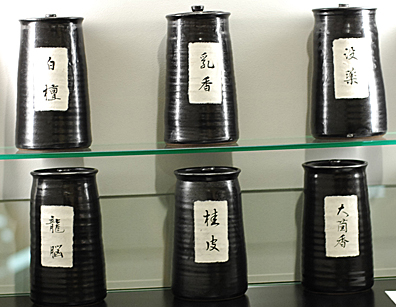
InasakaModern chemistry can achieve considerable synthesis, but replicating the scent of kyara still seems difficult. Therefore, even if individuals or manufacturers in the perfume industry strive to create 'oriental scents' and perhaps describe them as 'kyara-like,' they ultimately differ from the true aroma of authentic kyara incense wood.
YoshidaIt's difficult, you say...
InasakaShall we try 'listening' to the actual scent, then?