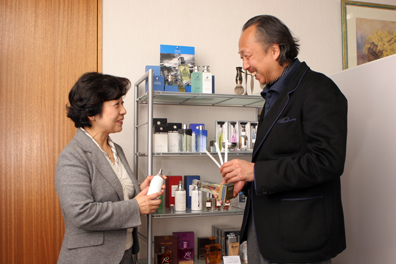
Learning from Yasuko Yoshioka: Part 2
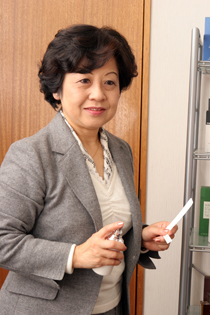
photo by IDEGUCHI Keiko
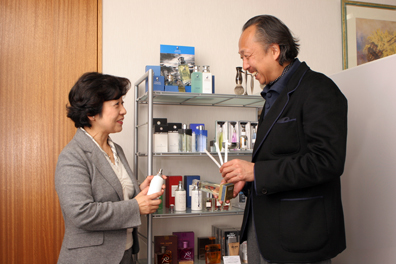
Selling Perfume, Made Simple
Yoshida: Is France still the top country for perfume production?
Yoshioka: According to recent Japanese import statistics, France is number one with a 56% share. Italy follows at 24-25%.
Yoshida: Do the brands that manufacture perfumes use natural ingredients?
Yoshioka: If everything were made with natural ingredients, it would be impossible to maintain current prices. Chemically speaking, most natural fragrances can be replicated with 100% synthetic compounds.
Yoshida: Is that so? But there are still brands that insist on natural ingredients, aren't there?
Yoshioka: Well-known perfume houses include Guerlain, and the eau de parfum from 'Parfums de Rosine Paris,' which we handle. Guerlain owns its own flower fields, and Chanel also has a rose garden in Grasse, the mecca of the French perfume industry. However, these are very special cases.
Yoshida: Even so, there are creators who want to use natural ingredients, right?
Yoshioka: Small, family-run maison brands with history and tradition are particular about natural ingredients. However, for designer or celebrity fragrances, which aim for large-scale global sales driven by capital, the designer's passion for using specific materials is rarely accommodated.
Yoshida: That's a sad thought.
Yoshioka: But that is the current reality worldwide.
Yoshida: Last time, when I spoke with Hiromi Kobayashi, I was reminded again that perfume is a delicate luxury item. Scent is invisible, and in the extreme, it's something you could live without.
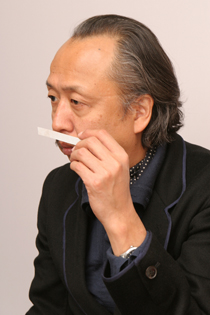
Yoshioka: It's what Japanese people are most uncomfortable with. In descriptions of Western perfumes, words like 'sensuous' or 'emotion' always appear, but they can't be accurately translated into Japanese. It's likely a sensibility or emotion that we Japanese don't possess. For Westerners, perfume is akin to classical music or classical painting. And it's a luxury. Do we listen to classical music every day? Therefore, I believe it's important for us in Japan to engage with fragrance on a different level and in different ways than its original intent. In that sense, it's gratifying to see an atmosphere and mood emerging where people are eager to enjoy scents.
Yoshida: As I mentioned to Ms. Kobayashi, I believe that for men in particular, anticipating the situation and TPO for wearing a fragrance will lead to wider adoption.
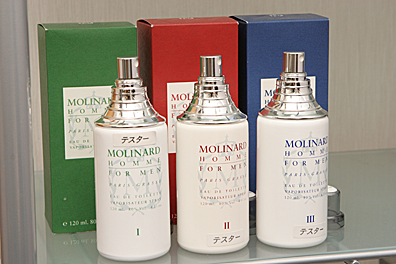
Green is 1, red is 2, blue is 3.
Yoshioka: Yes, this is also a men's fragrance from our company called 'Molinard Homme,' aimed at adult men. It's divided into three scents, from 1 to 3. To market it in Japan, we designated scent 1 as 'Work,' with a natural botanical aroma featuring Provençal lavender as the top note; scent 2 as 'After Five,' with a woody scent appealing to women; and scent 3 as 'Leisure, Outdoors,' based on herbs like tarragon and cedar.
Yoshida: Did you decide that, Ms. Yoshioka?
Yoshioka: Yes. Since no one would understand just from a description of the scent (laughs), I set them up in an easy-to-understand way. When you first mention the function or use, people understand. Like, 'This will make me popular' (laughs).
Yoshida: Exactly. Using different scents for morning, noon, and night. This one for a suit, that one for shorts.
Yoshioka: My goal is to popularize affordable, everyday men's fragrances that anyone can enjoy. The industry talks about 'aging odor' (laughs), but outreach to men is only just beginning.
Yoshida: Are there any methods to make perfume a daily item for men?
Yoshioka: I believe men who read fashion magazines and are more conscious of trends already use perfume. So, the challenge is how to get those who aren't interested to pick one up.
Yoshida: Is your company also making efforts to sell them?
Yoshioka: Recently, after approaching the men's floors at Hankyu Umeda and Isetan Kyoto, we've started to see our perfumes stocked there. Men feel embarrassed to buy perfume if it's displayed on the first floor of a department store. We're also proposing dedicated shelves for men's cosmetics and fragrances at stores like Tokyu Hands and LOFT.
Yoshida: Indeed, it's easier to pick up a perfume if it's placed near the cigar counter, for example.
Yoshioka: It seems department stores are finally beginning to understand.
To be continued in (3)