Learn from Yasuko Yoshioka - 1
Introduced by Hiromi Kobayashi, we met Yasuko Yoshioka, Director of Forte Inc. After graduating from university, Ms. Yoshioka spent many years in the international cosmetics business. She currently manages her own perfume business and has been actively involved in the industry, establishing the trade association "Japan Fragrance Association" in 2001 to promote fragrances. We visited her to learn about the history and current state of the Japanese market and the perfume business.
photo by IDEGUCHI Keiko
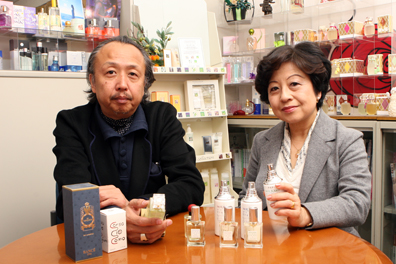
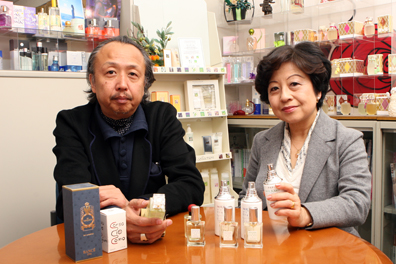
At Forte Inc. On the right is Yasuko Yoshioka. (Yoshida)
From the Dawn of Perfume in Japan to the Present
Yoshiki YoshidaYoshiki Yoshida: It's a pleasure to meet you. I'd like to hear your thoughts on "perfume" from a different perspective than Ms. Kobayashi's. Thank you for your time.
Yasuko YoshiokaYasuko Yoshioka: I'm happy to help if I can.
Yoshiki YoshidaYoshiki Yoshida: Looking at your background, you worked for a major cosmetics manufacturer and have observed the Japanese perfume business for a long time.
Yasuko YoshiokaYasuko Yoshioka: That's right. Looking back, there was a time after the war when the tariff on perfume was 600%, and the exchange rate was 360 yen to the US dollar. Imported cosmetics were extremely precious items in Japan then. For about 15 years, perfumes regularly cost over 20,000 yen.
Yoshiki YoshidaYoshiki Yoshida: Fifteen years ago still feels quite recent.
Yasuko YoshiokaYasuko Yoshioka: Perfumes, which were luxury items from overseas, began to be accepted along with Western lifestyles, but they were precious, treated like jewels. The brands were limited to names like Christian Dior, Chanel, Yves Saint Laurent, Nina Ricci, and Givenchy.
Yoshiki YoshidaYoshiki Yoshida: When did they start to become accessible to the general public?
Yasuko YoshiokaYasuko Yoshioka: They first began to spread among young people around 1993-95, when the French baby clothing brand Tartine et Chocolat by Yves Saint Laurent launched a children's perfume called "Petit Bonbon" in Japan. Until then, perfumes typically cost 8,500 yen for 50ml, but they set the price at 4,500 yen for 30ml, targeting office ladies. It became a hit, sparking a boom, selling 100,000 bottles in a year, which was a landmark event in the industry.
Yoshiki YoshidaYoshiki Yoshida: 100,000 bottles in one year?
Yasuko YoshiokaYasuko Yoshioka: After that, attention turned to designer perfumes, and the next hit was Calvin Klein's "CK ONE," released in 1995-96. This was a unisex eau de cologne priced at 6,700 yen for 200ml. The reason for its success was that, whereas previously perfumes were only sold in department stores, Plaza, or Okachimachi (Ameyoko), for PR purposes, it was also sold at Marui and Tower Records. This resonated, and the demand for perfume among young people became evident.
Yoshiki YoshidaYoshiki Yoshida: I remember that well.
Yasuko YoshiokaYasuko Yoshioka: Furthermore, its popularity surged after parallel import was permitted in 1997.
Yoshiki YoshidaYoshiki Yoshida: Nowadays, we see various brand perfumes even in discount stores. Do you think perfumes have truly taken root among Japanese people?
Yasuko YoshiokaYasuko Yoshioka: Japan still has a long way to go for perfumes to become a deeply ingrained culture. While the opportunity to encounter perfumes has certainly increased since parallel imports were allowed, Japanese people still lack a certain "heart" for perfume. Europeans love perfume; it's an essential part of their lives. However, the Japanese market relies heavily on imports, and we lack original Japanese scents.
Yoshiki YoshidaYoshiki Yoshida: Ah, Japanese cosmetics manufacturers don't really produce many perfumes.
Yasuko YoshiokaYasuko Yoshioka: Among Japanese manufacturers, only Shiseido and Pola have developed in-house perfumers. Even Shiseido now offers original perfumes only as limited editions for customers.
Yoshiki YoshidaYoshiki Yoshida: Why is that?
Yasuko YoshiokaYasuko Yoshioka: Simply put, there's no demand for Japanese manufacturers to create perfumes, even if they wanted to.
Yoshiki YoshidaYoshiki Yoshida: There's no demand?
Yasuko YoshiokaYasuko Yoshioka: With parallel imports setting open prices, there's no reason or market for Japanese companies to enter the perfume sector.
Yoshiki YoshidaYoshiki Yoshida: So, it's a combination of price collapse and the brand power of Western companies, I see...
Yasuko YoshiokaYasuko Yoshioka: I believe it's time for Japan to start creating scents that suit the Japanese sensibility.
Yasuko Yoshioka (Director, Forte Inc.)
Born in Hyogo Prefecture in August 1946. Graduated from the Department of English and American Literature at the University of the Sacred Heart.
Studied abroad at Rosemont College in Pennsylvania, USA, and at Alliance Française in Paris.
Gained experience in the cosmetics business over 20 years working at the Japan liaison office of Parfums Christian Dior and in the marketing department of Elizabeth Arden, Inc.
In 1995, she established a new fragrance business specializing in the import and wholesale of foreign fragrances at Forte Inc., her husband's architectural design firm. She has aimed to popularize fragrances by offering perfumes that are approachable to Japanese consumers at reasonable prices. Since 2003, she has also expanded into the men's cosmetics sector.
In 2002, she founded the "Japan Fragrance Association," an industry organization for fragrance-related companies, to promote fragrances and serves as its executive director.
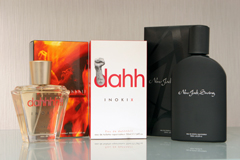
Original perfumes handled by Ms. Yoshioka.