DVD "Vivienne Westwood 1970s-1990" Talk Session: Yoshiyuki Shimazu × Hiroshi Enaitsu (3)
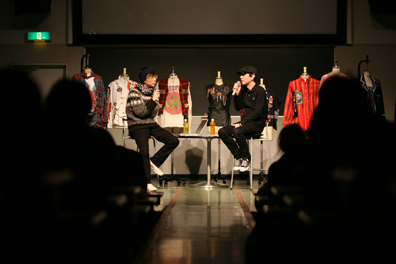
Continuing our series, this is the final installment of the preview and talk session for the DVD "Vivienne Westwood 1970s-1990," held at Shinjuku Fashion College on March 24th, featuring a discussion with writer Hiroshi Enaitsu!!
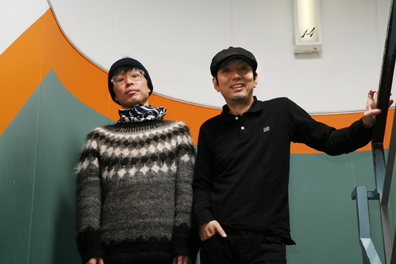
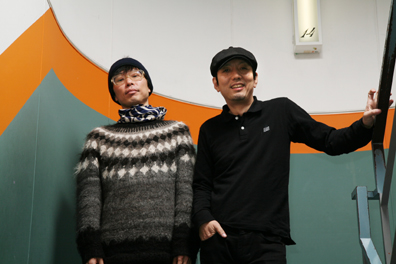
Left: Hiroshi Enaitsu, Right: Yoshiyuki Shimazu
Hiroshi Enaitsu (hereinafter E): Does skepticism mean adherence to tradition?
Yoshiyuki Shimazu (hereinafter S): Yes.
You study your roots, ancient Greece, the era of Aeschylus' plays, and 19th-century French thought and philosophy. I believe these essences are incorporated into her clothing designs.
Especially in the 90s, she established a distinct system as a designer.

E: So, unlike the process where European heritage brands gradually moved from aristocratic styles to the avant-garde, she, who began by collaborating with Malcolm and Jamie Reid on graphic art, ultimately reinterpreted the traditions of Western European culture.
S: That's right.
But in her case, it's more like an art form than just clothing... essentially, it's avant-garde.
The process and style of "rebellion" are also part of her personal attitude.
Her clothes can be pinned to a wall like an insect specimen, framed and displayed, or of course, worn.
It's up to the buyer's freedom, and she gives the customer the idea to think about what to do next.
This representative approach was consistent from the King's Road store to
her own stores after World's End.
The interior design changed according to the concept of the product line; for example, when pirate fashion was popular, a pirate ship-like stage was created inside the store...
It was a very theatrical store.
E: A store with a theatrical concept,you mean?
S: Yes.
It was an approach where you buy the clothes, including the atmosphere.
Because of that style, the clothes weren't cheap either. Even in the UK, they were priced beyond the reach of ordinary people.
However, they sold explosively in Japan in the 1980s.
E: I was one of the people who couldn't afford them (laughs).
S: Men's suits, in particular, sold very well.
E: Why do Japanese people find Vivienne's designs so appealing?
S: One reason might be
cosplay.
E: I see!
S: That's often said in fashion. Perhaps Vivienne's designs had the highest degree of cosplay potential.
E: So, what Vivienne considered skeptical in Western European culture was perceived by Japanese people as costume play?
S: Yes.
The cosplay element can be felt even in her early designs.
I personally believe fashion is cosplay. Even the IVY look, by wearing it, you adopt a certain stance, so in that sense, it's cosplay.
E: Mr. Shimazu, you've met Vivienne and Malcolm in person. Could you share your impressions from those encounters?
S: I last met Malcolm about five or six years ago.
At that time, I asked him about the future of fashion, and although he didn't elaborate, he offered one keyword:"Science."When I asked what he meant, he replied,a "never-wilting red rose" can be a business....
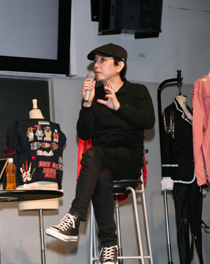
This is my interpretation, but with the continuous development of new materials, fashion using such materials will become mainstream, and it seems to imply the opposite of mass production...
But the expression "never-wilting red rose" is so like him.
I myself drew inspiration for styling from the phrase "red rose."
E: Could it be that "science," which constantly changes, is contrasted with the "never-wilting red rose," representing unchanging, universal value in fashion?
S: Perhaps so.
With Vivienne, it's not that she herself is changing, but her designs are becoming more structured. She's more of an artist, like a ceramicist, than a designer.
This tooresistance to herselfis emerging, I believe.
E: Then, let's move on to the question and answer session from the students to Mr. Shimazu.
Student A: I also collect early issues of "FACE" and "i-D" like you, Mr. Shimazu, and I draw inspiration for my own designs from them. When you first encountered these magazines, Mr. Shimazu, how did you feel?
How did you feel when you first picked them up?
S: I have the first issue of "FACE." The cover featured Ian Dury.
E: The feature was on lead vocalists, wasn't it?
S: Yes.
John Lydon was on the cover around issue number three.
Terry Jones, who was the editor-in-chief of "i-D," had previously worked for English Vogue.
He had two reasons for creating "i-D"...
One is that he was also from the punk generation and wanted to do fashion pages with a punk aesthetic, but Vogue at the timedid not allow punk.
The other reason is that around 1979, music styles were leading, and fashion styles were catching up.
At that time, Terrywanted to properly introduce such subcultures in the media.That's why he created the new media outlet "i-D."
For me, "i-D" and "FACE" were the first fashion magazines linked to music.
The covers featured various musicians of the time, like The Specials and David Bowie. Unfortunately, they later moved away from music.
"FACE" is no longer published, but "i-D" still exists today, so please pick up a copy and take a look.
In Japan, subcultures can be surprisingly difficult to perceive, but the origin of information dissemination introducing subcultures probably began with punk culture.
Student B
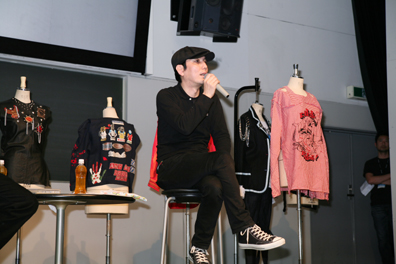
: Besides the Sex Pistols, what bands were exciting or popular for you back then? Also, what music are you listening to recently?S
: I listened to a wide variety of music even back then.Incidentally, in Japan, it's often assumed that punk culture originated from the Sex Pistols, but punk culture originally emerged from the New York underground scene. Anti-establishment music started earlier in America.
Perhaps bands like The Velvet Underground, The Ramones, Patti Smith, and Talking Heads in America.
Malcolm was managing the New York Dolls, who were linked to those artists at the time, so it seems he brought that culture back to the UK.
I heard that Richard Hell was the first to tear T-shirts and fasten them with safety pins, and Malcolm brought that fashion back to Britain.
If you delve deeply into the New York underground punk scene of that era, it ultimately connects to Andy Warhol.
The banana from The Velvet Underground and the Sex Pistols' "Never Mind the Bollocks."
They have an intelligent and pop feel in their design, and I feel there's a commonality there.
I like The Velvet Underground, so I used their song "Femme Fatale" in the music selection for a fashion show I attended recently.
I also listened to THE CLASH, of course, back then.
THE CLASH performed with the Pistols, but the Pistols caused so many problems that their concerts were often canceled.
I brought a T-shirt from when a concert was canceled back then; this one was made by Malcolm and is from around '76.
Recently, I've been listening to Radiohead and various other artists.
But sadly,
I find myself listening to a lot of old songs(laughs).Even more sadly,
I buy the same CD again.That's a sad reality(laughs).
The reason I buy the same CD again is quite personal...
I own about 15,000 vinyl records, but I entrusted them to a moving company when I relocated.
Since I also do music selection work, I want to use the songs I own, but they're not with me right now.
So, I end up buying them again at Tower Records...It's a rather lonely sight(laughs).
Just the other day, I bought a CD of a song I already own on vinyl...
Partly due to my work in music selection, I love punk and rock, but I also remember enjoying live performances by the Eagles...
In that sense, I listen to music without much prejudice.
E: Lastly, do you think fashion today would be significantly different if Vivienne hadn't existed?
S: Probably,
Tokyo's fashion would be completely different from what it is now.
What she did was very much a minority action, but something emerged from those movements.
Back then, of course, in the absence of information, various creations were born within Vivienne. In fact, she always said, "Thought and ideas are always important."
I believe there are both good and bad aspects to the globalization mindset where everyone moves forward with the same consciousness.
For example, not everything you see on TV is true.
That's what propaganda is, and against it, we must pause and think before acting. Otherwise, we cannot inherit Vivienne's actions.
Each of those actions, I believe, connects to the punk spirit.
As a stylist and creator, I want to continuously build my presence and originality.
Therefore, I want to inherit the legacy of Vivienne's actions that began from a minority perspective.
Profile
Hiroshi ENAITSUEGAITSU hiroshi
(one hand clappin')
Concept / Text / Direction
Born in Tokyo. Began DJing while at Rikkyo University and simultaneously started writing for magazines.
Has also been involved in the composition of compilations, radio programs, and TV shows. Notable albums include "Routine," "Temple of Dub," and "Ill Centric Funk."
Supervisor for the video work of the historic hip-hop party "Sanpin CAMP." Currently involved in collaborations with the NY shop "KIOSKHELLO," and the discourse project "onestoneinsidetheshoe" with artist Jörg Gieseler and new media researcher Philippe Codognie.
Also writes for RIDDIM, OKFRED, and VOGUE NIPPON.
Currently works as a part-time lecturer at Tokyo University of the Arts and Tama Art University!