DVD "Vivienne Westwood 1970s-1990" Talk Session: Yoshiyuki Shimazu × Hiroshi Enaitsu (2)
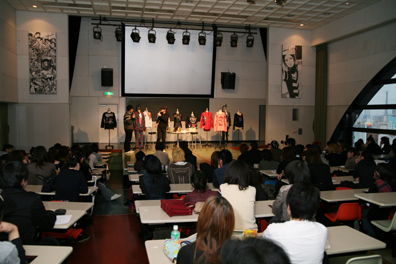
Continuing from last time, we present the talk session held on March 24th at Shinjuku Mode Gakuen, a preview and talk session commemorating the release of the DVD "Vivienne Westwood 1970s-1990," featuring a discussion with writer Hiroshi Enaitsu.
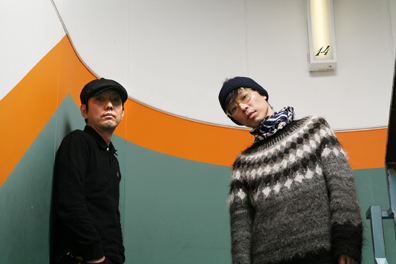
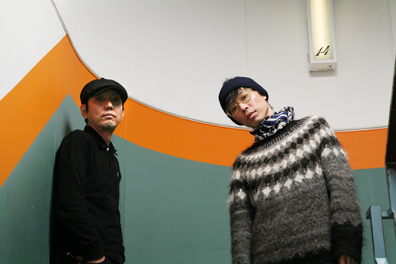
Left: Yoshiyuki Shimazu, Right: Hiroshi Enaitsu
Hiroshi Enaitsu (hereinafter E): Vivienne was aiming to become a school teacher, wasn't she?
Yoshiyuki Shimazu (hereinafter S): That's right.
It seems she was already a teacher when she met Malcolm.
Even after "World's End," she continued to study and obtain teaching licenses in other countries; she's a highly intelligent person.
E: When she met Malcolm, and with the participation of her art school friends like Julie Goldstein, Bernard Rose, and Jamie Reid, they took a completely different approach to clothing creation than haute couture at the time, but was it more of an amateurish method?
S: Yes, that's right.
In terms of her fashion style back then, she would alter clothes they had made by tearing or ripping parts she and Malcolm disliked, and it seems she incorporated this process itself into her style.
The muslin shirts that became a staple of punk were likely born from this iterative process, combined with Vivienne's "knowledge" (apparently inspired by Roman battle attire) and Malcolm's slogans in this collaboration.
Later, during the "World's End" era (a brand name taken from the name of the street at the end of King's Road), there was a fashion called "Pirate Fashion" that became a huge hit. Given that Britain itself has a history of Vikings colonizing new lands by ship, perhaps this was their "research and development" of stolen cultures and ideas from various countries, leading to the next stage.
E: Was this incorporation of inspiration from past history and ideology into design something that started from the early days?
S: Yes, it was.
I believe Vivienne's technical skill and attention to detail truly blossomed from "SEX" in '75.
Rather than history, she incorporated many meanings into political provocation and contradiction, and used past cultures, aesthetics, and sexual fetishes as material for bricolage (a creation from a diverse range of items). This likely gave birth to the precursor of "ultimate punk fashion," designed for "polarization of conflict."
E: For example, here (pointing to the text on the back of a piece) there's a message from a philosopher.
S: Around this area, she seems to have wanted to make it symbolic by incorporating Situationist slogans expressing rebellion and contradiction.
(Pointing to a badge on the collar of a piece) This is an actual Nazi badge.
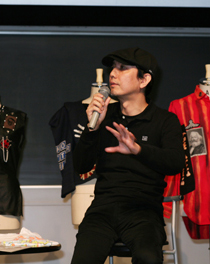
E: What! Really!?
SFor "Let It Rock" and "SEX," they used original accessories, which is amazing.
Speaking of which, the Harley-Davidson team, the Hells Angels, also wore the same thing as the Nazis. Vivienne seemed to love it and reflected it in the designs from the "Let It Rock" era.
E: I see, so that's how it was.
What year is this from, by any chance?
SThis is also from the "World's End" period, from late '84.
It's from the early days of Italian production, just before she took a break from design activities. The back design is also intricate and looks great. It's almost too well-made. The print work is beautiful too.
If you were to make something like this now, it would be incredibly expensive (laughs)!

E: Looking at this, was she foreseeing the logo culture from this period?
S: Yes, I think so.
E: Now, logo culture is completely...
S...forming the base.
E: This badge here is also a genuine Nazi one, isn't it?
S: It's genuine.
E: I see, is this "Seditionaries"?
S: Yes, it is.
Incidentally, the origin of the name "Seditionaries" is that a regular customer at the shop was arrested by the police for wearing a cowboy t-shirt.
He was charged with sedition, and it seems they incorporated that directly into the shop's name.
E: This is the famous parachute shirt, isn't it?
SThis design is the culmination of research and practical application! I love it. Apparently, it was everyday wear on the streets of Britain back then. Isn't that amazing?
E: What aspects appeal to you?
SHer designs are truly inimitable.
Especially the sharp designs from the early 70s had a strong visual impact. Looking back, they were modern, but at the time they were so cutting-edge that I still don't think any designer has surpassed those designs.
There are some strange shoes used in mixed martial arts, and at "World's End," there were shoes with the same shape but square toes... there were quite a few such unnecessary (laughs) designs. Back then, I thought that was normal.
While the current era is different, I still really love those sharp designs. In that sense, an anarchy shirt like this is a truly groundbreaking design.
E: Is this related to what are known as restraint garments?
SRegarding that connection, when Malcolm bought army pants... army pants are wide, aren't they?
By adding a zipper here (on the back of the pants), the pants become slimmer (the fabric used was from a British Rail porter's uniform). This zipper goes all the way to the buttocks, incorporating highly SM and fetishistic ideas, resulting in something that truly feels like a battle uniform.
At "SEX," they seem to have incorporated such SM elements into their designs. To hide the zipper on the buttocks, they apparently devised the pleated skirt design.
E: Incorporating SM elements directly connects to the name SEX, doesn't it?
As fashion, isn't that quite a direct expression?
SIt's quite direct.
This next one is an early t-shirt from the Sex Pistols.
EThe use of color is striking, isn't it?
SIt's intense, isn't it?
The early t-shirts were produced by Bernard Rose, who later managed The Clash, and they were apparently screen-printed.
E: The band, the Pistols, debuted in clothes that were a collaboration between Vivienne Westwood and Malcolm McLaren, and they emerged with anti-establishment slogans. However, the actual impact they had is different, isn't it?
SYes, that's right.
I think punk fashion, like spiking your hair or wearing pins, is merely an attitude or a style; it's something that can't truly be expressed through mere appearance.
But in Britain at the time, there was severe inequality, and people had very little freedom. So, they probably wanted an unpredictable movement.
I believe Vivienne and Malcolm's original idea was to approach the establishment. Later, Malcolm would express himself through music, and Vivienne through clothing.
However, this didn't necessarily make her anti-establishment. Instead, she ended up providing ideas to a society that was opening up. Contrary to the methodology of breaking out from the streets that she envisioned, perhaps her sense of ennui with how rapidly things were spreading throughout society led her to create designs like the Pirate Fashion for "World's End."
E: So, by incorporating provocative elements into fashion, such as those related to organizations and systems like the Nazis, and by incorporating SM-like essences directly linked to sex into her designs, did it ultimately result in providing ideas to the nation and the establishment?
SYes. For example, John Lennon was also anti-establishment, but he's in textbooks now, isn't he?
I don't know when it happened, but John also did anti-establishment things like his "Christ" remark.
E: That is to say, an anti-Christ statement.
Did such anti-establishment elements influence Vivienne's designs?
SI believe so.
The establishment aspects probably haven't changed much even now. I think it's a matter of her ideology.
After "World's End" concluded, she studied fashion design once more. By understanding her own deeper self, she began to pursue originality.
This is interesting: I thought she would return to punk-style fashion, but instead, she became more skeptical.
Profile
Hiroshi EnaitsuEGAITSU hiroshi
(one hand clappin')
Concept / Text / Direction
Born in Tokyo. Began DJing during his time at Rikkyo University, and simultaneously started writing for magazines.
He has also been involved in the composition of compilations, radio programs, and TV shows. His representative albums include "Routine," "Temple of Dub," and "Ill Centric Funk."
Supervisor for the video work of the historic hip-hop party "Sanpin CAMP." Currently involved in collaborations with the NY shop "KIOSKHELLO," and discourse projects such as "onestoneinsidetheshoe" with artist Jörg Gieseler and new media researcher Philippe Codognie.
Also contributes to RIDDIM, OKFRED, and VOGUE NIPPON.
Currently working hard as an adjunct lecturer at Tokyo University of the Arts and Tama Art University!