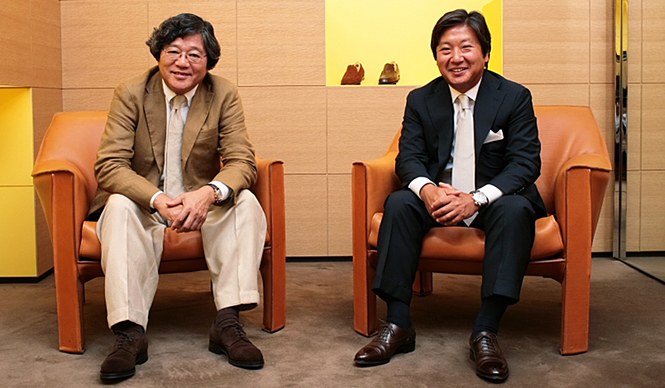
Jiro Ishikawa (1): "Memories of Shoes"
Jiro Ishikawa (1): Editorial Director
Memories of Shoes
Jiro Ishikawa, who was involved in the launch of numerous magazines such as Popeye, Brutus, and Tarzan,
is known as one of the key figures who shaped today's magazine media.
He continues to be active at the forefront of magazine and broadcast media as an editorial director.
In this conversation, we will explore what Jiro Ishikawa thought in his youth, what kind of journey led him to become an editor,
and his enduring memories of travel and shoes throughout his life, across three installments.
First, we will focus on his memories of "shoes," which he has loved since childhood.
The host is Tomooki Matsuda, President of John Lobb Japan.
Text by Daisuke Hata (City Writes)Photos by jamandfix
Shoe Memories Etched by Time
Tomooki MatsudaMr. Ishikawa, I understand you have long had a fondness for shoes.
Jiro IshikawaYes, I remember the feel of the shoes my parents made me wear as a child so vividly. It was after the war, and resources weren't abundant, so they were likely hand-me-downs from relatives. They were black lace-up boots. Tying the laces was a hassle, but the sense of security I felt the moment I put them on, or perhaps a feeling of fulfillment, was something I understood even as a child. I still believe this sense of security is the most important aspect of shoes.
MatsudaYou were interested in them from such a young age.
IshikawaI have many peculiar memories of shoes from my middle and high school years. By the time I entered university, I had become a bit cocky and would go all the way to Futabaya in Ginza to buy shoes. I didn't have much money, so I'd work part-time and spend it on shoes and shirts.
MatsudaIt's impressive that you could go to Futabaya as a university student.
IshikawaIt was the influence of the cocky but well-behaved delinquents around me (laughs). I also had my first experience with custom-made shoes around that time. I had two pairs of side-gore boots made at a shop called Heiwado in Kanda. They cost about 5,000 yen each. At the time, a day's part-time work earned around 600 yen. If I worked on a truck, I could earn 1,000 yen. Considering that, spending so much money on shoes was rather obnoxious for a kid, wasn't it? (laughs)
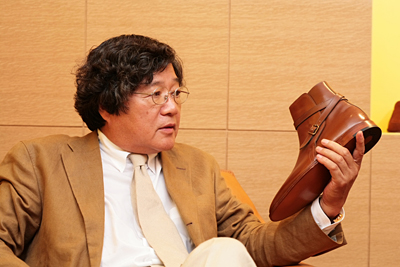
Holding the reissued Jodhpur boots
MatsudaYou've always been stylish, haven't you?
IshikawaI was just interested. Around that time, VAN
(Japan's first fashion brand, launched in 1954. It adapted the fashion popular among students of the Ivy League, a group of prestigious private universities in the eastern United States.
It was immensely popular among fashion-conscious youths in the 1960s)
was popular, and at the same time, information that wasn't available in Japan began to pour in. It was a turning point, transitioning from an era of scarcity to one where goods from around the world became accessible.
MatsudaDid you ever consider pursuing a career in fashion?
IshikawaI didn't think of it as a profession. I didn't think I had the talent. Also, at the time, I actually wanted to be a newspaper reporter. In the end, I became a weekly magazine reporter, though (laughs).
Later, when I was editing the "Made in USA Catalog" (1975), I became engrossed in work boots. I have a memory of going all the way to California to do a feature on Red Wing.
Even Without Money, I Wanted to Glimpse the Adult World
MatsudaWhen did you first become aware of John Lobb?
IshikawaI remember it very clearly. It was in 1969, when I was a rookie editor at the magazine "WEEKLY Hanbai Punch." It was my first overseas assignment, and I went to Paris. I wanted to see the adult world, so I headed to the Rue du Faubourg Saint-Honoré, which I had always admired. As a new editor, I had no money, of course, but as I wandered, I ended up at an Hermès store. And there were John Lobb shoes.
Of course, I had no idea about the relationship between John Lobb and Hermès back then, but I could still sense the aura of English shoes. I stared at them for a long time. I couldn't afford them, so it ended with just looking that time.
Incidentally, the first pair I actually wore was much later, around the time the magazine "Brutus" was launched. I remember the thrill of finally being able to get them!
MatsudaDo you still have that first pair?
IshikawaNo, I don't anymore. It was 25 years ago. But, if I still had them, you would repair such old shoes, wouldn't you?
MatsudaYes. We aim for shoes that can be worn for over 30 years.
IshikawaJohn Lobb shoes aren't exactly easy to buy, but when you consider wearing them for a long time with proper care, they offer good value.
MatsudaThe initial investment is certainly higher, but we are supported by customers who think that way. It makes us happy.
What to Expect from John Lobb's Future
MatsudaWhat do you hope for the future of John Lobb?
IshikawaI hope they remain independent of fleeting trends. While challenging new designs, I hope they preserve the old as they were. Take the Jodhpur boots, for example; they are incredibly classical, yet still truly beautiful today. This is timeless beauty. I heard that they were revived after being discontinued once.
MatsudaYes. As classical style shoes, the order numbers were low, and they were eventually removed from the production line. However, through our efforts, particularly from Japan, we revived them by fitting them onto the popular 7000 last.
IshikawaThat's wonderful. Shoes like these should be preserved. (Looking at them) They look like they'll develop a beautiful patina with wear. I'd love to wear them on rainy days. Although, looking at them like this, I also feel like displaying them (laughs).
Jiro Ishikawa (2): A Life of TravelTo be continued
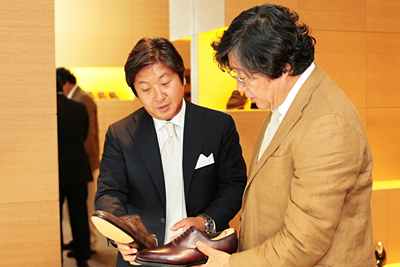
At the Marunouchi boutique
Profile
Editorial Director
Jiro Ishikawa
Born in Tokyo in 1941. After graduating from Waseda University in 1964, he joined a travel agency specializing in overseas travel. He left after two years and joined Heibon Publishing (now Magazine House), becoming an editor in charge of overseas assignments for "Hanbai Punch" magazine.
After working on "Made in USA Catalog," he was involved in the launch of "Popeye," "Brutus," "Tarzan," and "Gulliver," serving as editor-in-chief for each. In February 1993, he left Magazine House and established an editorial production company.
From 1994, he served as a caster for TV Asahi's "Tonight 2" for eight years. He currently appears on the BS Asahi travel program "Asia Kenbunroku."