December 22, 2014
MARGARET HOWELL | Hirofumi Kurino Special Contribution: "The Unwavering Appeal of Margaret Howell"
MARGARET HOWELL | Margaret Howell
Hirofumi Kurino: Special Contribution
The Unwavering Appeal of Margaret Howell (1)
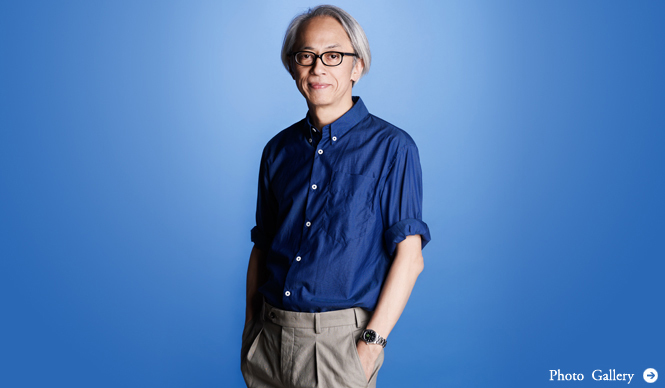
Hirofumi Kurino arrived at the photo studio in a three-piece suit, but quickly changed into this season’s blue shirt and single-tuck trousers that he had requested, and the shoot concluded smoothly. It was only later that I learned his personal tie and backpack were also from Margaret Howell. It is this kind of subtle consideration that speaks to Mr. Kurino’s affection for the brand, and likely why the brand cherishes him in return. Hirofumi Kurino writes about Margaret Howell’s materials, colors, designs, and style.
Text by KURINO Hirofumi
photos by OHMORI Sunao (TABLEROCK. STUDIO)
Simple Beauty and Perfection: Encounters with Exemplary Products
It’s been about 33 years since I started working in the fashion industry. I’ve been involved in buying, in a sense, since the very early days. I’ve also been hands-on in selling those items in stores.
While I’ve been involved in creative direction and management, I truly believe the essence of the fashion retail business lies in “providing excellent products to customers.” And both buying and selling involve “encounters.”
Encounters with wonderful products, and with the brilliant designers who create them. Undoubtedly, “people who make good things are themselves wonderful people.”
“Things” are honest. Just as the creator’s presence can be felt in paintings, sculptures, and even photographs, surely the wearer’s essence is palpable in clothing, in fashion?
I met the late Yves Saint Laurent twice. More accurately, we exchanged nods. Even so, an aura of refinement emanated from Mr. Saint Laurent. Or Paul Smith. Every time I meet him, I sense his humor, much like his clothing. Or Christophe Lemaire. A very kind man, he always invites his grandmother and parents to his shows, letting them witness his work from the front row.
Among these designers, who imbue their work with such humanity, I feel a particular sense of the person in Margaret Howell. In the early 80s, Mr. Osamu Shigematsu (then head buyer for Beams, now CEO of United Arrows) sourced a new brand called Margaret Howell at an overseas exhibition. While the brand was still relatively unknown, not only in Japan but also abroad and even in her native London, we staff at Beams immediately understood the excellence and value of the products she sourced (primarily shirts).
The designs were by no means flashy. In fact, they could be called understated. Yet, the finest shirt fabrics, meticulous sewing techniques like fine gathers, and delicate collar shapes… these were truly products that exemplified simple beauty and perfection.
At the time, the average price for a shirt was around 28,000 yen. My monthly salary was about 100,000 yen, a local lunch cost around 600 yen, and a coffee at a cafe was about 200 yen. You can understand how expensive (!) a Margaret Howell shirt was back then.
Despite the price, the shirts became bestsellers. As mentioned, they were so perfectly crafted that they were comfortable to wear. Moreover, their simplicity made them easy to coordinate; whether paired with a denim jacket or a linen blazer, a Margaret Howell shirt underneath completed the look. They were embraced by many customers who understood and appreciated the quality of the product.
MARGARET HOWELL | Margaret Howell
Hirofumi Kurino: Special Contribution
The Unwavering Appeal of Margaret Howell (2)
So, what is the “something” reflected in Margaret Howell’s products? Compared to other designers, I believe Howell’s products are characterized by their “unchanging nature.” However, “unchanging yet appealing” can be a double-edged sword, especially in fashion. If a brand were to create and offer exactly the same items for 30 years, customers would eventually grow tired of it.
If one were only concerned with wearing them, one could wear the same items for 30 years (my own household is proof of this). However, if one saw the exact same items in stores every season, the desire to purchase would diminish. Therefore, even when we say Howell’s designs are “unchanging,” they are “slightly changed.” But the degree of this “slight change” is so well-judged that each collection feels “fresh.” The collar shape might be the same, but the body balance differs; the same wool might be used, but the weight is different; the same design might feature garment washing… and so on.
And what I feel most strongly after observing Howell’s products for many years is her unique “way of choosing colors.” Her selection of “blue” in particular is her greatest characteristic. It’s a blue that is neither too light nor too dark, elegant, delicate, easy to coordinate, and yet instantly recognizable from afar.
Personally, Margaret Howell’s blue and Comme des Garçons’ blue are my favorite blues. I find myself drawn to them, and as a result, my drawers are lined with double-digit numbers of blue shirts.
“Choosing colors” is a simple act, yet it is the lifeline of fashion. I can imagine Ms. Howell meticulously selecting colors each season with the utmost care. “Not that blue, it has to be this blue. This beige is too grayish; let’s go for a more yellowish beige next season…” I can sense her saying this through every shirt, every jacket in the store, or even through the chairs and art books (which are also for sale) that are not her own creations.
Her careful way of living, her work ethic – this is what I call her “unwavering appeal.” She might be stubborn, but she is not obstinate. She upholds certain things for a reason… That, I believe, is the essence of Margaret Howell’s charm.
Especially now, during a time of great global value shifts, isn't it precisely this unwavering stance that draws people in?
Hirofumi Kurino
Born in 1953. Has been involved in the fashion industry since the 70s as a buyer and director. After working at Szuya and Beams, he co-founded United Arrows in 1989. As one of the founding executives, he held positions such as Senior Managing Director and Chief Creative Officer. He currently serves as Senior Advisor and Creative Advisor, overseeing brand direction for the company.
He also works as a freelance journalist, writing and lecturing. In 2004, he was awarded an Honorary Fellowship by the Royal College of Art in the UK.
Born in 1953. Has been involved in the fashion industry since the 70s as a buyer and director. After working at Szuya and Beams, he co-founded United Arrows in 1989. As one of the founding executives, he held positions such as Senior Managing Director and Chief Creative Officer. He currently serves as Senior Advisor and Creative Advisor, overseeing brand direction for the company.
He also works as a freelance journalist, writing and lecturing. In 2004, he was awarded an Honorary Fellowship by the Royal College of Art in the UK.