
Series: Taishi Nobukuni | Part 14: TAISHI NOBUKUNI A&W 2011-12 ~No More Hip-Hangs, Surely~
Series | TAISHI NOBUKUNI
TAISHI NOBUKUNI A&W 2011-12
Part 14: No More Hip-Hangers
No more hip-hangers. Fashion, like the times, is said to repeat in cycles. So what is coming to an end? I feel it's the hip-hanger. The men's low-slung waist and the women's hip-hanger, I recall, have been with us since the eras of hip-hop and grunge, respectively.
By TAISHI NOBUKUNI
The Tide Turns from Hip-Hangers to High Waists!
When I was a buyer, I was the first to witness the low-slung waist. I bought large quantities of unreleased GAP chinos in size 40 and sold them to B-boys and skaters who were just starting to lower their waistlines.
Around the time Martin Margiela debuted and Björk released her first album. Jean Colonna, for one, created pants with significantly lowered waists. Alexander McQueen, in his debut collection, sent models down the runway in pants so low they barely grazed the hips, revealing just enough to hint at pubic hair. This was 20 years ago. McQueen is no longer with us, and street brands are fading.
The anti-establishment, 'fashion be damned' sentiment has ultimately devolved into cheap fashion, a commodity built on the exploitation of the third world, becoming nothing more than trash.
So why high waists? Firstly, it's simply preferable to have legs that appear longer. However, a merely high waist can make the torso and hips look elongated, so technique is required.
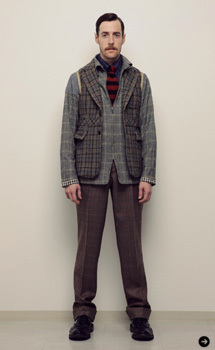
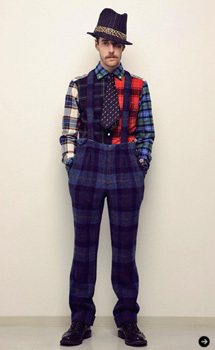
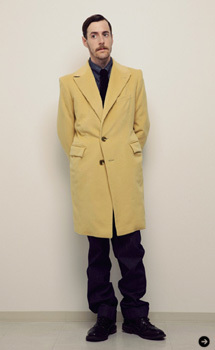
Do you know about 'dress cut'? It sounds elegant, but let me explain. It involves deciding which side of the crotch the male genitalia will rest, and then using cutting techniques to add volume to that side. This results in pants that are extremely comfortable and visually appealing, with a crotch that barely grazes, preventing any discomfort when straddling.
My pants apply such bespoke tailoring techniques to ready-to-wear. The reason for using tailoring techniques is that it depends on which side the wearer prefers. However, since 95% of people prefer the same side, I've boldly applied this technique. We will soon be releasing basic chinos in two standard size expansions, allowing you to choose your preferred side, so please wait a little longer.
For this collection, I was inspired by the 1930s, an era when both men and women possessed an elegance, a time when legs appeared longer. Like the beautifully rebellious bank-robbing couple, Bonnie and Clyde.
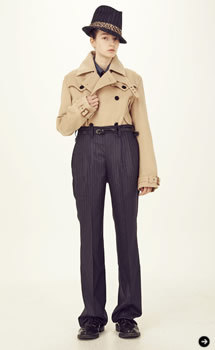
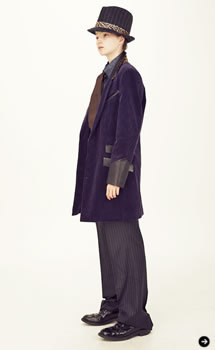
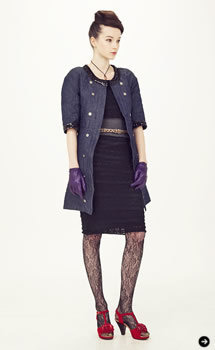
The rise and fall of waistlines, like the size of lapels, are mirrors of the times. Fast suits, not fast fashion, are becoming Dior-esque. In this era, comedians' faces appear larger due to their narrow lapels and shoulder pads. Let us now embrace the余裕 of that elegant era in our lapels. In his book, Mr. Susumu Hattori, who tailors suits for His Majesty the Emperor, compares fashion illustrations from the 1930s and 1960s, stating, 'The 1960s are childlike.'
But I can't accept such nostalgia. Because we came from punk, you see.—You might be thinking that. But seniors, did you know that punks were often high-waisted? Please take a closer look. Surprisingly, punk often featured high waists with braces (suspenders), a classic combination.
The spiral evolution of fashion is fascinating, isn't it? I see Bonnie and Clyde as the Sid and Nancy of their time.
TAISHI NOBUKUNI
http://www.taishi-nobukuni.co.jp/