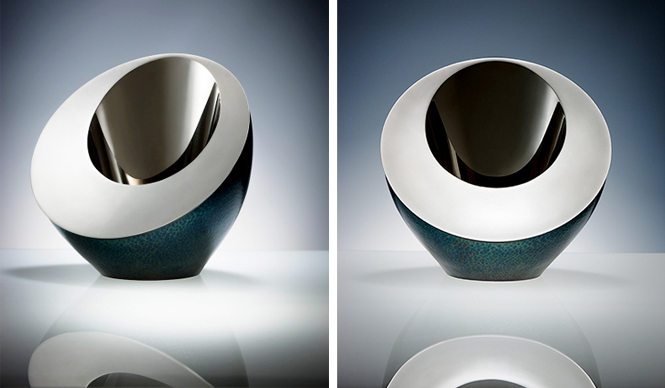
Junji Tanigawa | Series Vol. 6: "Hammered Ware 'Moon'"
Part 6: "Tsuiki Ware 'Tsuki'" (1)
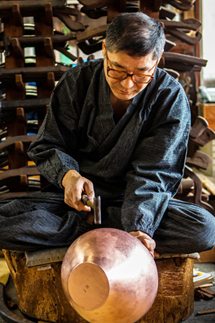
Bottle cooler for champagne house KRUGThis led to my introduction to Gyokusendo, a long-established maker of "Tsuiki" copperware based in Tsubame-Sanjo, Niigata. After successfully completing the work for Krug, I received a proposal from Mr. Tamagawa, the 7th-generation head of Gyokusendo: "I want to create a piece that can convey the pinnacle of Tsubame-Sanjo's metalworking techniques to the world."Tsuiki Ware 'Tsuki'This was the starting point for the "Tsuiki Ware 'Tsuki'" project. I would like to take this opportunity to reflect on the thoughts behind this project and the approach taken to treat it as an art piece.
Text by TANIGAWA JunjiPhotographs by TSUTSUI Yoshiaki
The Two-Year Journey from Conception to Completion of "Tsuiki Ware 'Tsuki'"
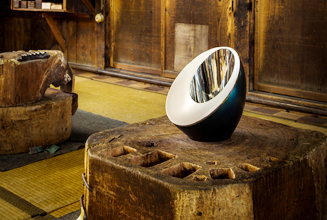
"Tsuiki Ware 'Tsuki'" is inspired by the ceaseless cycle of the moon's phases, weaving the forms of the waxing and waning moon—from full moon to half moon to new moon—into a single shape. The moon's phases, floating in the night sky, have captivated the imaginations of people worldwide since ancient times, spinning countless tales. We chose a universal theme that transcends national boundaries, allowing everyone to share a common image. The result is 'Tsuiki Ware 'Tsuki',' a vessel where the artisans of Tsuiki and the metalworking masters of Tsubame-Sanjo competed in skill, achieving a high-dimensional fusion of craftsmanship and practicality, usable at times as a bottle cooler, and at others as a vase or interior object. The concept of 'Wa' (harmony) originally means to maintain one's core while embracing and harmonizing with others. By softening and refining different materials and techniques, we aimed to weave the spirit of 'Wa' into a tangible form. We selected and combined various traditional crafts and ultimate techniques from across the country to create a supreme handmade piece, not a mass-produced item."
This concept serves as a universal theme for future craft development and a dream I will continue to pursue.
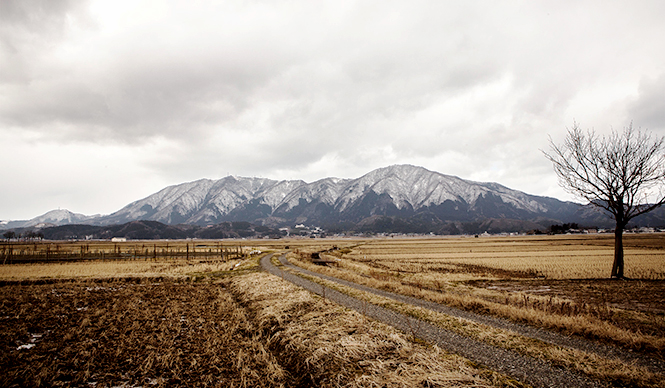
Around this time, I was visiting Tsubame-Sanjo about twice a month. The industrial foundation of Tsubame-Sanjo lies in metalworking, with a world-class level of technical expertise. Originating in the Edo period with the production of "Waku" (Japanese nails) during the farming off-season, copperware also flourished with the discovery of copper from nearby Mt. Yahiko. Today, metal processing is carried out in all fields, and the region boasts a world-leading share, particularly in food-related products. Over 1,000 businesses, large and small, continue production. Tsubame-Sanjo is home to experts in all aspects of metalwork.
From my very first visit to this city, I was deeply impressed and captivated by Tsubame-Sanjo and the world of perfection it embodies. I wondered if it were possible to introduce Japan's proud, supreme craftsmanship to the world in my own unique way. I believe this desire was born the moment I first set foot in this city. It was at this precise moment, when this feeling solidified, that Mr. Tamagawa uttered those words.
Even a superficial reading reveals a significant difference between "industrial products" made as a livelihood and "craft products" made purely for art. Yet, it is not uncommon to see "industrial products," efficiently mass-produced by machines, being compared on the same scale as "craft products," which can only be created by human hands.
Post-war growth was achieved with the goal of material prosperity for all Japanese people. Today, having reached the maturity of this material society, we are beginning to open the door to a new world in search of spiritual richness.
The era when the advent of fluorescent lighting illuminating the world was a sign of recovery and progress has passed. As the phrase "In Praise of Shadows" suggests, we are now in an era that values the emotions evoked by light and shadow, and the significance of empty space. It is an era of creating lasting value, rather than just continuous new creation. Everyone is beginning to recognize the importance of this perspective. This project began at precisely the same time as this growing sentiment.
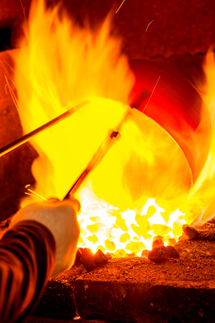
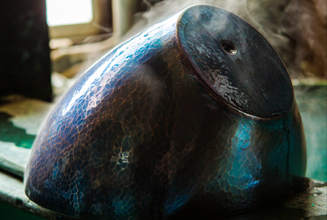
When translating the moon's phases into a design, the expression required the combination of different materials, which would be difficult with Tsuiki copperware alone. The front part, creating a sharp and solid impression, was formed by casting. This part was polished to a mirror finish, creating a perfect reflection. Techniques such as blast processing, intentionally frosting parts with fine sand, were also incorporated, ultimately leading to a collaborative structure involving six companies. The completion of this piece took approximately two years.
Global Communication as Art Pieces
Part 6: "Tsuiki Ware 'Tsuki'" (2)
The "New Value" Challenged by the Realm of "Craft"
Industrial products recoup their production costs through mass production, but craft products cannot do so.
We focused on the established practice in the contemporary art market of guaranteeing rarity through "editions." We considered whether this method of value creation could be applied to craft products.
The conventional distribution method in the world of manufacturing typically involves passing through wholesalers to local retailers. For this work, we considered that changing the distribution channel might be effective in reaching discerning audiences. Through acquaintances, we approached contemporary galleries overseas, and simultaneously launched a new website, developing a channel for direct contact with Gyokusendo.
What kind of land do the creators of 'Tsuki' inhabit? What context gave rise to such a work? What joy arises from incorporating this piece into one's life? While firmly believing that the creation of intangible value, beyond tangible worth, is the greatest power of craft, we have also incorporated the communication of its story to form the context of this project.
I was surprised to see demographic projections for the period after the Tokyo Olympics, when I myself would be entering middle age. As is widely known, the population will decrease, and the aging of society will accelerate even further. Of course, I sincerely hope that Japan will become a society where stylish and vibrant elderly people fill the streets, enjoying their leisure time after stepping down from their careers.
However, I do not believe that a world with such余裕 (leeway/comfort) awaits. The reduction in the workforce will result in more than just a loss of tax revenue. In a sense, a true opening up to the world may be waiting. Surely, work and the global framework will become different from what they are now.
Amidst such a period of great change, Japanese crafts are at a critical juncture. With issues of traditional succession, market challenges, and workforce shortages, I feel that the only way to survive is to change while continuing to create. If traditional techniques are lost, it will take 50 to 100 years to revive them. I sense a comprehensive crisis situation.
Branding Tsubame-Sanjo's Manufacturing
Part 6: "Tsuiki Ware 'Tsuki'" (3)
Branding the Excellence of Tsubame-Sanjo's Manufacturing
Japan does not possess abundant resources. Nevertheless, it is home to many manufacturers that dominate the global market. The aesthetic sense woven into the functionality of objects, and the beauty of their creation process, captivate those who appreciate true quality.
"Quality" in manufacturing is Japan's lifeline. The Japanese context captures the hearts of those who own these products. When craftsmanship nurtured in such a place crystallizes into something that everyone instinctively accepts, and when something else is added to it, I believe that trust, which we call "brand," is born.
From this perspective, I believe I am strongly drawn to the brand potential of the Tsubame-Sanjo region. With this in mind, I hope to use 'Tsuki' as an opportunity to shed light on Tsubame-Sanjo in the field of industrial tourism, and new initiatives are already underway.
I considered what lies beyond the experience of "seeing things, encountering things." I feel that tracing back to the source, a "journey" to the production site, will become the most valuable luxury consumption in the future.
With expanding networks and the omnichannelization of logistics, almost anything can be obtained from anywhere. That is precisely why "travel" is important. I want people to experience the energy of the land by carrying their souls within the vessel of their own bodies. The joy of being able to say, "I've been to authentic Tsubame-Sanjo," and the admiration of others. The Shinkansen, the world's highest quality means of transport, can take you safely and securely from Tokyo to Tsubame-Sanjo in just two hours.
In summer, the Niigata area, known for its famous rice from Yuzawa, Minami-Uonuma, and Muikamachi, also produces a wealth of high-quality vegetables thanks to its rich soil. It is also a paradise for sake lovers. In winter, leveraging the heavy snowfall of over 5 meters, the region attracts fans from all over the country as a winter resort. The inner parlor of this Niigata region, enjoyable from different perspectives throughout the year, is the sacred ground of manufacturing: "Tsubame-Sanjo."
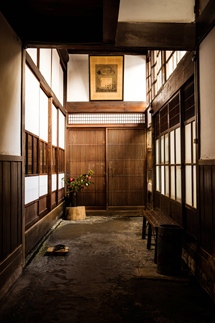
On my previous journey to Krug, I visited the Champagne region many times. A short drive would reveal vineyards stretching as far as the eye could see. Back in town, world-renowned champagne houses lined the streets. Numerous auberges were scattered throughout the area, offering a travel experience where one could enjoy not only all kinds of champagne but also the perfect food pairings during their stay.
I wished such a journey were possible in Japan. Now, several years later, I believe that this journey will indeed take shape in Tsubame-Sanjo.
I believe that the narrative of a journey, woven from tangible objects and experiences, is the true treasure and goldmine of 21st-century Japan. It is only when people feel needed that they can strive and continuously improve. Having personally experienced the difficulty and importance of making things known, I am determined to carve out a path steadily, even if it means getting a few scrapes along the way.
Indeed, the factory tour event "Tsubame-Sanjo Factory Festival" attracts many participants from all over the country, creating a vibrant atmosphere. I believe it is a great opportunity to experience the potential and possibilities of this region, and I highly recommend visiting.
As the phrase "Quality of Life" suggests, people work to enrich and fulfill their lives. The Chinese character for 'work' (働く, hataraku) is composed of the radical for 'person' (人) and the verb 'to move' (動)."
In other words, working means moving for others, and as a result, one is sustained. This is the nature of human society. Regardless of monetary exchange, the motivation for people to do something stems from being useful to someone. This has been true for me, and I believe it will continue to be so.
What can I do in the time I have left for the next generation? As I approach my 50th birthday, I want to think deeply about this once again.
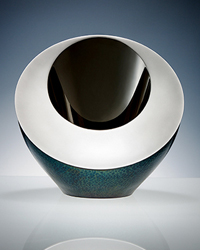
Tsuiki Ware 'Tsuki'
Size | W27 D22 H26cm
Weight | 7.5 kg
Material | Copper, Stainless Steel
Price | ¥450,000 (excluding tax, domestic price)
http://www.tsuikiwaki.jp
Order Inquiries
Gyokusendo
Tel. 0256-62-2015
Fax 0256-64-5945
info@gyokusendo.com