MONTBLANC | Limited Edition
MONTBLANC
New Release in the "Great Characters" Special Limited Edition Series
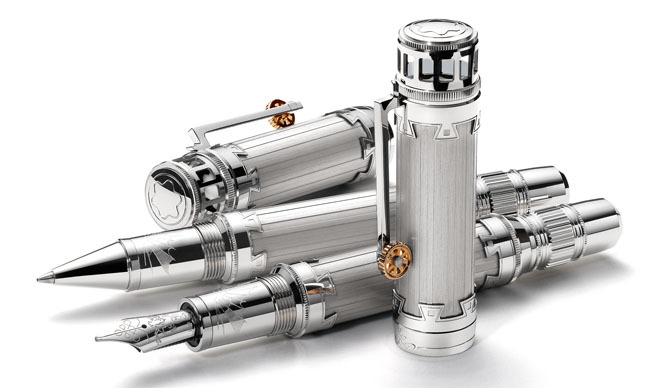
Introducing the "Limited Edition LEONARDO 3000"
Following Alfred Hitchcock in 2011 and Einstein in 2012, 2013 honors Leonardo da Vinci, hailed as the "universal genius."—Montblanc's "Great Characters" writing instruments are crafted to celebrate historical figures who have profoundly influenced human culture, thought, and life itself. The latest addition, the "Limited Edition LEONARDO," has now been unveiled.
Text by KAJII Makoto (OPENERS)
Expanding the Possibilities of Writing Instruments
This year's Great Character, inspired by Leonardo da Vinci, the "Limited Edition LEONARDO" collection comprises a limited edition of 3,000 fountain pens and rollerball pens, along with a highly exclusive fountain pen limited to just 74 pieces (scheduled for release in January 2014).
Fragments of da Vinci's written works, discourses, and the logic behind his great inventions are subtly and organically woven into the design, creating details where the concrete and abstract interplay. These elements are balanced with dynamic lines, capturing the essence of da Vinci's spirit and encapsulating the enigmatic allure of this historical figure within these limited edition writing instruments.
Montblanc Depicts Da Vinci's Unfinished Dreams
The rotating gear, finished in red gold and adorning the clip of the "Limited Edition LEONARDO" as an accent, is inspired by the gear drive, a fundamental element of da Vinci's inventions. The fountain pen nib (750 gold) is engraved with the image of a bat with outstretched wings, and the cap of each writing instrument features a sketch of a flying machine's wing.
The fittings that define the cap and body of the "Limited Edition LEONARDO 3000" are shaped after the silhouettes of wedges and gears found in da Vinci's original sketches of flying machines and mechanical devices. While mechanical in nature, they evoke the gravitas of the transition from the Middle Ages to the Renaissance.
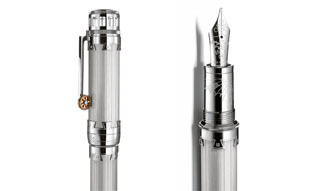
Great Characters Limited Edition LEONARDO 3000
Fountain Pen (Nib M)
Price: ¥379,050 (Limited to 3,000 pieces worldwide, released November 2013)
Rollerball Pen
Price: ¥339,150 (Limited to 3,000 pieces worldwide, released November 2013)
Montblanc Ginza Main Store
Tel. 03-5568-8881
http://www.montblanc.com