Knife Sharpening: "Buy a Knife, Take it Home!" | DESIGN
Series | For OPENERS from PLEASE.
Knife Sharpening: "Buy a Knife, Take it Home!"
The words "Japanese Sword Sharpening" caught my eye in Asakusabashi. What is a "Japanese sword" in modern society? What is "Japanese sword sharpening"? I decided to conduct an impromptu interview with Yasumasa Nagaoka of "Nagaoka Japanese Sword Sharpening."
Photograph and Text by KITAHARA Toru
"Swords exist not as weapons, but as cultural artifacts."
The encounter happened right before me, at walking pace.
I was walking briskly from Asakusabashi towards Okachimachi. Without a specific direction, I turned a corner and only the words "sword" and "sharpening" remained in my mind. I had heard from the president of "Morihei" in Asakusabashi (featured in PLEASE 5) that this area had many shops related to blades. So, I assumed this shop was also a remnant of the old town and walked past.
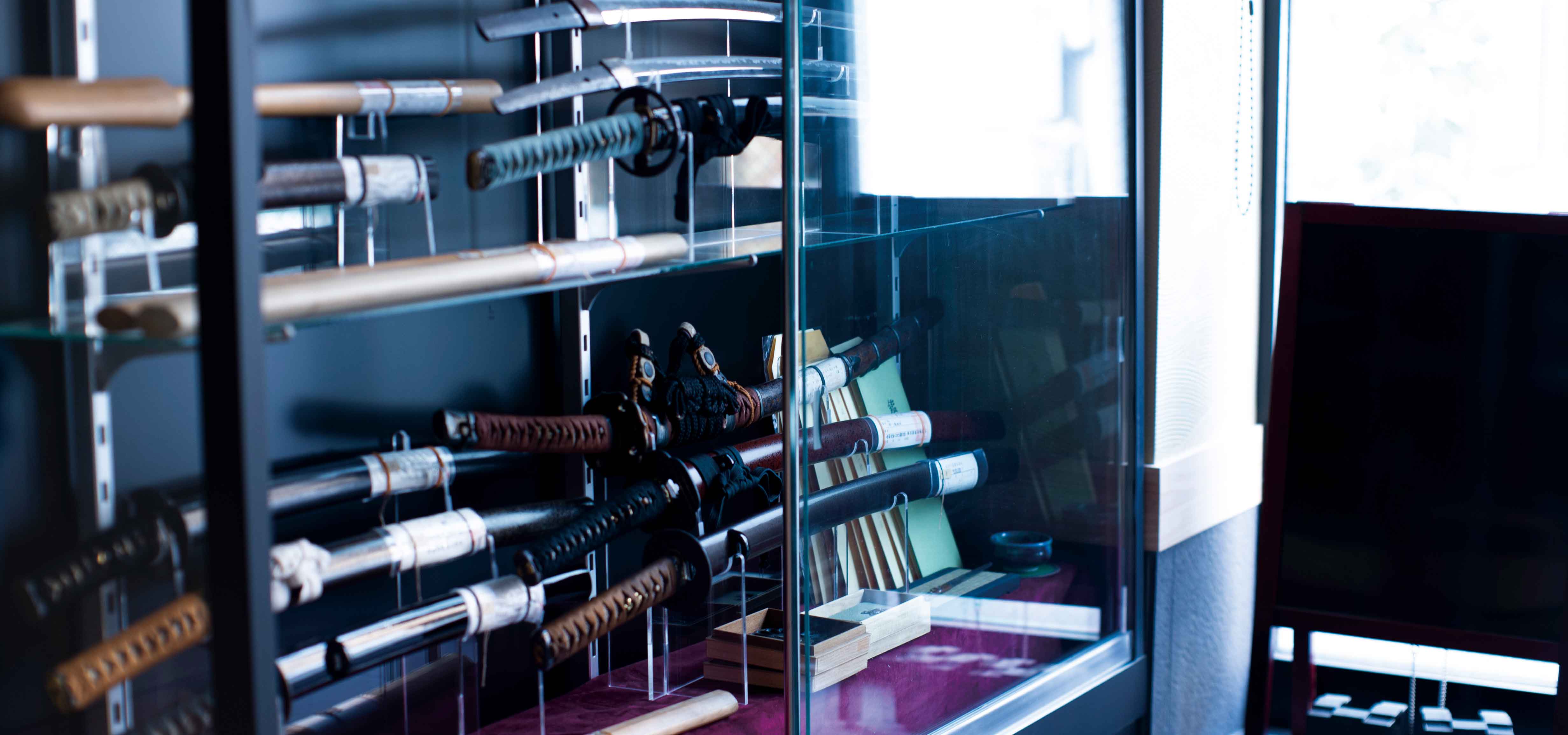
But I became curious, turned back, and peeked inside. The whiteness of about a dozen displayed swords remained dazzling in my mind. It was certainly an intriguing presence.
In modern times, even sharpening kitchen knives is barely a viable business, so I wondered if sharpening swords could even be a profession? Would the hamon (temper line) continue to spread? (laughs)
Therefore, I decided to knock on the door of this mysterious world of "sword sharpening," eager to see the "hamon."
Before visiting, the first thing that came to mind was that the profession of sword sharpening, even today, might be passed down through generations, with terms like "secret transmission" and "oral tradition" coming to mind. I imagined it was a family business that had been sword sharpeners for generations.
"Nagaoka Japanese Sword Sharpening" is where Yasumasa Nagaoka sharpens Japanese swords, bringing out their beauty. The glass-fronted shop is open for anyone to casually view at any time. They also sell Japanese swords. Because of this, even high school students interested in swords sometimes visit.
After a brief greeting with Nagaoka-san, as we stood before a sword, he delivered a surprising opening statement.
"You can buy a sword here today and take it home."
I was taken aback. "What? What did he say? Isn't there the Firearms and Swords Control Law?" I thought.
"I can see it in your face – you're thinking about the Firearms and Swords Control Law, aren't you?"
Was Nagaoka-san a psychic? Did he possess mind-reading abilities? For the record, Nagaoka-san's title is sword polisher (touken togi-shi), and he was by no means psychic.
"Everyone needs to start from that understanding, otherwise the conversation won't make sense. In other words, swords exist not as weapons, but as cultural artifacts."
Even to buy a hunting rifle, you have to go to the police, take a course, get a license... it's a cumbersome process to acquire one.
"While firearms are under the jurisdiction of the police, swords are under the jurisdiction of the Agency for Cultural Affairs, so they are traded as works of art. Therefore, as long as you have the 'legitimate reason' to buy and take it home, you won't be arrested by the police, and there's no problem possessing it at home."
Of course, if you carry it around with the intent to harm, or carry it around unnecessarily (perhaps like carrying a knife because you never know when a fight might break out?), then it can lead to arrest under the Firearms and Swords Control Law.
It's best to think of swords not as weapons, but as works of art. For this reason, each sword has a registration certificate, and it is mandatory to keep and carry this together. Of course, swords are primarily for appreciation, not self-defense, in modern times.
Furthermore, it is said that even during the Sengoku period, swords were not used in the way depicted in manga and movies. Swords were meant to intimidate opponents; in reality, it was more about striking than cutting (so, "tataki kiru" - to strike and cut - is correct, isn't it?). Actual combat involved more punching and kicking than using a sword, and given the visible strength of the forces, opponents would surrender quickly. (Apologies, this writer is weak on history.)
In particular, the swords that remain today have likely not been used to cut or be cut by people. This is because cutting would damage the bone, cause bending, or chip the blade, and the swords themselves are not that strong as weapons.
Hearing this, I thought, "Ah, swords are like symbols of peace." They remain today precisely because they escaped battle.
So, why sharpen such swords? The reason was very simple.
"There are also sharpenings intended for actual cutting. These are used in iaido for cutting tatami mats (which is probably what was used when Sadaharu Oh developed his one-legged stance!). For these, the focus is on sharpness rather than beauty, so the sharpening process is prioritized. For display pieces, beauty is prioritized. The former involves grinding down the metal blade to improve sharpness, but the latter involves removing scratches and rust while considering the intentions of the sword's creator. The key is not to reduce the metal. Since we must also consider preservation as cultural artifacts, sharpening is kept to a minimum, and the focus is on polishing."
I see. So, the difference between a practical item and a work of art dictates the sharpening method.
I asked about something that had been bothering me: how the creator's intentions are reflected in the sharpening.
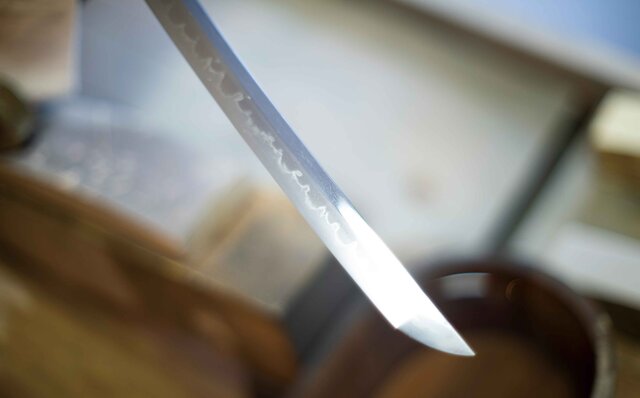
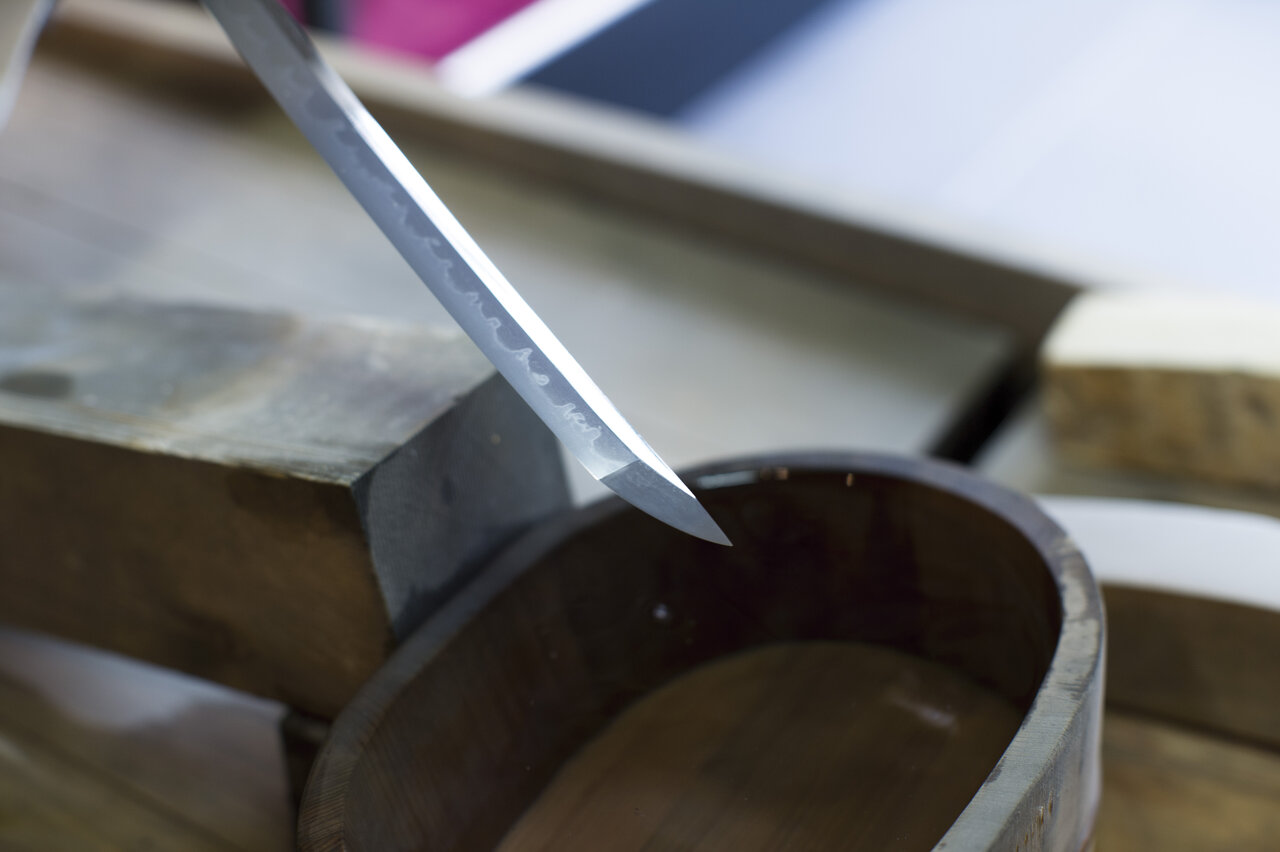
"The hamon differs for each sword, doesn't it? As you can see if you look closely, each hamon has its own characteristics. There are patterns depending on the era, the maker, and the school."
Hearing this, I vaguely thought that perhaps the hamon appeared naturally when sharpening due to differences in metal quality. It seems my understanding was somewhat mistaken. Nevertheless, I believe the beauty of the hamon is the greatest pleasure in appreciating a sword.
This "hamon" can be created by the sword smith's intention. Nagaoka-san explained it to me, but I still don't quite understand. To put it very simply, it's created during the quenching process (heating in fire and then plunging into water with a 'hiss' to harden the blade and simultaneously create the hamon). During this quenching, clay is applied to the blade and then fired. By varying the thickness and type of clay in different areas, the hamon can be intentionally created. However, this also feels like a matter of pride for a craftsman. While the tang (nakago) has the maker's name, it's hidden by the handle. So, perhaps they left their artistic signature in the form of the hamon on the visible blade.
Before I could see the sharpening, I cautiously asked: living in a town with many blade shops, and it being a secret family tradition?
"No, no, I was a salaryman at first. I studied genetic engineering at university and worked for a pharmaceutical company, checking things like the Pharmaceutical Affairs Law (now the Pharmaceuticals and Medical Devices Act). At the same time, I handled brochure creation myself, taking photos and writing copy (which sounds a lot like how PLEASE is made). Then, the photos in the brochures were praised, and I transitioned into photography. I worked in advertising photography, focusing on product shots. Eventually, I had the opportunity to photograph swords, which I loved, and I started thinking about how I would photograph them myself. This led me to pursue sword sharpening. Each career change took about ten years, but this is the longest one, isn't it? My current job."
My photography skills were self-taught, or rather, I became a professional through the act of taking pictures, but surely you followed a path of apprenticeship for sword sharpening?
"No, no. First, I just tried it, sharpening the swords I had, searching for whetstones, and figuring out which ones worked. I'd occasionally ask other professionals, but it was mostly self-taught."
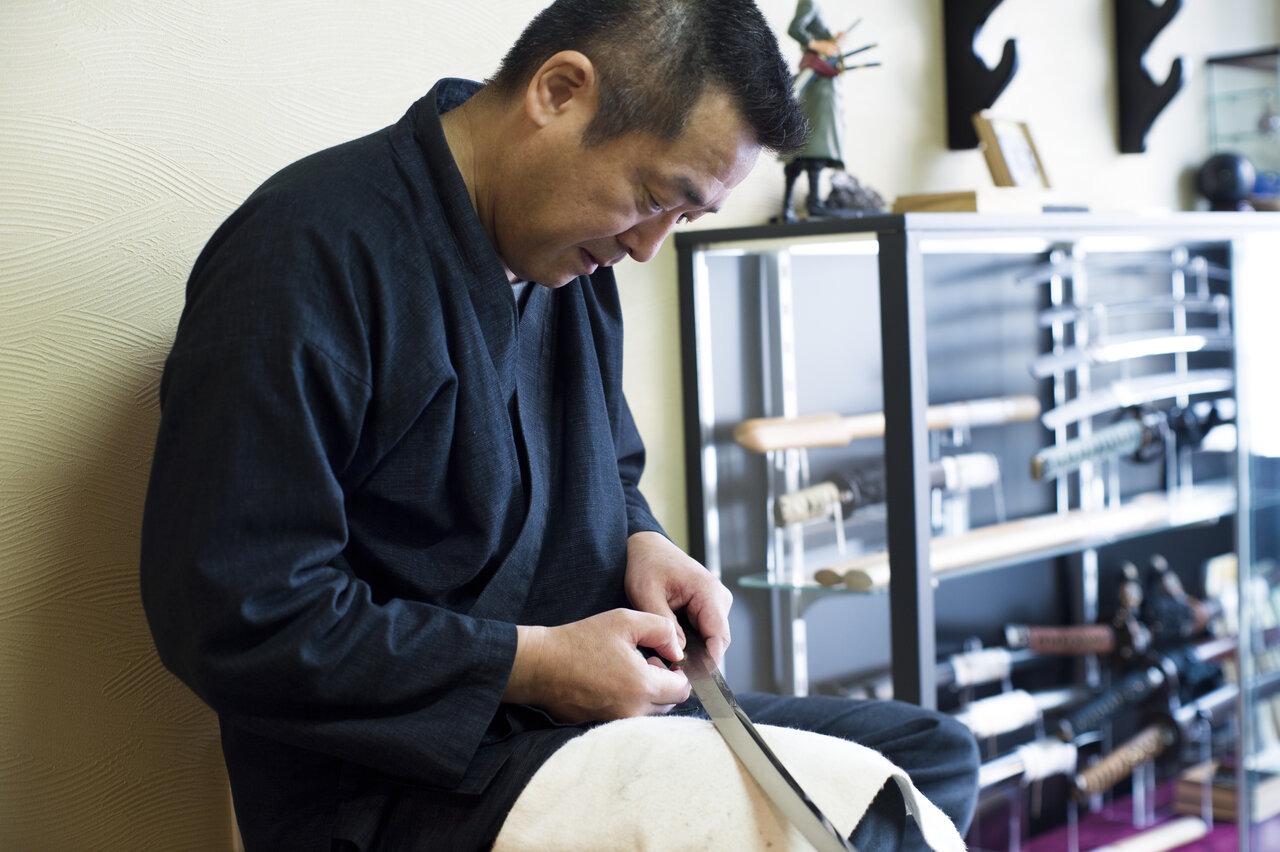
He blended perfectly into the town of blades, and his gaze upon the Japanese sword's edge captivated my eyes as a passerby. He had a wonderful presence.
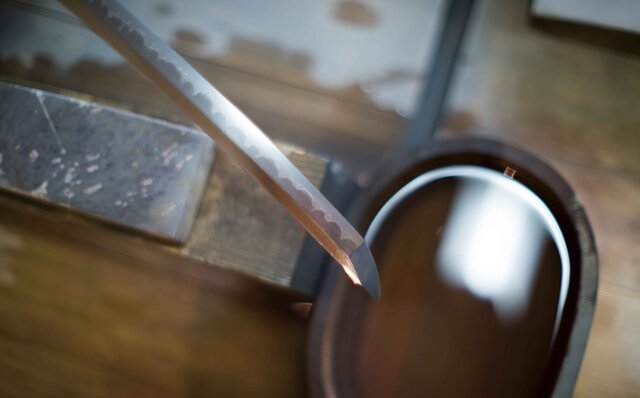
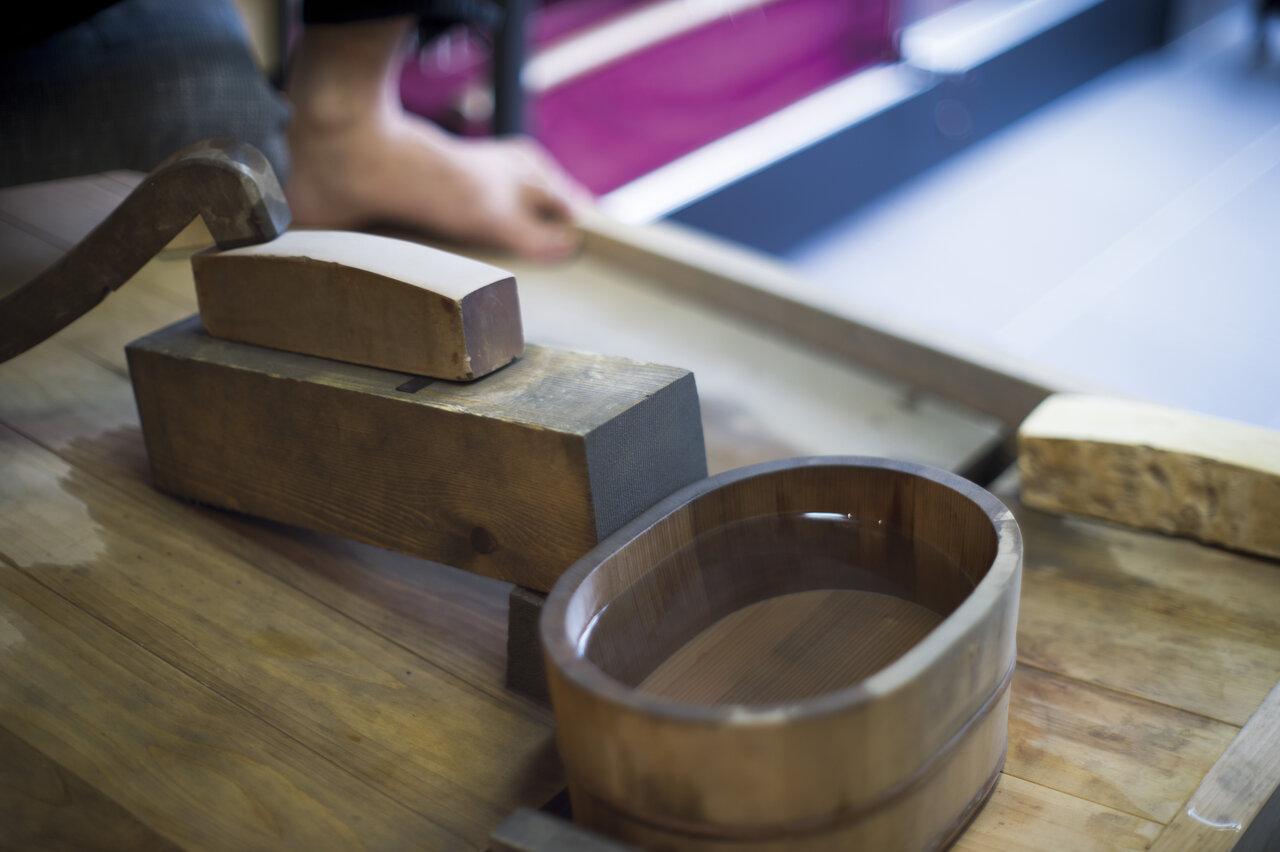
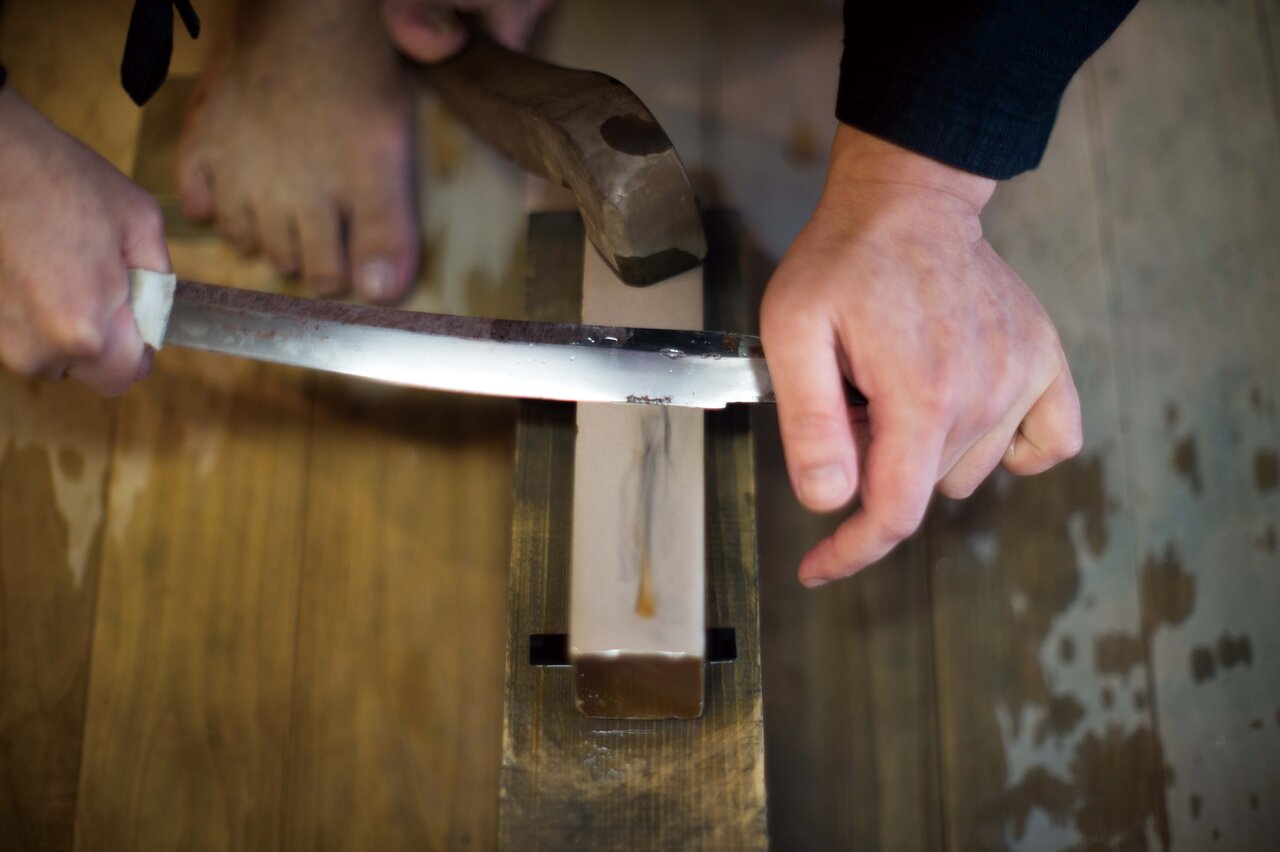
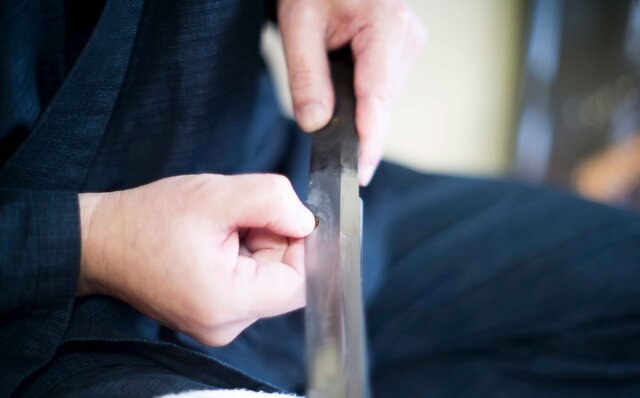
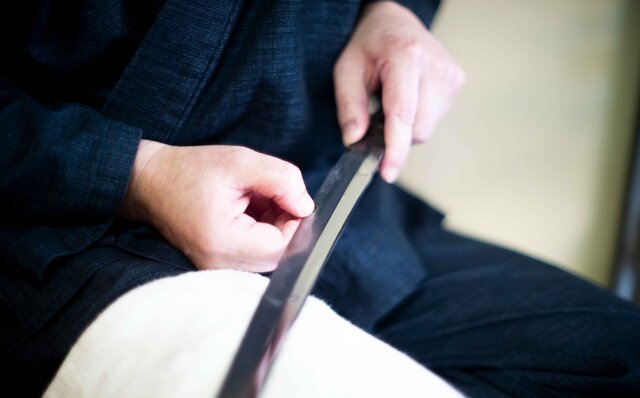
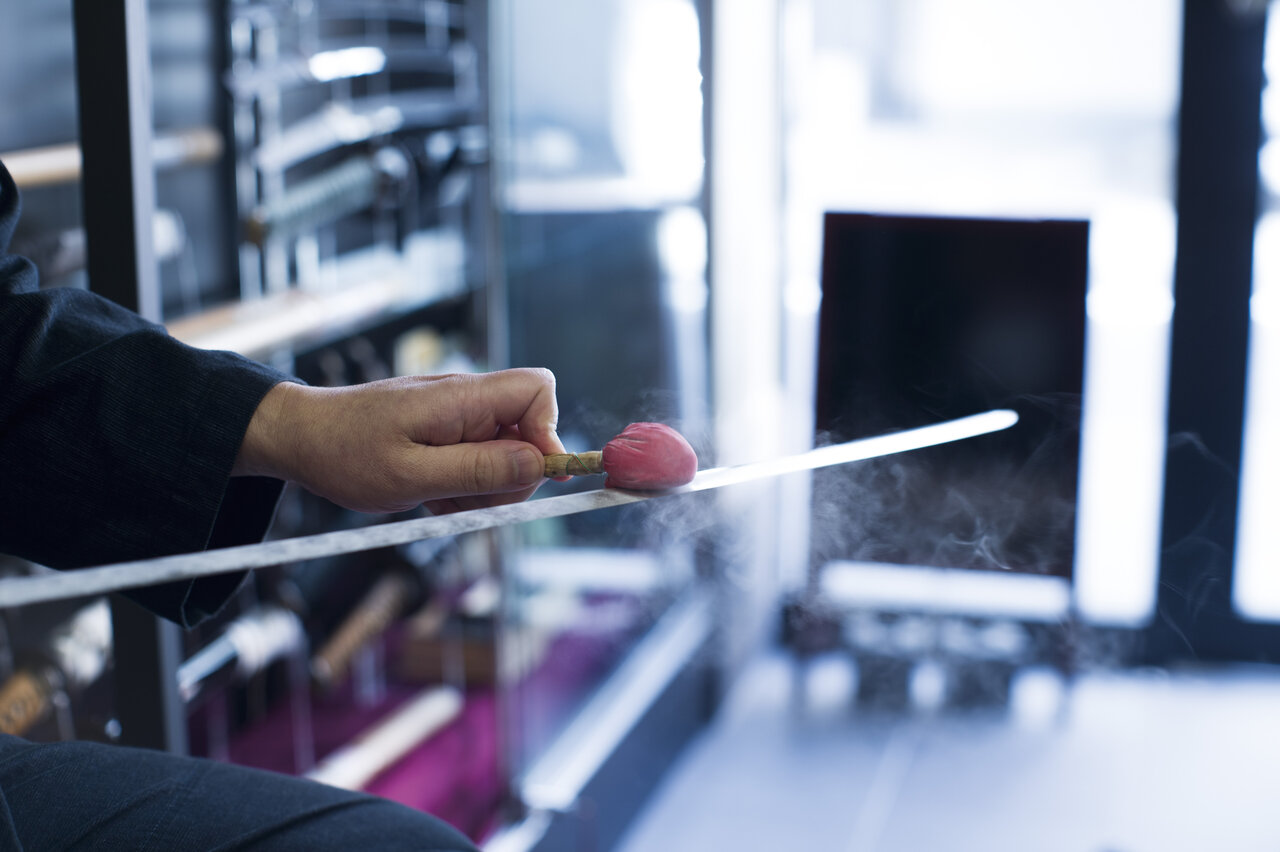
From that presence, he quietly worked the abrasive powder, and then he showed me the sharpening process.
When there are large rust spots, or for new swords sent from the smith (without an edge), the process starts with a coarse whetstone, grinding with considerable force. However, for swords with a white edge, it seems they shouldn't be sharpened too much. This is because sharpening, by definition, removes metal. If the metal is reduced, the sword will eventually become diminished!
"There are sharpenings for cutting, such as for iaido, but what I do is for display. For display pieces, it's about how to make them look beautiful, how to bring out the hamon I envision, which is different from so-called 'sharpening.'"
Nagaoka-san said. As I watched the final finishing touches, he carefully peeled away the layers of the whetstone and adhered it to paper with lacquer (urushi). Why lacquer?
"If you use adhesives like animal glue (nikawa), they are too hard and can cause the whetstone to break. Lacquer, however, has a suitable elasticity and is less likely to break."
As he said this, he glided the whetstone over the blade's surface with his thumb, almost silently, in a motion that could be described as rubbing or caressing.
It felt like the opposite of dynamic sharpening, but this meticulousness and delicacy polished the beautiful blade.
A long time ago, I was in New York. The father of the house where I was staying in a B&B called out to me one night, "Hey, Toru." When I approached him, he was gazing at a Japanese sword. "Toru, It’s beautiful," he whispered, lost in ecstasy. Perhaps he also wanted to say, "Japan creates such beautiful things; live your life with pride."
I realized that Japanese swords are loved around the world in this way.
Someday, I want to buy a beautifully polished Japanese sword and take it home.