Discussing Photographic Expression with Photographer and Artist Joy Kawakubo (Part 3) | Makoto Tanijiri Dialogue
Makoto Tanijiri x Joy Kawakubo Dialogue
In Conversation with Photographer and Artist Joy Kawakubo on Photographic Expression (3)
The Direction of Expression Born from Communication and the Individual
This is the third installment of a dialogue between architect Makoto Tanijiri and Joy Kawakubo, a rising photographer and artist known for unique projects such as the installation and nuclear power plant series "The New Clear Age." In this final part, they discuss photography and architecture.
Photographs by SUZUKI ShimpeiText by KAJII Makoto (OPENERS)
What is the State of Solitude?
Makoto TanijiriThe atmosphere and sensibilities in the worlds of photography and art must be quite different, wouldn't you say?
Joy KawakuboI was shocked by the sheer number of people with monstrously unique sensibilities in the art world. As I mentioned, my photography is a solitary endeavor; I go to the shooting location alone with earplugs, and I develop the prints alone. I enjoy solitude because it allows me to perceive many things within myself.
TanijiriThat must be a state of intense concentration. I enjoy being with people, but I also maintain a detached self that observes from above. For instance, at a live concert, I might find and appreciate a sense of solitude within the crowd. I'm drawn to the quiet within overwhelming noise. I like falling asleep listening to loud music through headphones; there's a certain comfort in that for me. It's like searching for solitude.
KawakuboSolitude is relative, not absolute. It's a kind of sober, special state.


Alignment Between Thought and the World
TanijiriYou have a unique career path, Kawakubo-san, and your wife is very understanding, isn't she?
KawakuboShe says she doesn't understand much about art, but she supports my work and wants me to succeed.
TanijiriPerhaps being close to you makes her more attuned to art.
KawakuboDo you take photographs, Tanijiri-san?
TanijiriI don't understand camera mechanics well; I just press the shutter. However, I think a lot about 'how this should be photographed.' I consider the shot, the composition, and the angle before pressing the shutter, but what's important is whether it aligns with my own thoughts.
KawakuboThat alignment between what you're thinking and the world is the most difficult thing.
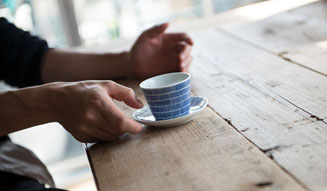
TanijiriTalking with you, Kawakubo-san, I've realized I'm trying to 'photograph architecturally.' I believe it's essential to capture architecture not just as a landscape but as a space, considering its context and the passage of time. For example, I might see this table as a landscape, the coaster as the site, and the teacup as the building. I like photographs that capture space.
KawakuboI wonder how many people photograph with that level of consideration. But it's a fundamental way of thinking.

Composition Reflects the Entire Personality
TanijiriI want to at least get the composition right. I often tell my staff, 'Someone bad at photography (composition) is bad at design' (laughs). If you're bad at placing a building on a site, you can't create space. Composition reflects the entire personality. What are your thoughts on composition, Kawakubo-san?
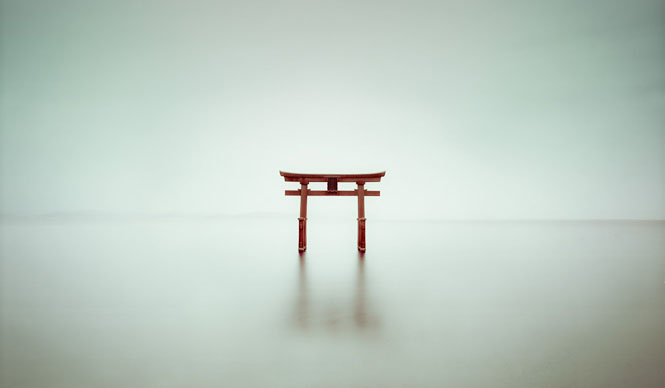
KawakuboOf course, I have my own approach to composition, but it's self-taught and based on intuition. As you can see from my photos, I often use what's called the 'hinomaru' composition—placing the subject in the center—and a symmetrical composition with the horizon in the middle, which is typically frowned upon in Western classical painting (laughs). But I aim to enhance the sense of centrality with the hinomaru composition.
TanijiriI see. Hearing you explain it makes it much clearer.
KawakuboI believe both photography and architecture are forms of communication. What are your thoughts on the 'verbalization of architecture,' Tanijiri-san?
TanijiriI used to find what previous architects said incomprehensible (laughs). I thought they were all brilliant, but perhaps that was because they were discussing things I didn't understand, making them seem impressive. Building architecture socially requires social engagement, yet architects' language is often inaccessible. I figured laypeople wouldn't understand architectural writing, so I decided to become a 'translator' who could make it interesting for anyone to listen to.
KawakuboA kind of revealing the trick?
TanijiriBy becoming a translator, I hope to foster more people who engage with architecture. Rather than hiding the intentions behind things, I want to make them open. I aim to break down the rigid image of architects.
KawakuboYou have a very healthy way of thinking, Tanijiri-san.
TanijiriI'm interested in the gray areas. While life and art might seem distant, I'm drawn to the intermediate spaces where something feels 'artistically remarkable within everyday life.' I believe such things still exist in the world.
KawakuboWhat kind of things do you mean, for example?
TanijiriUltimately, I want to witness the 'moment a table becomes a table.' I believe we live in an 'age of discovery,' where anything can be researched, obtained, or seen. However, the realm of new invention is very narrow; if you invent something, you become a pioneer. While architecture is typically built with roofs and windows, I constantly consider the design to define the boundaries of what is considered 'ordinary.' What are your thoughts on 'verbalization,' Kawakubo-san?
KawakuboLately, I've been pursuing non-verbalization. My personality changes depending on whether I'm speaking Japanese or Spanish. Japanese feels more logical, while Spanish is more intuitive.
TanijiriThat's fascinating. You mentioned wearing earplugs to become 'an individual,' Kawakubo-san. I'm curious about where I would go in such a state.
KawakuboPlease come see my work again sometime.
TanijiriThank you for your time today.
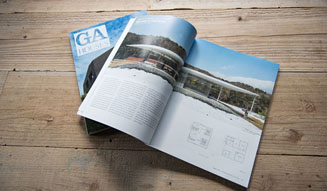
Joy Kawakubo's Photographic Project "The New Clear Age"
What Should Be Left for Tomorrow's Japan? – Crowdfunding
The project "The New Clear Age," which photographer and artist Joy Kawakubo has been working on since 2011, documents Japan's existing nuclear power plants using a large-format (8x10 inch) film camera.
Kawakubo states, "As someone living in Japan in this era, I want to record the facts about Japan's current energy situation, the nuclear power that underlies it, the handling and ethics of nuclear power itself, and its justice, and preserve them through methods and perspectives different from the media." He continues to shoot with the hope that Japan's future will be a little brighter.
The target amount for the expedition (shooting) expenses for this project was reached within the first three days, but support is being accepted until June 15 (Monday) for locations at four other sites across the country.
Crowdfunding
https://greenfunding.jp/micromecenat/projects/1043