A Conversation with Photographer and Artist Joy Kawakubo on Photographic Expression (2) | Makoto Tanijiri
Makoto Tanijiri x Joy Kawakubo Talk
A Conversation with Photographer and Artist Joy Kawakubo on Photographic Expression (2)
On the "Fear within Serenity" Felt in Kawakubo's Photographs
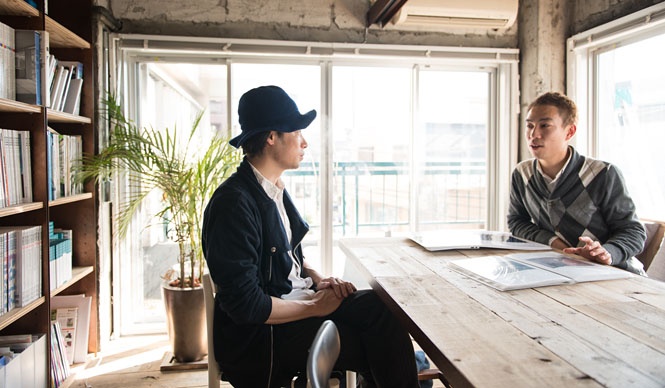
Architect Makoto Tanijiri was keen to meet photographer and artist Joy Kawakubo after seeing his work. Born in Spain, Kawakubo primarily uses an 8x10 inch large-format film camera, focusing on themes of nuclear issues and the disaster-stricken regions of Tohoku, while also engaging in unique installation art.
Conversation with Photographer and Artist Joy Kawakubo on Photographic Expression Vol. 1
Photographs by SUZUKI ShimpeiText by KAJII Makoto (OPENERS)
What Do I Want to Do?
Makoto Tanijiri (hereinafter, Tanijiri)Tanijiri: Your profile so far, which we discussed last time, was very interesting. One thing I wondered about is how you balance making a living by selling your photographs with pursuing what you truly want to do, regardless of money.
Joy Kawakubo (hereinafter, Kawakubo)Kawakubo: What has repeatedly interested me in my life is linguistic philosophy and neuropsychology. I like the meta-structure of "thinking about the brain with the brain," and I became interested in how that applies to the photography I do.
Many characterize 20th-century philosophy as an "linguistic turn," with Ludwig Wittgenstein at its center. Wittgenstein's philosophy is famously represented by the *Tractatus Logico-Philosophicus*. For example, it states that "the relationship between a picture and the landscape it depicts cannot be expressed in the picture itself." This could also be said for photography: "the relationship between a photograph and reality cannot be expressed (explained) in the photograph." So, what should be done?
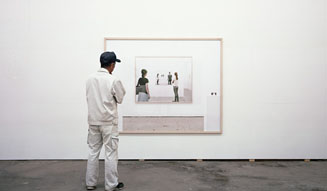
So, I began creating photographic installations where I would set up an invisible camera at the venue, and the viewer (photographer) would become the subject. It's an expression that considers my own transparency while acknowledging that I cannot see myself with my own eyes.
TanijiriTanijiri: I see. Was that the next stage, around 2012?
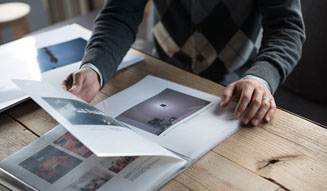
KawakuboKawakubo: Yes. After doing installations, I became engrossed in conceptual work. In my piece "The colossus drive and the black sun," I first took a photograph of a solar eclipse, scanned the film, turned it into data, and when opened in Word, it became garbled hexadecimal characters. I then printed these and exhibited them, asking, "What is data?"
Additionally, for the work "Bright Darkness," I created an experiential installation based on the feeling of darkness I experienced when I got lost while shooting in Dartmoor National Park in the UK.
Photography Without Images: The Ultimate Landscape
TanijiriTanijiri: So, all your works and installations are based on your own experiences, aren't they?
KawakuboKawakubo: When I considered the "ultimate paradise," photographs felt too concrete, and I felt my own photography was getting in the way. I thought that photography without images might be the ultimate landscape. So, when I went to take photos, I recorded binaurally using a condenser microphone placed inside my ear.
TanijiriTanijiri: That's a sound installation, then.
KawakuboKawakubo: Exactly. I recorded the process from carrying camera equipment, deciding on the location, loading the film, to pressing the shutter. Then, I played it back through special headphones. Viewers imagine the landscape by listening to the sound. The film I shot at that time was exposed to light on the spot, so when developed, nothing appeared on it. It's a work that relies on the negative, the camera, and the sound for imagination.

Selling Art vs. Conveying Ideas
TanijiriTanijiri: But the more conceptual your work becomes, the harder it is to sell, isn't it?
KawakuboKawakubo: Yes. Although museums do purchase my Fukushima works.
TanijiriTanijiri: Japanese people buy paintings, but they're hesitant to buy photographs. I think that's because they mistakenly believe they can take photos themselves.
KawakuboKawakubo: There's a sense that art is something to be seen in museums, not necessarily to be bought. My works are also purchased by design firms, hotels, art coordinators, and banks.
TanijiriTanijiri: But the more I hear about your career and your ideas, the more I see a divergence between selling your work and conveying your message, don't you think?
KawakuboKawakubo: Should I create work that resonates with many people, or should I push my experiments further and break new ground? I grapple with this myself, wondering which path is simply more enjoyable. I stayed in London last year and created work there, and I felt a high level of art appreciation. Recently, I've been thinking about going abroad.
TanijiriTanijiri: Is that so? Your relationship with photography has a philosophical and scientific dimension, woven into your work. To put it bluntly, there's a fear within the serenity. There's an unease in your photographs that goes beyond mere calmness, and hearing you speak, I feel I understand it very well.


Joy Kawakubo's Photographic Project "The New Clear Age"
What Should Be Left for Japan's Future? - Crowdfunding
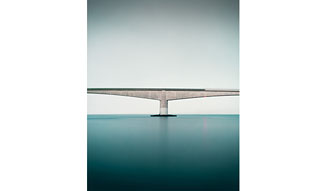
The project "The New Clear Age," which photographer and artist Joy Kawakubo has been working on since 2011, documents Japan's existing nuclear power plants through large-format (8x10 inch) film photography.
Kawakubo states, "As someone living in Japan during this era, I want to record the facts about Japan's current energy situation, the nuclear power that underlies it, and consequently, the handling and ethics of nuclear power, and its justice, in a way that differs from conventional media." He continues to shoot with the hope that Japan's future will be a little brighter.
The target amount for the expedition (shooting) costs for this project was reached within the first three days, but support is being accepted until June 15 (Monday) for the remaining four locations nationwide.
Crowdfunding
https://greenfunding.jp/micromecenat/projects/1043