A New Wave of California Design (Part 2)
This is the second interview with Caleb Siemon, a glass artist whose work blossomed on the fertile soil of California after honing his craft in Murano, the heartland of glassmaking in Italy. Returning to his native Southern California, he established his own studio and is now fully immersed in creating his works. What lies at the origin of his creative process?
photo&text by Aya Muto
Setting up the first studio.
A Trailer Workshop in California
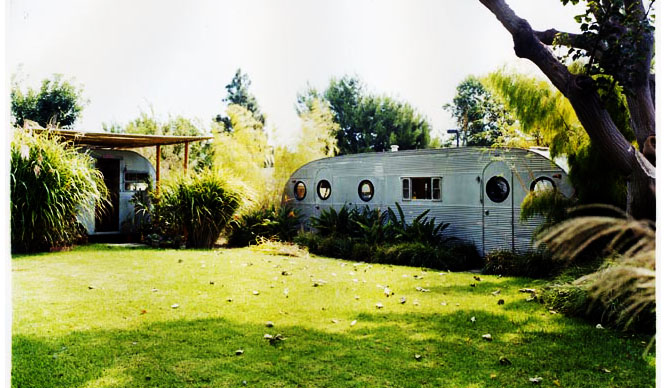
I returned to California in 1999, and I think it was about a month before I found a workshop space in an industrial area; I was staying with my parents. I found an abandoned old repair shop, bought a vintage 1950s trailer and moved it in. I bought another trailer for my first assistant (Brian, who was in the garden earlier), and Brian started living in his trailer while I lived in mine. Brian and I have known each other since school (RISD), and we started building the studio from scratch together. After about a year of struggling, to manage all the payments, I kept blowing glass and planned to sell it, and at night I kept the household accounts, and further improved the equipment. It was quite a chaotic situation. Around that time, my wife Carmen moved in. I met her at RISD too, and since Carmen was in the sculpture department, she was used to metalwork and helped me with various welding tasks. We worked non-stop, day and night. During that period, I exhibited at a trade show in Baltimore. It was a show that gathered American crafts. I had developed several product lines and presented them together in a way that felt cohesive. That's when I started taking orders, and galleries from all over America came, and orders came in steadily. It was at that moment, I think, that I finally felt confident that 'I can make a living doing this.' That I could turn this into a business. From then on, things really took off.
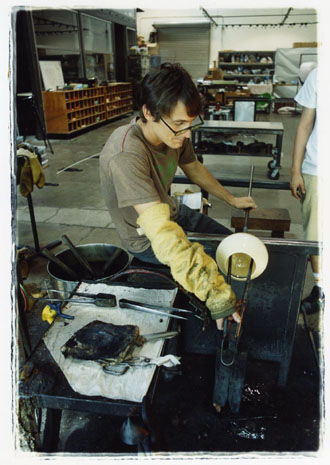
One of the charms of glassblowing is that it's a team effort. There's frequent communication, and a unique energy flows between people. For example, I might be sitting at the bench while an assistant blows into the pipe, someone else rotates the pipe, and another person adds color. In the finishing process, there are also people responsible for grinding and polishing. It took time to assemble the current team. In any case, the workspace requires us to operate in close proximity, almost touching, and because it's such an intense process, it's difficult if you don't get along really well with your colleagues. You have to work standing so close all day long. Finding people with the same 'vibration,' as it were, is like trying to identify a chemical reaction. Luckily, I've been able to gather such wonderful people. We all share a common passion for blowing glass, and because we get along well, it works.
Life with a view.
Embraced by the California Coast
In 2003, I moved the studio to its current location, which is a considerably larger space. Sales were gradually increasing, and the growth of the studio was becoming steady, allowing for a proper profit for the first time. I wanted to invest in equipment. This would make it safer for everyone in the long run, and I aimed to improve the working environment by enhancing ventilation and so on. The new location is actually part of my father's jewelry factory; we rent a small portion of a large property. But I paid attention to the landscape. The studio opens onto a large garden, and we created a large lawn area, planted trees, and fruit trees. I also brought in the trailer I had been living in previously to create a relaxation area. In any case, I made various investments to build a better production environment. It's safer for everyone that way. Plus, looking outside, there's grass, there are trees, an environment that makes it easier to feel inspired. It's a wonderful place to work.
—Did you decide that your studio would be in California?
I went to high school on the East Coast, and college was also on the East Coast. After that, I went to Italy for two years, so I was away from California for about 10 years in total. During those 10 years, I felt I hadn't spent enough time with my family, and I thought it was time to return and spend time with my family—especially my grandparents. I also missed the ocean. I grew up surfing and fishing on the West Coast, so I wanted to return to a place where I could do those things again.
—Does the place, California, influence your work in any way? The climate, the environment you live in?
Yes, I think living here probably influences my work in some form. Southern California is a beautiful area, but at the same time, it's a unique region with parts that aren't so pristine. Ultimately, you have to discover things for yourself. But it's certainly a vast, open area. There's a lot of space. It faces the ocean, and sometimes it feels strange, but the entire United States heads west, reaches this coast, and ends here. This is the boundary where it turns into water. It's like the edge of a vast oasis. Or the beginning of a vast void. Having lived in many places, I realized that this boundary, the presence of the ocean, is very comforting. When I go to a big city surrounded by buildings, or a place where I can't even tell where the ocean is, I sometimes feel agitated or restless. Just knowing the ocean is there brings a sense of security. For example, even on the hottest day, I know I can go there to cool off, and when I'm stuck in traffic, I can look out there and see a world with nothing in it. It's the ultimate peace. Even with ultimate chaos so close by. At least, if the ocean is there—.
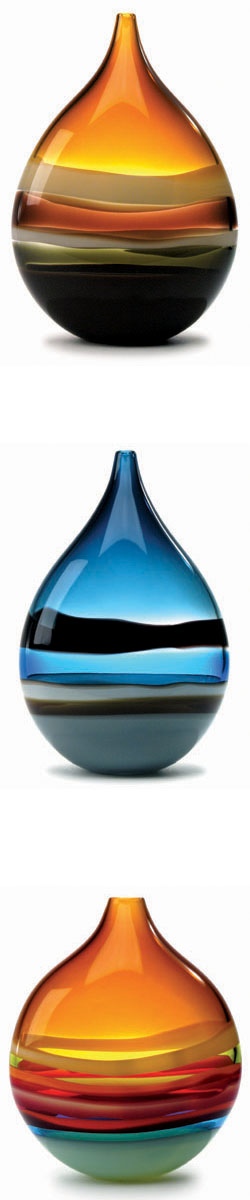
And then there are the beautiful sunsets here. I spend a lot of time surfing myself, so I'm often looking at the water, or looking from the sea towards the land, or gazing at the sky. Here, much of the landscape is open and flat, so things exist in a realm parallel to a vast horizon. Colors and their gradations. I think these things have a significant impact on my work. Because in my work, I often use large, parallel bands of color to create forms. Also, the greatest fascination of glass is its transparency. There aren't many other materials that can utilize transparency so well. I can create vessels using not only opaque colors but also transparent ones. Everything that overlaps and weaves different colors, like the sea and the sky, transforms into expression. As you can see from the garden, I'm also interested in plants. How they overlap, how light shines through them. In any case, if you open your eyes and see things as they are, they become inspiration. In that sense, I'm just valuing the act of simply observing things. If you take a little time and discover the beauty of an object, your surroundings are full of inspiration. Living in this area, in that sense, is a great source of energy for my creative process.
Caleb Siemon
Born in Southern California in 1975. From his teenage years, he helped his father in the jewelry industry, designing and developing an interest in ceramics, growing up in an environment surrounded by making things. In 1993, he enrolled at RISD. He studied glass art in various parts of the world, including the United States, New Zealand, Japan, and Scotland. Afterward, he went to Murano Island, Italy, and studied under Pino Signoretto for two years, absorbing the centuries-old traditions of glassmaking. In 1999, he established his own studio, "UNITED GLASS BLOWING," in Southern California. He is currently based in Santa Ana, where he is dedicated to creating his works.
Related products can be purchased at web shopping rumors
