A New Wave of California Design (Part 1)
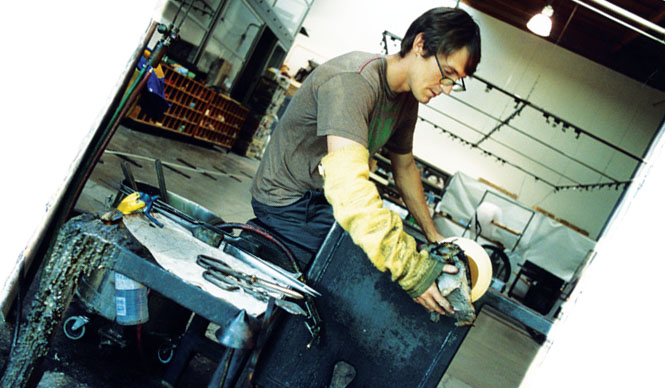
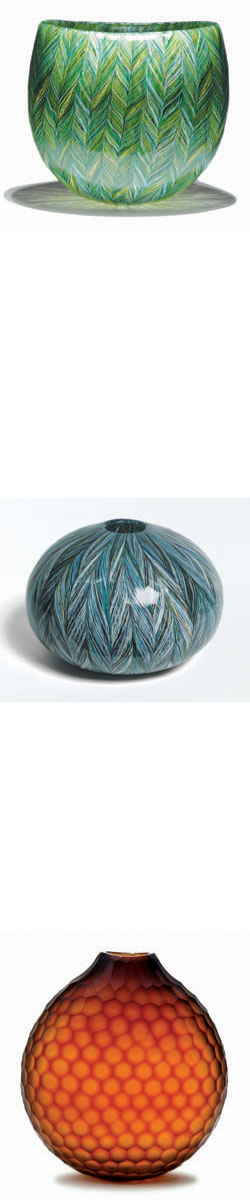
Caleb Siemon, a glass artist whose work blossomed on the fertile soil of California after a formative period in Murano, the heartland of glass craftsmanship in Italy. His creations are innovative, a crossover of the spaciousness of classic California modernism, traditional techniques, and contemporary sensibility. We spoke with Caleb Siemon ahead of his first solo exhibition in Japan, which opened at Playmountain in Sendagaya on December 21, 2007.
photo&text by Aya Muto
Interview with Caleb Siemon
Encountering Glass, The Beginning of a Journey
— How did you first encounter glass?
It was at an art camp for high school students. My father had a jewelry company, so I was interested in making jewelry from a young age. In high school, I was passionate about ceramics and always made vessels from clay.
— Was that art camp in California?
No, it was in Amherst, Massachusetts. It was a rural area with rolling hills, a beautiful place surrounded by nature, with a workshop that only had a roof and no walls. That's where I first blew glass, and I was completely captivated. I realized, 'This is what I want to do!'—not jewelry making, not ceramics. It was more enjoyable than anything I had done before. I was 17 then, still in high school, and choosing my path. I was looking at universities in California and the Rhode Island School of Design (RISD). I decided on RISD, which had the most renowned glass program in America, and committed to focusing on glass art there. My parents always told me, 'Don't worry about money, do what you love. Everything else will follow.' I always moved forward without looking back, assuming everyone felt the same way about pursuing their passions. I was completely focused on it. But in reality, many people are anxious and don't pursue what they truly love. I never imagined that. Many people probably give up on pursuing their passions due to financial worries. So, I consider myself a fortunate child who always felt it was okay to chase my passions. The glass department at RISD often invited Italian glass masters, who have a tradition in this craft, so I was convinced that I would eventually go to Italy to gain authentic knowledge and skills to have my own studio. That's why, as a university student, I always listened to Italian language tapes in my car. In winter, I used to drive three hours each way every weekend to go snowboarding. During those drives, I would listen to Italian tapes the whole time. I'd drive all night, camp, snowboard all day, and then drive back, repeating this almost every weekend. It cleared my head and was good exercise. For three hours on the way there and three hours on the way back, I would listen to Italian tapes and repeat them, so by the time I graduated, I had a solid grasp of basic Italian. After graduating, I worked for my father's jewelry company for just that summer, and then I immediately went to Italy with just a backpack. I didn't know anyone there. That's where my adventure began, searching for glass masters to study under.
Caleb meets Pino Signoretto.
Encountering Pino Signoretto
I went to the island of Murano every day, walking around and visiting various glass workshops to find a master to study under. I handed him a letter that said, 'Hello, this is my background, I just moved to Italy, and I would love to study under you. I won't be a burden, but could I visit your studio for a month and observe your work?' He granted me permission. From 8 AM to 5 PM, I attended and sketched constantly in my notebook. By the end of the month, my notebook was completely filled with notes on his techniques. During that time, he completely ignored me as I stood right behind him all day, taking notes. He never made eye contact, never said 'Hi.' Of course, no 'Good morning,' and no 'Bye-bye.' I was completely invisible. After a month... well, I was only allowed to observe for a month, so finally, he contacted me through an assistant and asked, 'Would you like to come for lunch on Saturday?' So, while having lunch with his family, he finally asked, 'So, who are you? Why are you here? Why do you come to my studio every day? What do you want?' He was clearly interested, but he was too busy to give me even a minute before. I didn't have a chance to tell my story. Finally, at that moment, I was able to explain why I had moved there, that I wanted to be an apprentice without pay, and that I intended to stay for a while. Then he said, 'Okay, you seem serious, and you passed the trial of this past month.' He acknowledged my diligence in coming every day (despite being ignored) and accepted me. He said, 'We'll have you start working on Monday.' On Monday, I went to the studio and waited to do whatever job he needed me to do, standing behind his bench. First, he said, 'Grab this!' and after seeing me grab it, he confirmed I could handle the pipe. I had learned the basics in school, after all. The next day, he had me try this, hold that paddle, and move that over here... As I did these things, he saw that I wasn't breaking anything. Little by little, he let me do something new each day. Then one day, I was finally given my own position for the entire day, and I started getting yelled at if I wasn't doing anything. He trusted me as a member of his team. The transition was a truly valuable experience.
When I first moved to Italy, a year felt like a very long time. But in reality, that year flew by. I realized that a typical apprenticeship usually requires at least four years. They teach each step slowly, with such thoroughness that you become a master of every process. Because of this, I realized I could stay there for a long time. But I was restless because I had something I wanted to do. Being in a foreign country gave me more time alone, allowing me to reflect on my path. I began to think about returning to America and establishing my own glass studio in the Italian style. Around that time, I witnessed the decline of traditional Italian glassmaking firsthand. Many masters were nearing retirement, but there was no one to succeed them. I believe we will witness the clear disappearance of these traditional techniques and knowledge, which have continued for 1000 years, within the next decade. Fortunately or unfortunately, I realized this, and I thought that if I established my own studio in America, I could bring back what I learned in Italy, not only to use in my own work but also to pass on that tradition to others. I could also invite the masters I worked with to America and create opportunities for them to teach directly. Young people in America, living far removed from this 1000-year tradition, are incredibly fascinated by it. I myself traveled halfway around the world to become an apprentice, yet on the other hand, young people in Venice might not have even visited Murano. So, after two years, I decided to return. I had a very clear vision of what I wanted to do. I was eager to have my own studio and truly believed I could achieve it. I could have stayed and mastered more techniques, but what I wanted to create didn't rely on extensive technical skills; it was about using the sensibility and design I learned in school. My focus was on simple vessels. Like some of the Italian traditions and techniques, I was drawn to the simplicity, not ornate or complex forms, and I had acquired the basics of that. Of course, there was still much to learn, but I felt ready to embark on my own path. I thought I could learn more as I went along once I had my own studio.
Caleb Siemon
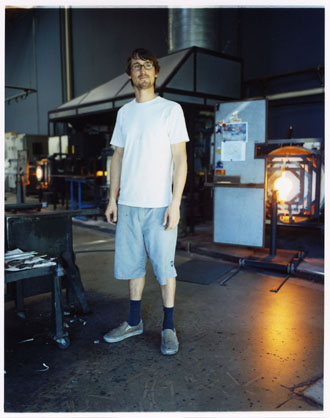
Born in Southern California in 1975. Growing up surrounded by creativity, he assisted his father in the jewelry industry from his teenage years, designing pieces, and developed an interest in ceramics. In 1993, he enrolled at RISD. He studied glass art in various locations worldwide, including the United States, New Zealand, Japan, and Scotland. Afterward, he moved to Murano, Italy, where he apprenticed under Pino Signoretto for two years, absorbing the authentic glass craftsmanship that has been passed down for over a century. In 1999, he established his own studio, "UNITED GLASS BLOWING," in Southern California. He currently works on his creations in Santa Ana.
His first exhibition in Japan is currently being held at Playmountain until January 13, 2008.
Purchase related products at web shopping rumors
