Playfully Serious: A Dazzling Fusion of Classical and Subculture
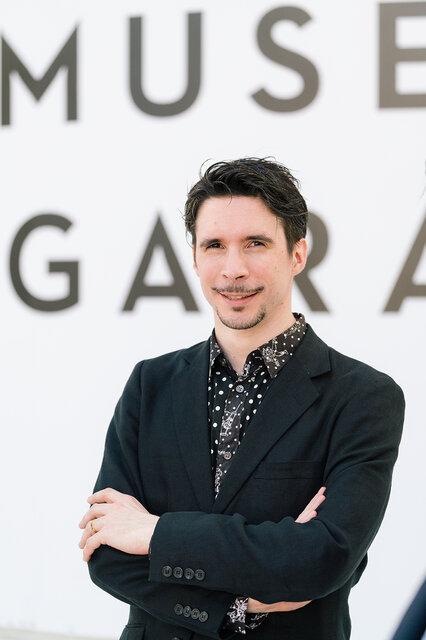
Nicolas Buffe: An Interview
Nicolas Buffe, a contemporary artist who has garnered attention for his unique style blending European classical aesthetics with Japanese and American pop culture, grew up immersed in Japanese anime and tokusatsu. Since receiving high acclaim for his art direction of the opera "Orlando" staged at the Châtelet Theatre in Paris in 2012, he has captivated audiences in Japan with his solo exhibition "The Dream of Poliphilo" at the Hara Museum (2014) and "The Story of the Winter Kingdom and the Summer Kingdom" utilizing the vast atrium space of GINZA SIX (2018).
It has now been decided that several of his representative works will be released as art toys by Medicom Toy. Here, as an introduction, we asked Mr. Buffe about the works that have influenced him and his creative concepts.
In the 21st-century contemporary art scene, a succession of ambitious artists is emerging, focusing on the dynamism of manga and anime and striving to elevate it to new dimensions through their unique interpretations. Nicolas Buffe, whom we introduce here, is one such artist who, from a young age, has been immersed in pop culture and greatly influenced by anime, tokusatsu, manga, and video games.
"During my childhood in the 1980s and 90s, many Japanese TV anime and tokusatsu shows were broadcast in France, and I could watch a wide variety of genres almost every day, including shonen, shojo, sports, sci-fi, and super robot series. Some of my favorites back then were Space Sheriff Gavan, Space Pirate Captain Harlock, Science Ninja Team Gatchaman, Calimero, UFO Robo Grendizer, Astro Boy, Super Dimension Fortress Macross, The Mysterious Cities of Gold, Sherlock Hound, Candy Candy, Captain Future, Cobra, Maison Ikkoku, Saint Seiya, Dr. Slump, Dragon Ball, The Rose of Versailles, Cat's Eye, Fist of the North Star, Ranma ½... the list is endless (laughs)."
Among the numerous titles, "Space Sheriff Gavan" (Note 1) was particularly influential for Mr. Buffe.
(Note 1) A tokusatsu TV drama produced by Toei, broadcast from March 1982 to February 1983 on the TV Asahi network. Its action scenes, featuring transformations into a metallic armored suit, were popular, leading to sequels "Space Sheriff Sharivan" (1983-84) and "Space Sheriff Shaider" (1984-85). It became the origin of the subsequent Metal Hero series.
"Gavan" first aired in France in 1983. As a child in kindergarten and elementary school, I was immediately captivated by the show's cool yet slightly menacing atmosphere, and I would make Gavan's combat suit out of cardboard and play "Gavan" with my friends.
"Gavan" was rebroadcast many times along with "Sharivan" and "Shaider," so I gradually became interested in the cityscapes, scenery, and people shown on screen. That might have been my first real connection with Japan."
He later enrolled in the prestigious École des Beaux-Arts in Paris, France's leading art institution, where he studied classical works from the medieval, Renaissance, and Baroque periods. Aspiring to create works that fused "the West and the East" and "tradition and modernity," he moved his base to Tokyo after graduation and completed his doctoral program at Tokyo University of the Arts in 2014. How did Japan appear to him?
"Before entering the Beaux-Arts, I had already studied architectural environmental design and fine arts at a national design school in Paris. However, the cultures that resonated most with me were still pop cultures like Japanese anime, tokusatsu, manga, and video games, American cartoons, and French bande dessinée (Note 2)."
(Note 2) Comics from the French-speaking world, primarily France and Belgium. Also known as BD (pronounced 'bay-day'). Many experimental and artistic works exist, and the styles of representative artists like Enki Bilal and Moebius have greatly influenced Japanese manga artists such as Katsuhiro Otomo, Hayao Miyazaki, and Jiro Taniguchi.
"The Beaux-Arts, located in the heart of Paris, has a tradition of about 400 years, and the moment I entered that culturally significant building, I felt the weight of history. Nevertheless, I felt that to become a contemporary artist, I shouldn't neglect my own background – pop culture such as Japanese anime, tokusatsu, manga, video games, American cartoons, and French bande dessinée. In other words, I began to be interested in the process of mixing history and culture.
Just as there are preferences within pop culture, I also have favorite works, genres, periods, and artists in history and culture. Works from history were not born from nothing; every work from any era is influenced by something. With that in mind, I started to become interested in grotesque ornamentation (Note 3) of the time. I found it fascinating as an ornamentation that could mix various genres, including humans, animals, architecture, and minerals."
(Note 3) A style of ornamental motifs originating in ancient Rome, combining various hybrid monsters and non-existent plant patterns. It was rediscovered during the Renaissance.
"Since then, I began to think about mixing personal history with grand history. Moreover, I started to use the Renaissance concept of 'Serio ludere' (to play seriously), not just with serious matters, but with a playful spirit."
"At Tokyo University of the Arts, I deepened this idea further and began to think of my work as a form of 'time-space travel.' The idea that 'artwork' exists as a network between 'time (history)' and 'space (world culture).' I kept in mind the concept of 'creolization' by the French philosopher Édouard Glissant (Note 4)."
(Note 4) A writer, poet, and literary critic (1928-2011) from Martinique, a French-speaking Caribbean island. His concept of 'creolization' refers to the contact of elements from multiple different cultures in a certain place in the world, producing entirely unpredictable new conditions.
"To mix two elements, one must acknowledge that their importance is on the same level. In other words, to successfully blend 'pop + classical culture,' both must be equally respected without distinction. The Beaux-Arts has an art library that houses many rare books. It was there that I encountered "Hypnerotomachia Poliphili" (Note 5), which greatly influenced me, and its French translation, "Le Songe de Poliphile."
(Note 5) "Hypnerotomachia Poliphili" is an illustrated book from the Italian Renaissance, first published in Venice in 1499. The protagonist, Poliphilo, searches for his beloved Polia in a dream. Though they are united, the dream ends upon waking. The French version, "Le Songe de Poliphile," was published in 1546.
"Also, being an otaku at heart, I started frequenting Akihabara soon after arriving in Japan and acquired many books related to anime (storyboards, setting art books, etc.), not just figures. I also grew very fond of the old downtown areas of Tokyo (Yanaka, Nezu, Sendagi) and Ameya Yokocho in Ueno, which I discovered after coming to Japan."
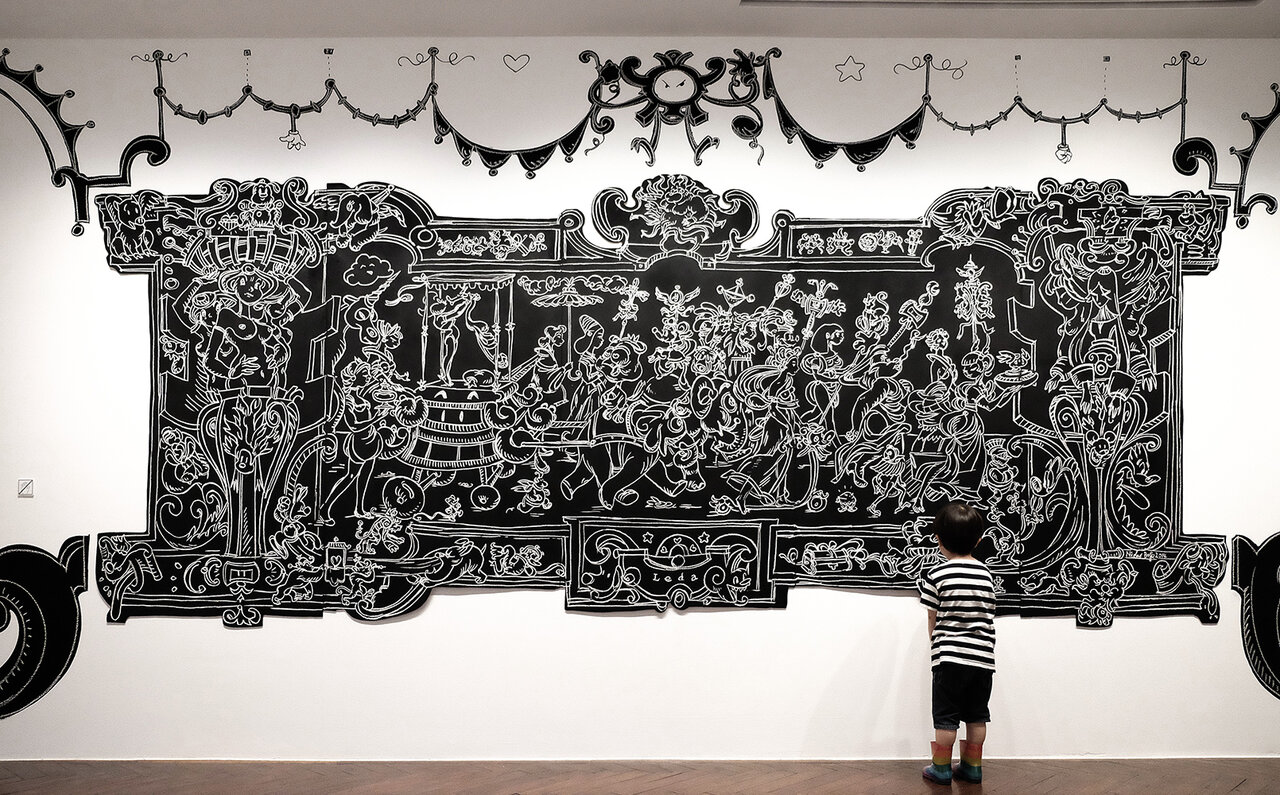
His exhibition "Nicolas Buffe: The Dream of Poliphilo" at the Hara Museum in 2014 is likely what widely introduced him to the Japanese public. The installation, which reconstructed classical literature like a role-playing game using murals, three-dimensional works, and augmented reality (AR) technology, provided an immersive experience as if stepping into a game.
"When I read "The Dream of Poliphilo" in the Beaux-Arts library, I realized something. The structure of the story is similar to a role-playing game, where the protagonist, Poliphilo, advances his adventure by gradually leveling up in his dream. He loves a woman named Polia, but she initially ignores him. Saddened by this situation, he embarks on an adventure in his dream to find Polia. He undergoes a path that can be called an initiation, encountering ancient Roman architecture, fantasy buildings, and monsters, and completing various challenges.
"However, the original Poliphilo doesn't fight much and doesn't wear armor. So, I mixed it with adventure video games like "The Legend of Zelda" to create my own version of Polifilo and an original story. At the Hara Museum, the entire building became the environment for the adventure."
Through a collaboration with Medicom Toy, it has been decided that several of his representative works, including "The Hero's Armor / Super Polifilo" (2014) and "Mouth of a Wolf" (2014) from the exhibition, as well as the early masterpiece "Pulcino" (2009), will be sequentially released as art toys. We asked about the thoughts behind each work and his encounter with Medicom Toy.
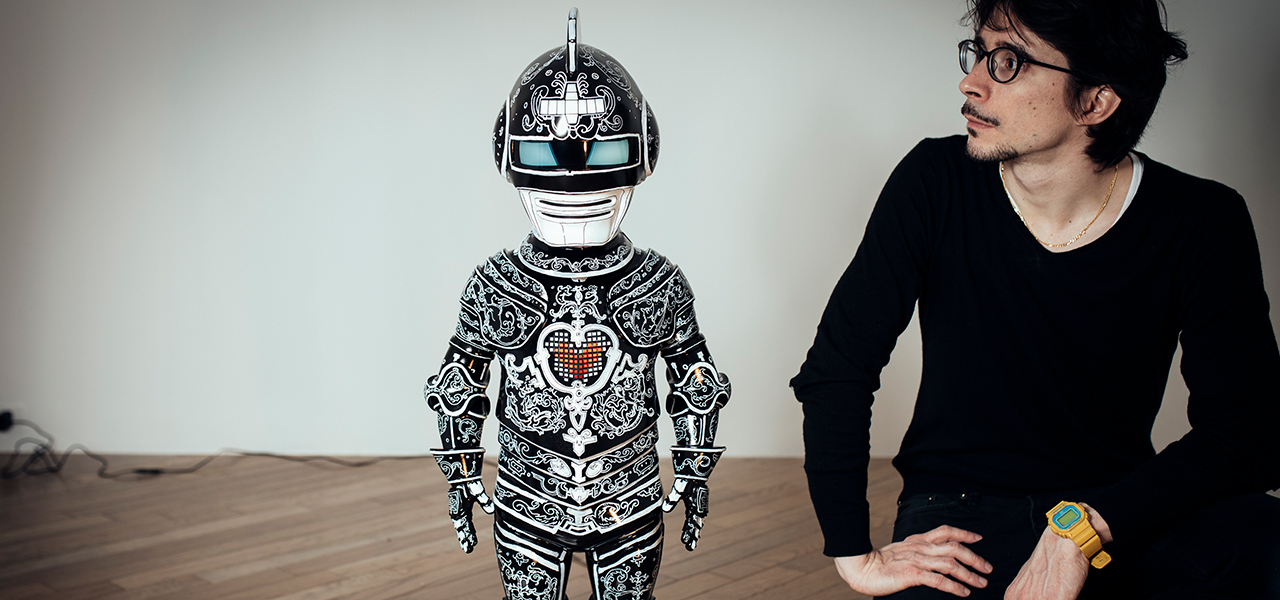
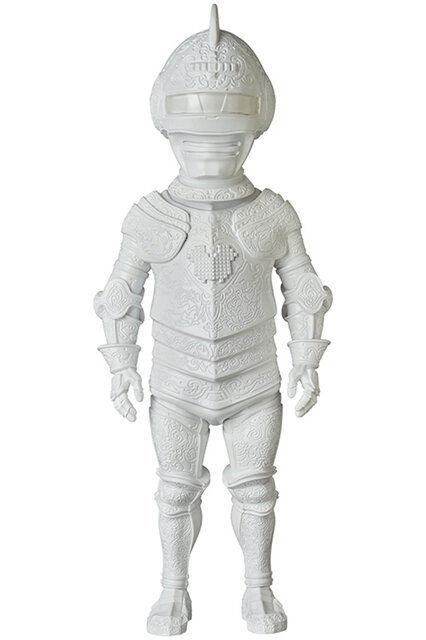
"The idea for "The Hero's Armor / Super Polifilo" came from wanting to create a super version of Polifilo, like one that might appear in a video game.
The influences include not only Renaissance art, which inspired "The Dream of Poliphilo," but also the Japanese tokusatsu series "Space Sheriff Gavan," and the armor of King Henry II of France by the 1555 goldsmith Etienne Delaune. New meanings are born precisely from the mix of different eras and cultures."
"The Hero's Armor / Super Polifilo" (2014)
FRP, lighting device, paint
Production cooperation: Rainbow Molding Planning
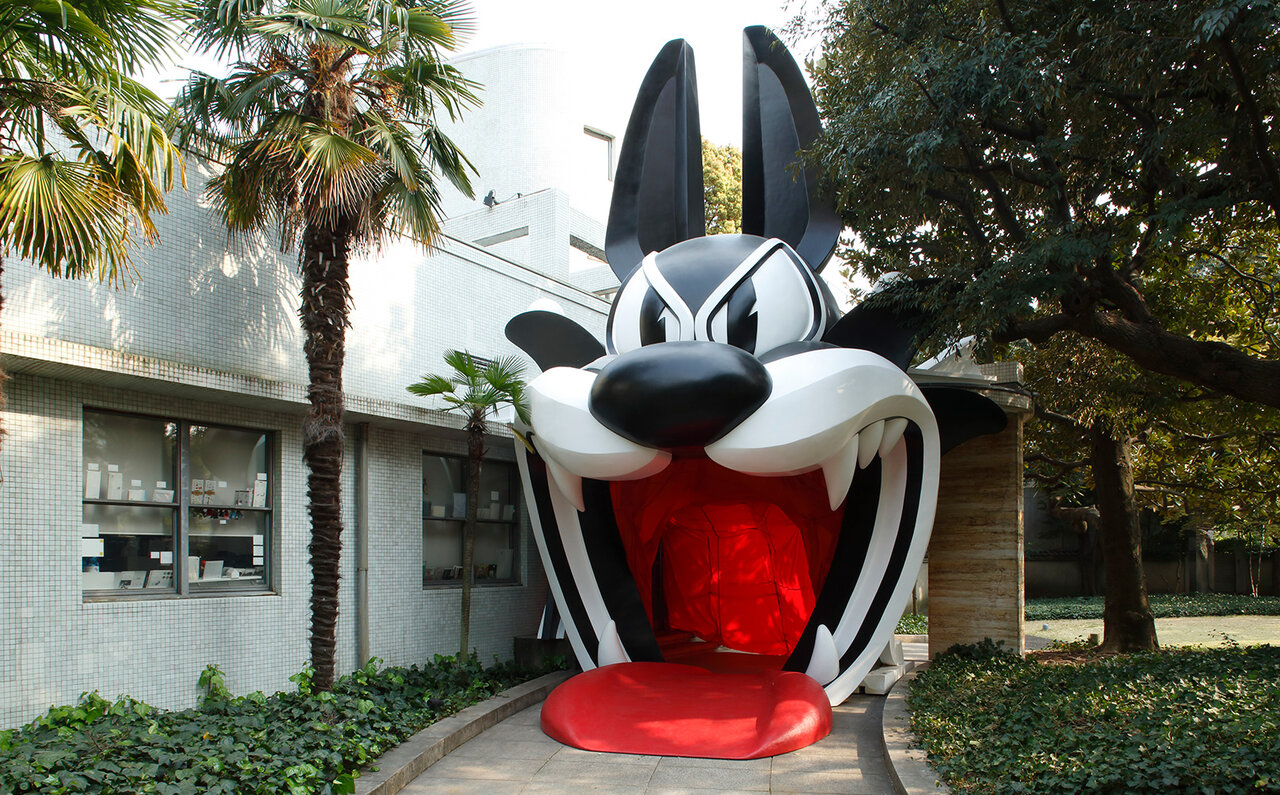
"At the beginning of the dream, Polifilo is chased by a wolf within ancient Roman ruins. He then enters the terrifying head of Medusa (Minerva) perched atop the gate of a giant pyramid and continues his adventure inside.
"Mouth of a Wolf" is heavily influenced by American cartoons, such as the works of Tex Avery and Chuck Jones, who worked on "Looney Tunes," and Hanna-Barbera of "Tom and Jerry." It is also greatly influenced by the "Mouth of Hell" in Italy's Park of the Monsters in Bomarzo (Note 6)."
(Note 6) Officially known as the "Sacred Grove of Bomarzo" (Bosco Sacro di Bomarzo). This garden was created in 1552 by Prince Pier Francesco Orsini of the Orsini family, the lord of Bomarzo in central Italy. It is globally known as a tourist attraction for its scattered colossal stone statues of gods and monsters within the forest.
"Mouth of a Wolf" (2014)
Styrofoam, FRP, sheet, paint, etc.
Production cooperation: Jushisaku Co., Ltd.
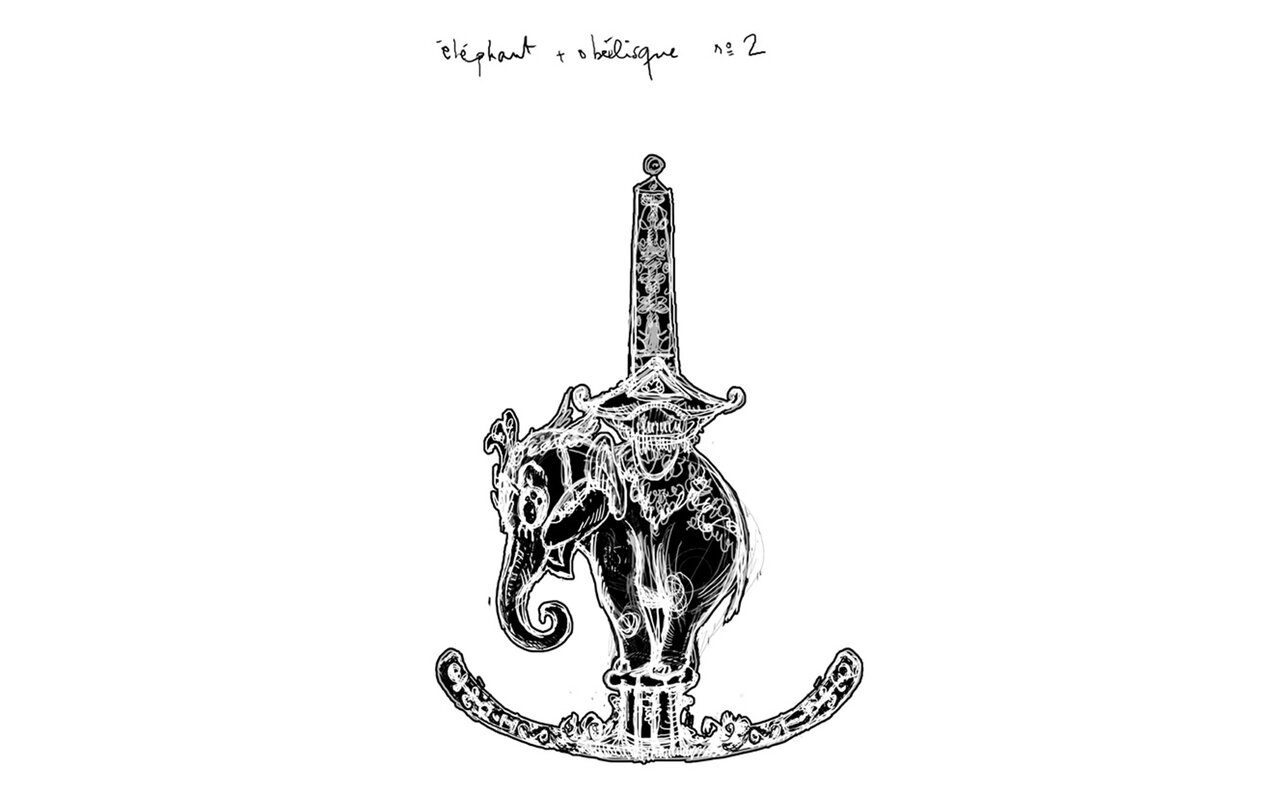
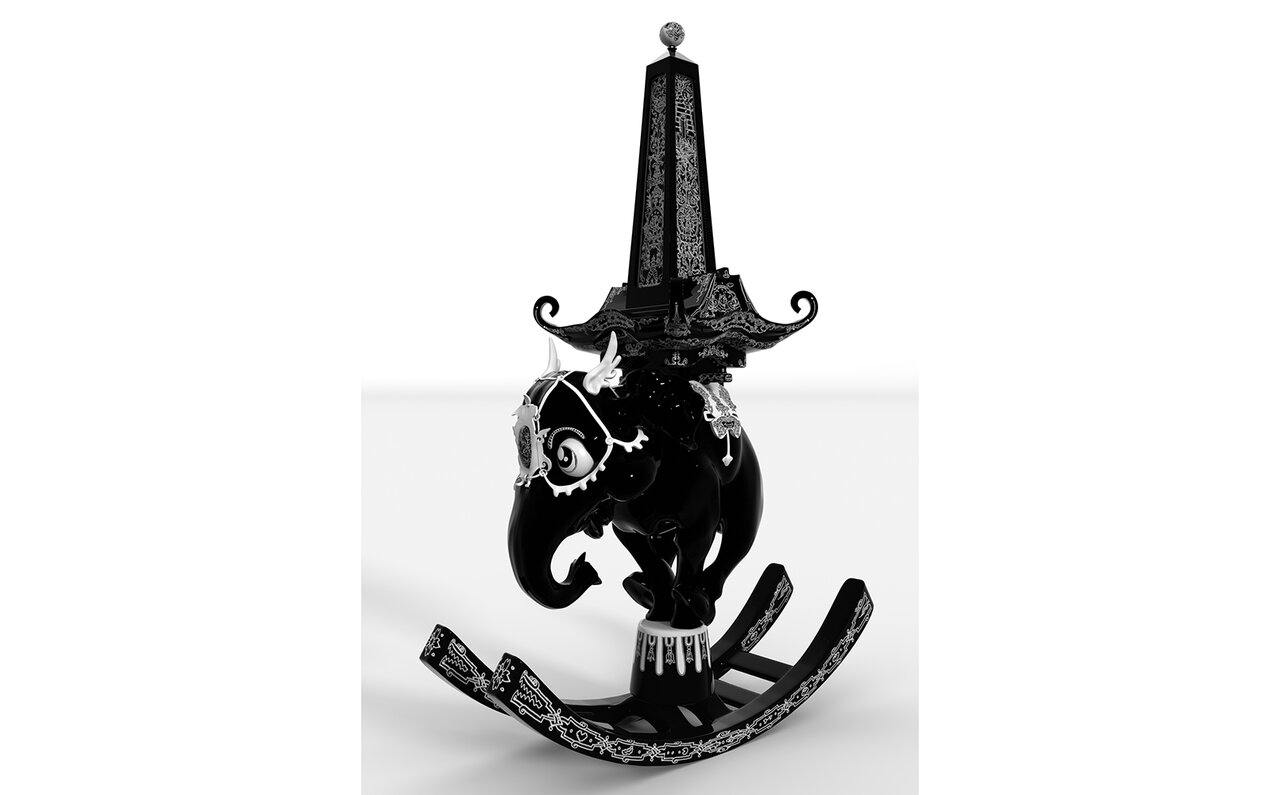
"Pulcino" is also inspired by "The Dream of Poliphilo." In the story, a sculpture of an elephant carrying a giant ancient Egyptian obelisk appears in the plaza in front of a pyramid.
This symbolizes that to pass down the obelisk (monument), which represents "knowledge of civilization," to future generations, the "strong spirit" symbolized by the elephant is necessary. This theme was already embodied by the sculptor Gian Lorenzo Bernini 160 years after the story was created (Note 7). There is also a story that the somewhat stout elephant was nicknamed "porcino" (piglet) or "pulcino" (chick) by the Romans of the time."
(Note 7) Created in 1667. It is called the "Minerva Obelisk" (Obelisco della Minerva) as it is housed in Minerva Square in Rome.
"In 2009, when I became interested in this theme, I decided to create my own version of Pulcino, based on my cherished concept of 'Serio ludere' (to play seriously). Influenced by American cartoons and Disney animation, I placed the elephant on a seesaw. The upper part (elephant + obelisk) represents seriousness, while the lower part (seesaw) represents play, creating a structural duality."
"Pulcino" (2009)
2.95 x 0.6 x 2 m, FRP, paint, etc., 2009
Production cooperation: Atelier Prométhée
Cooperation: SAM Art Projects, Galerie Schirman & de Beaucé
"Soon after moving to Japan, I became interested in Medicom Toy's products. I found their collaborations with artists to be very interesting, with a thorough commitment to quality and detail. The opportunity for this project arose two years ago when I was introduced by Mr. Hitoshi Ishii, a director I know.
"I am interested in projects across various fields. Collaborations with different fields allow me to meet people with wonderful skills and worldviews, and to experience new creations together with them. It is important to collaborate across genres such as art, design, and toys.
"I hope this project with Medicom Toy will be a great opportunity to present my work to a wider audience, not just museum-goers, gallery visitors, specialists, and art collectors. I am delighted to have been able to produce art editions of such high quality with people who have deep respect and affection for artists.
"Although some projects have been postponed due to the impact of the COVID-19 pandemic, many ongoing projects continue. I have become accustomed to working from home, so it has not significantly affected my production. I sincerely hope that this COVID-19 issue will be resolved as soon as possible."
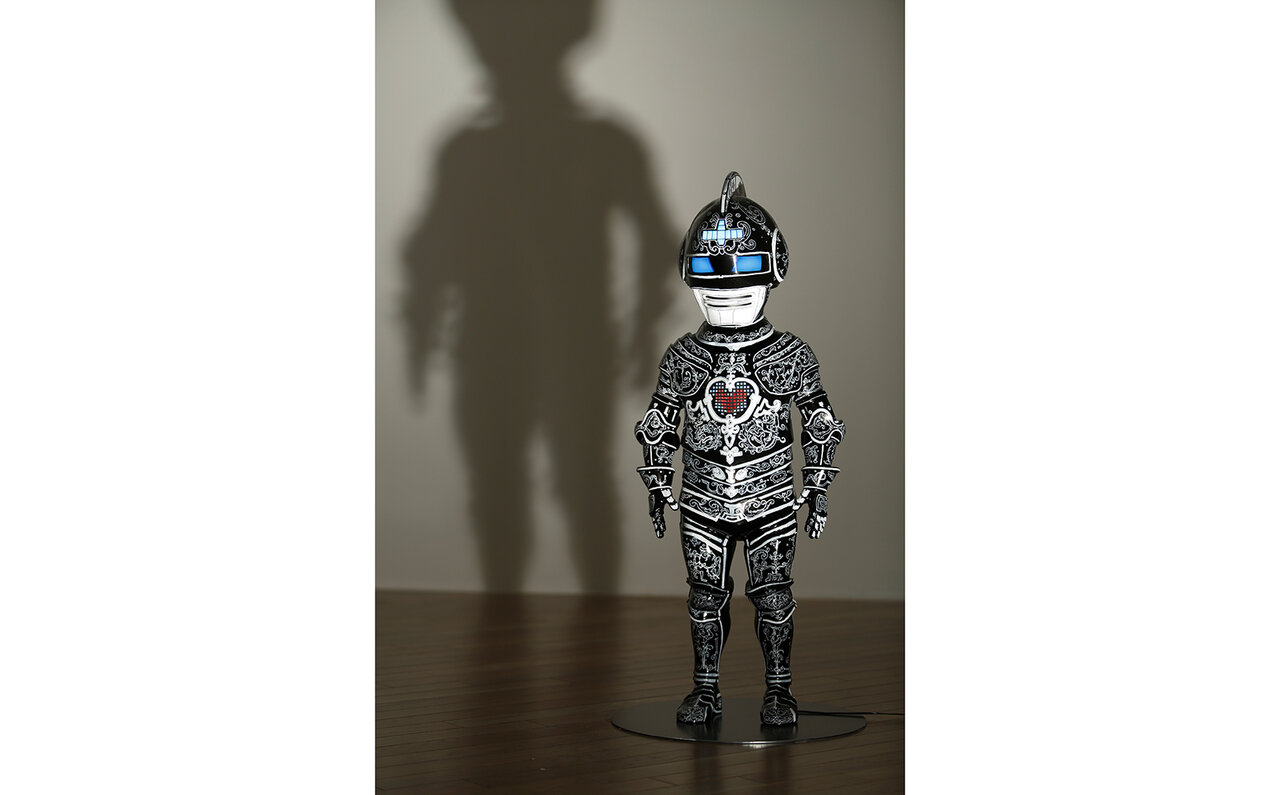
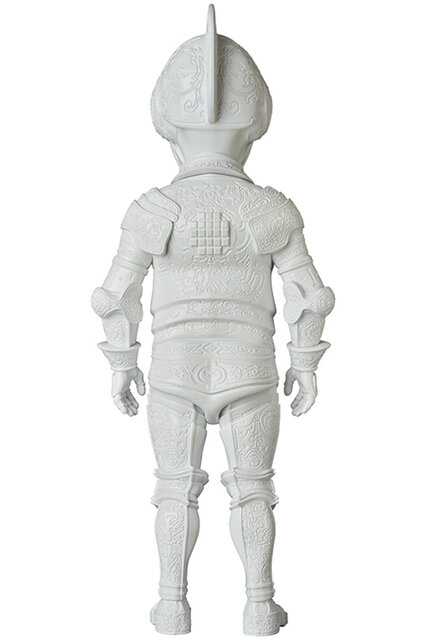
Armor of SUPER POLIFILO STATUE WHITE Ver.
Nicolas Buffe's representative works are now available as art toys. The first release is the "Armor of SUPER POLIFILO" statue (WHITE Ver.), which was presented at his solo exhibition "The Dream of Poliphilo" in 2014.
Size: Approximately 380mm in height
Price: ¥88,000 (excluding tax)
Release Date: Scheduled for release in August 2020
Retailers: MEDICOM TOY PLUS, 2G
(C) 2020 - Nicolas Buffe - All rights reserved.
* Quantities are limited. Please forgive us if it is sold out.
* The photo shows a sample under supervision. The actual product may differ slightly.
Inquiries
Medicom Toy User Support
Tel. 03-3460-7555
ImagenSubliminal (Miguel de Guzman + Rocio Romero) 2018
Born in Paris, France, in 1978. Graduated from the École des Beaux-Arts in Paris. Moved his base to Tokyo in 2007. Obtained his doctorate from Tokyo University of the Arts in 2014. A rising contemporary artist drawing attention for his multifaceted style that blends academic knowledge with popular culture, drawing inspiration from European classical literature such as "Orlando Furioso" and "Hypnerotomachia Poliphili," as well as pop culture like "Space Sheriff Gavan" and "The Legend of Zelda."