MLE FABRICK × ROSTARR Series | MEDICOM TOY
MEDICOM TOY
An Interview with ROSTARR (1)
Textile items featuring artwork by Brooklyn-based artist ROSTARR (http://www.rostarr.com) are now available from MEDICOM TOY's FABRICK series. ROSTARR has been active since the '90s and has garnered global attention for his diverse work, including screenings of his video art at the Centre Pompidou in Paris, exhibitions at the agnès b. gallery, and providing artwork for NIKE campaign advertisements. For this interview, conducted via email, ROSTARR answered OPENERS' questions about his journey to becoming an artist, the artists who influenced him, and the concept behind the FABRICK X ROSTARR series.
Text by SHINNO Kunihiko
Perhaps being a B-boy was the first time I could express my true self.
—You've been living in New York since 1989. How do you feel the city's environment and art scene have changed over the past 30 years?
ROSTARRI was born in Washington D.C. in 1972 and moved to New York in '89 to attend art school. New York at that time felt very edgy and stimulating. The club, fashion, and art scenes of the '80s were fascinating, but also fraught with danger, so I studied hard to become street-smart as quickly as possible.
In recent years, urban development has progressed in surrounding areas, leading more people to move from Manhattan to Brooklyn and Queens, and the entire city is changing. New York is now one of the safest cities in the world, but I preferred the New York of the past. Back then, before social media and the internet, connections between people were crucial in the art scene where we were active, especially when attending small parties and events.
—Can you tell us about a moment that you consider the origin of your artistic career?
ROSTARRI loved drawing from the age of three or four. My older brother also had a significant influence on me. He was very good at drawing comic characters and manga. My parents were very strict, and we weren't allowed to watch much TV or anime, so I always spent my time drawing with my brother.
In high school, I took as many art classes as possible instead of boring subjects and just kept drawing. I didn't think I had the same talent as my brother, nor did I have the goal of becoming an artist. However, after moving to New York, I became captivated by graphic design, and that's when I started to immerse myself in drawing again.
—Your work shows influences from graffiti and street art. What kind of activities were you involved in when you were younger?
ROSTARR: To be honest, I've never done graffiti, nor do I consider myself a street artist (though my brother was a graffiti artist in a B-boy crew in Washington D.C.). However, I've always been influenced by street culture since I was young. After moving to New York in '89, I started receiving requests for large murals in various countries around the world. From 1998 to 2006, for about eight years, I was also a member of Barnstormers, an art collective connecting New York and Tokyo. Looking back now, perhaps being a B-boy was the first time I could express my true self, and I developed those skills then.
ROSTARRStreet-oriented graffiti artists, for example,Cy Twombly,Dali,Frank Stella,Robert Rauschenberg,Warhol,Basquiat,Keith Haring,Rammellzee, Phase 2, Lee Quiñones,Futura 2000, Os Gemeos,Banksy, and so on.
I respect many artists, but my favorite is Pablo Picasso.
—Are you influenced by music such as hip-hop and club culture, as well as film and other visual works? Is this a unique sensibility of New York?
ROSTARRI was a B-boy deeply involved in New York's hip-hop culture from 1982 to '85. After '85, I was fascinated by Japanese fashion designers (Yohji Yamamoto, Rei Kawakubo, Junko Koshino, JUN, PASHU, etc.), Washington D.C.'s club culture, and the New York club scene from '88 to 2004.
I believe New York is unparalleled as the birthplace of hip-hop, club culture, fashion, and art. However, I also feel a similar energy emanating from Paris, Tokyo, and London, driving new cultures and innovative ideas out into the world.
MLE FABRICK × ROSTARR
All scheduled for release in June 2019.

OUT DOOR WAIST BAG
Size: W400mm x H210mm x D100mm.
Material: COTTON/NYLON.
¥9,000 (excl. tax).

OUT DOOR MINI SHOULDER BAG
Size: W145mm x H180mm x D55mm.
Material: COTTON+PVC.
¥6,800 (excl. tax).

TOTE BAG
Size: W450mm x H500mm x D200mm.
Material: COTTON+PVC/LEATHER.
¥13,000 (excl. tax).

TRAVEL POUCH SMALL
Size: W140mm x H90mm x D90mm.
Material: COTTON+PVC/NYLON.
¥4,500 (excl. tax).

TRAVEL POUCH LARGE
Size: W150mm x H120mm x D100mm.
Material: COTTON+PVC/NYLON.
¥5,500 (excl. tax).

SIMPLE TOTE BAG
Size: W440mm x H430mm.
Material: COTTON.
¥4,800 (excl. tax).

KNAPSACK
Size: W360mm x H460mm.
Material: COTTON/NYLON.
¥3,800 (excl. tax).

SLIPPERS
Size: 25.0–26.5cm (L), 26.5–28.0cm (XL).
Material: COTTON/LEATHER.
¥3,800 (excl. tax).

CARD CASE
Size: W115mm x H75mm.
Material: COTTON+PVC.
¥2,000 (excl. tax).

DOCUMENT CASE A4
Size: W230mm x H330mm.
Material: COTTON+PVC.
¥3,800 (excl. tax).

SV PEN CASE
Size: W220mm x H50mm x D55mm.
Material: COTTON+PVC.
¥2,800 (excl. tax).

GLASSES CASE
Size: W190mm x H80mm.
Material: COTTON+PVC+LEATHER.
¥2,800 (excl. tax).

BOOK CASE
Size: W110mm x H170mm.
Material: COTTON+PVC.
¥2,000 (excl. tax).

COIN CASE
Size: W75mm x H70mm.
Material: COTTON+PVC+LEATHER.
¥2,200 (excl. tax).

iPhone CASE for X,XR
Size: FREE.
Material: POLYCARBONATE+SILICON RUBBER.
¥4,500 (excl. tax).
Page 02.Additive and Subtractive Design
MEDICOM TOY
An Interview with ROSTARR (2)
The theme is 'Diluvium Alice (In Wonderland)'. It's very trippy and moody.
—How did your style of constructing graphic, typographic forms into paintings, which you call 'Graphysics,' come about and evolve?
ROSTARRIn 1996, I coined the term 'Graphysics' by mixing the words 'graphics' (art techniques and tools) and 'physics' (objects and energy). It embodies my desire for the art and designs I create to be powerful and full of energy.
At that time, I excelled at designing abstract imagery incorporating concepts and styles, as well as typographic logos. I sometimes paint abstract landscapes with a similar sensibility.
After September 11, 2001, I wanted to create more expressive works that included gestures, so I began practicing calligraphy. During that time, I was greatly influenced by the beauty of Arabic and Pan-Asian calligraphy styles, Abstract Expressionism, and the handwriting styles of graffiti from Brazil and Tokyo.
—You've been active worldwide with large-scale art projects and collaborations with companies. When do you feel the most fulfilled in your work?
ROSTARRThe most fulfilling moments in this work are when I'm concentrating on my artwork or designs for a company and enter a state of flow. I think it's similar to the satisfaction of solving a difficult problem. It's not often that one has an environment where they can focus so intensely on a single thing.
—You've visited Japan many times. How does it strike you compared to New York? Also, please tell us about your interactions with other artists.
ROSTARRI first came to Japan in 1998. Since then, I've visited over 40 times for exhibitions, projects, and meetings for collaborative products. I have many old friends in Japan, and former Barnstormers members I worked with back then are also here. Tokyo is one of my favorite cities.
Everything about Japan—art, fashion, architecture, design, food, culture—is fascinating, and it's remarkable how safe it is. Comparing Tokyo and New York, New York has a more unique impression, but I feel a similar energy from both cities. I still keep in touch with old artist friends via social media, but they all seem busy with work and family.
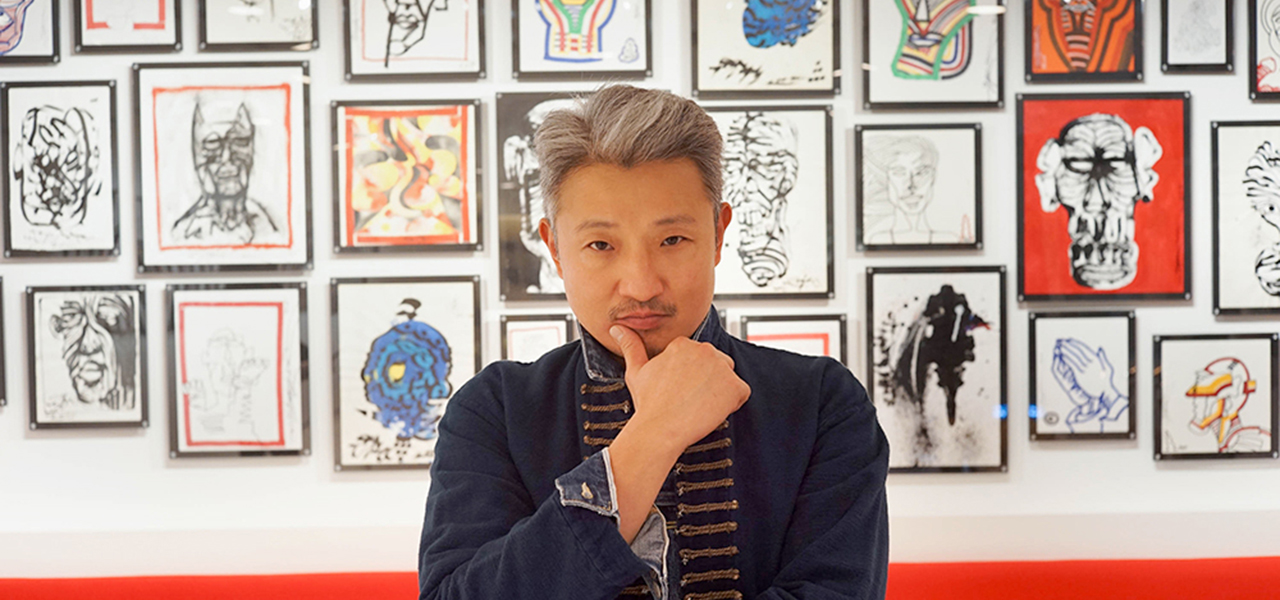
—At the 'PAREIDOLIC BEHAVIOUR' exhibition held at the agnès b. gallery in Aoyama (December 8, 2018 – February 3, 2019), a large number of drawings from your sketchbooks were displayed. Your primitive style, reminiscent of tribal face paint, was striking. What emotions gave rise to those works?
ROSTARRActually, I've wanted to publicly display those drawings for over 20 years. Most of my work consists of abstract motifs and calligraphy, but when I draw in my sketchbook, it's almost always faces and masks. This is a unique habit, as I felt the need to reveal all my hidden faces.
I always draw faces from memory, without a model. Sometimes I draw the faces of friends, superheroes, or celebrities. The idea of a mask is very interesting. Everyone wears a mask for different reasons. Like a psychologist, I'm interested in people's personalities and their unique quirks.
—Were you familiar with MEDICOM TOY before this project? What are your impressions of working with them?
ROSTARRI learned about MEDICOM TOY around '98 through collaborations with artists like Futura, Mo'Wax, A Bathing Ape, and KAWS. Now, I'm a big fan and a collector of MEDICOM TOY. The quality of MEDICOM TOY's toys and packaging is the best in the industry, and they are a special presence that has sparked the art toy revolution and inspired other companies like Kidrobot in America. I am deeply honored to be working with them.
—Please tell us about the concept behind the 'FABRICK X ROSTARR Series' being released this time.
ROSTARRRecently, I've been creating patterns based on a painting called 'Diluvium Alice (In Wonderland).' This painting is very expressive with hard lines and soft splatters, and its unique calligraphic lines create a very trippy and moody atmosphere. I felt this pattern would be perfect for the FABRICK series.
I am very satisfied with the outcome of this collaboration, and it feels like a small dream come true.
—By the way, what is the background behind the shape of the 'A' in the ROSTARR logo?
ROSTARRI call that part, which looks like a 'poop' shape, the 'seed.' I conceived this in 1996, the same year I came up with 'Graphysics.' It represents my belief that creativity should be shared and should inspire others (like fertilizer for creativity).
—Finally, what would you like to do with MEDICOM TOY in the future?
ROSTARRI'd like to create a lamp in the shape of my signature 'seed' (poop), or perhaps collaborate with Karimoku to make wooden products. I have many more ideas I want to bring to life.
BE@RBRICK ROSTARR 100% & 400%


Size: Approx. 70mm / 280mm (total height for each)
Price: ¥12,000 (excl. tax)
Release Date: Scheduled for release and shipping in August 2019
*Scheduled for release at all MEDICOM TOY direct stores, online stores, and other select retailers.
©︎ ROSTARR
BE@RBRICK TM & ©︎ 2001-2019
MEDICOM TOY CORPORATION. All rights reserved.
ROSTARR
An artist based in Brooklyn, New York. Active since the '90s, he has a diverse career including screenings of his video art at the Centre Pompidou in Paris, exhibitions at the agnès b. gallery, and providing artwork for NIKE campaign advertisements. He also participated in the international touring exhibition for the film 'Beautiful Losers,' which garnered significant attention in Japan. As an artist with roots in street culture, he is currently gaining international recognition.
MEDICOM TOY User Support
Tel. 03-3460-7555