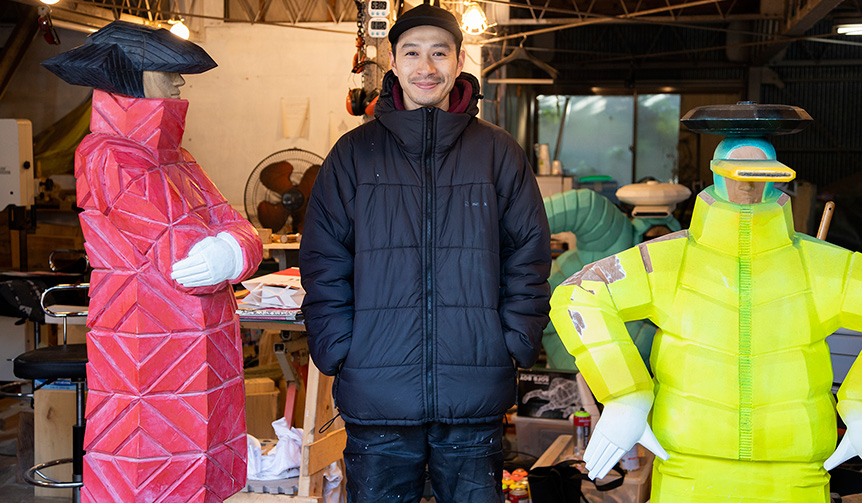
When you focus on creating space rather than just form, your perspective on shape naturally evolves | MEDICOM TOY
MEDICOM TOY | MEDICOM TOY
An Interview with B-Boy Sculptor TAKU OBATA (Part 1)
TAKU OBATA, who calls himself a “B-BOY (breakdancer) sculptor,” continues to create works inspired by breakdancing, one of the four major elements of hip-hop. After completing his master's degree in sculpture at the Graduate School of Tokyo University of the Arts, he has exhibited numerous works both in Japan and abroad. Last year, he held an exhibition titled “Kazuki Umezawa × TAKU OBATA: Landscapes Beyond” at the Watari-um Museum of Contemporary Art in Gaienmae, Tokyo, with contemporary artist Kazuki Umezawa. To commemorate this, a limited edition of 100 scaled-down replicas of his sculpture “B-GIRL Down Jacket NAGAME” were released by Medicom Toy. In this interview, conducted at Obata's studio in Tokorozawa, Saitama, we asked him about what inspired him to become a sculptor, the meaning behind his work, and what he wants to express through sculpture in the future.
Photographs by Kaku OhtakiText by Kunihiko Shinno
In Japan, this is how B-BOY is perceived
—Sculptures inspired by B-BOY are quite rare worldwide, aren't they?
TAKU OBATAThat's true. There's a lot of graffiti, though.
—Seeing "B-GIRL Down Jacket NAGAME" in person like this, it has an overwhelming presence.
TAKU OBATAIt looks human, but there's a strangeness to it, like it's not quite human upon closer inspection. I felt compelled to make it life-size or larger to create a sense of space. If it were smaller, it would feel like I was the one in control.
The other piece I exhibited at Watari-um is even larger, at 2.3 meters. I incorporated subtle details, like offsetting the horizontal lines of the down jacket front and back, to convey a sense of movement even when it's just standing there. It's quite complex.
—Is this piece carved from a single piece of wood?
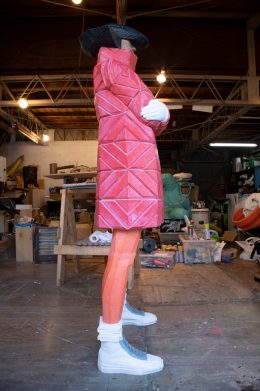
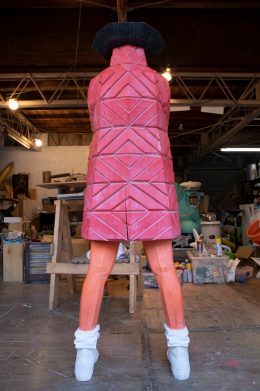
TAKU OBATAYes, it is. I only used carving knives and chisels, and it became this smooth without any polishing. Also, if you look from the side, you can see it has the same curve as the human torso. Without that, it would be difficult to make something this large stand up like a person.
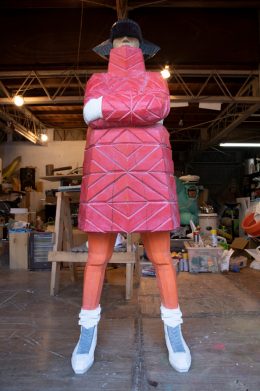
Wooden sculpture "B-GIRL Down Jacket NAGAME"
People often comment on the interesting clothing and poses, but I feel it's built upon a solid foundation.
—When did you start breakdancing?
TAKU OBATAI was in the basketball club in junior high and high school, but it was when my older brother started dancing in high school that I got into it. Then, I formed a dance team called UNITYSELECTIONS with friends from my hometown, and we'd take mats and boomboxes to places like Kōen Park and the area in front of Tokorozawa Station to practice, perform, and battle.
I guess you could say I grew up with B BOY PARK (a large-scale hip-hop block party held annually in Yoyogi Park, Tokyo, from 1997 to 2017). When you delve into the '80s old-school style,Wild Style (1982)and the dancers in "Beat Street" (1984) have a very slim build. Like LEE denim jackets and jeans. That look was striking.
Their footwork was cool, and I thought, 'This is real hip-hop.' So, all my sculptures are slim.
—Was it difficult to pursue a degree at Tokyo University of the Arts while also playing basketball and dancing?
TAKU OBATAI never even considered sculpture in high school. I just wanted to go to college. At first, I looked for programs that accepted practical dance skills and applied, but it was full of ballet dancers, and I felt completely out of place.
So, I spent a year studying at Tachikawa Art School, in the visual arts department. I was shown Jan Švankmajer's (Czechoslovakian filmmaker) clay animation in class, and it was so impactful that I wanted to try it myself. I made a clay animation with dance as the motif. That's when I started drawing and sculpting, and I became completely hooked.
I thought it would be interesting to have B-BOY sculptures, so I switched my major to sculpture in my second year of prep school. I passed the first stage of the entrance exam for Geidai (Tokyo University of the Arts), and since passing the first stage made prep school half-price as a scholarship student, I ended up studying for three years before finally being accepted.
—Even within Tokyo University of the Arts, the sculpture department is particularly competitive.
TAKU OBATAWhen I applied, the competition ratio was about 20 to 1. The sculpture entrance exam was very simple, requiring only drawing and modeling. In the end, those three years at prep school were incredibly intense. I did a tremendous amount of drawing and modeling.
I feel very fortunate. I decided early on that I wanted to create sculptures inspired by B-BOY, so I entered a university environment where I could pursue that without hesitation.
Furthermore, by using wood carving, I further distinguished myself from others. There's also the Japanese element. In my early work, I also used FRP, but B-BOY is an American culture, and it wouldn't be interesting to express it with American materials. Wood carving was something nobody else was doing, and I thought it would be an original expression of 'This is how B-BOY is perceived in Japan.' I call myself a B-BOY sculptor as a way to deliberately put myself out there and hold myself accountable.
—Your experience with dance must also be a strength.
TAKU OBATAI know what kind of movements I like and what looks cool, so I strive to create my ideal pieces. Although there are some poses that are difficult to replicate even if I try, they are anatomically plausible. I'm still involved in a performance group called "HIPHOP SENSHI B-BOYGER" with MC JINGI (GERU-C Kakka), which formed from UNITYSELECTIONS. If I hadn't danced, I wouldn't have pursued sculpture, and I wouldn't have known what I wanted to create.
Page02.I've always been hesitant about figures
MEDICOM TOY | MEDICOM TOY
An Interview with B-Boy Sculptor TAKU OBATA (Part 2)
I've always been hesitant about figures
—In 2014, you held a solo exhibition at Jonathan LeVine Gallery in New York. Grammy Award-winning music producerSwizz Beatzalso purchased your work.
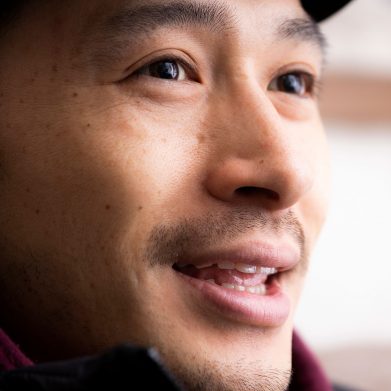
TAKU OBATA DOZE (DOZE GREEN)was also having a solo exhibition in a different space at the same gallery. He's originally a B-BOY and the guy posing in the bottom left of the "Wild Style" poster. He bought one of my small pieces and bragged about it to everyone. That's how Swizz Beatz ended up buying my work too.
Also, in New York,ROSTARR (an artist based in Brooklyn)let me stay at his place for about 10 days, and I really appreciated his hospitality.
—In Japan, too,Utamaru of Rhymesterfrequently introduces your work in the media.
TAKU OBATAMy older brother was a longtime backup dancer for Rhymester,and he even appeared in the music video for "B-BOY ISM" (1998).So, at an event, my brother introduced us, and when I told him I was a B-BOY sculptor, he was like, 'Awesome!' and came to my first solo exhibition. He introduced me on the first week of "Keiko Kojima's Kira☆Kira" (March 2009 - March 2012, TBS Radio), and I was also invited to appear on "Tamafuru" (Rhymester Utamaru's Weekend Shuffle, April 2007 - March 2018, TBS Radio).
—Utamaru-san must have been delighted to see a talented artist emerge from the Japanese B-BOY scene.
TAKU OBATAI'm grateful that he feels that way. He even came to the talk event at Watari-um last year ("Rhymester Utamaru & TAKU OBATA's After 7 Junction @ Watari-um Museum of Contemporary Art" held on October 27, 2018).
—The Watari-um exhibition at that time led to this project with Medicom Toy, correct?
TAKU OBATAIt was Watari-um that initially suggested making a figure with Medicom Toy. It seems Medicom Toy was already aware of my work.
—Were you familiar with Medicom Toy before this?
TAKU OBATAOf course. I liked figures too.
My first encounter with toys was with the "Kinkeshi" (Kinnikuman Keshi) figures that were popular in kindergarten and elementary school. In high school, 200-yen gashapon (capsule toys) started appearing, and they were surprisingly realistic, which was a shock.
I loved them and bought a huge number, lining them up at home. Even without knowing the characters, I just thought the sculpts were cool. Later, apparel brands started releasing stylish figures, and Medicom Toy released BE@RBRICK, which I found interesting.
—There are similarities in terms of sculpting.
TAKU OBATAMany sculpture students work part-time making prototypes. Some of my seniors and juniors from Geidai became prototype artists. I also used to work part-time making prototypes for a mannequin company, where I would modify existing mannequins' hair using a sculpting material called poly putty to create new shapes according to different companies' styles. I was actually praised for that. The mannequins at BEAMS still use the ones I modified (laughs).
Simplification is quite difficult, but that's where a sculptor's skill is tested... For this project ("B-GIRL Down Jacket
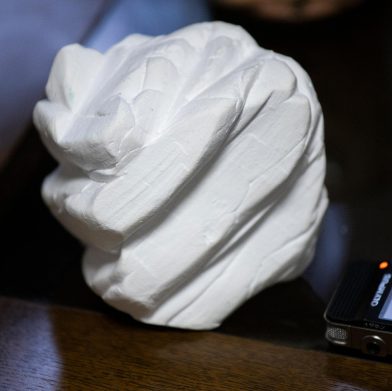
NAGAME"), do you ever get involved in the prototype production yourself?
—It's rare for the artist themselves to handle the prototype production.
TAKU OBATANormally, a prototype artist would bring a 2D drawing to life in 3D. That's probably what's new here. With architectural models, you create something small and then scale it up. But this is a scaled-down version of a large existing work that was scanned, so it truly becomes a sculpture.
I've always been hesitant about figures. The company UNBOX has been asking me for a while to make my work into soft vinyl figures, and I created this one knowing it could be made from 3D scan data. It's made of 13 parts, is articulated, and is of very high quality. However, soft vinyl is hollow and sensitive to heat, so the center of gravity tends to shift forward, which is a drawback.
To differentiate it from that, the Medicom Toy version is solid and completely immobile, which is why I consider it a "work of art."
—What kind of discussions did you have with Medicom Toy regarding the production?
TAKU OBATA I told them to output the scanned data as is and to make the colors as close to the original as possible. The first 3D-printed sample was hollow, and I explained that if that were used as the prototype, the shape would change slightly. So, I insisted that it must be done with a solid piece, and the final product should be exactly like the original sculpture.
—By the way, what's the origin of the title "B-GIRL Down Jacket NAGAME"?
TAKU OBATAIt simply means the down jacket is long (laughs). All my other works also have straightforward titles.
—Do you plan to continue this series?
TAKU OBATAOf course. I don't know if they'll be made into figures, but regarding sculptures, I want to work with other materials. I've already worked with bronze, and a French company has been persistently asking me to create ceramic pieces, which I plan to do.
Page03.The absence of a base is crucial for my works
MEDICOM TOY | MEDICOM TOY
An Interview with B-Boy Sculptor TAKU OBATA (Part 3)
The absence of a base is crucial for my works
TAKU OBATAI believe that digitizing through scanning has opened up many possibilities. Alongside my sculptures, I'm also developing a video project called the "Object Series."
—At Watari-um, you also exhibited video works featuring abstract objects floating gently.
TAKU OBATAThose are also works derived from dance, with a strong emphasis on sculpture. I've pondered why I'm so drawn to dance. The connection between sculpture and dance is, first and foremost, "gravity." When creating something, you inevitably have to confront gravity. Especially as works become larger, you must consider how they will stand and how humans stand.
Michael Jackson's dance in "Billie Jean"MoonwalkYou know, the moonwalk. I saw Masashi Tashiro doing it on "Shimura Ken's Daijoubu Da" years ago, and I was so moved that I practiced it relentlessly until I could do it. I realized it's fascinating because it appears to defy gravity within the context of gravity.
—I see.
TAKU OBATASince my student days, I've wanted to create abstract works alongside figurative ones. I thought it would be interesting to place enlarged objects, like down jackets or shoelaces, next to my figurative sculptures. However, in that case, they would still be sharing the same relationship with gravity simply by being placed there. So, I decided the objects should be in a state of weightlessness. Initially, I would take photos of small wooden objects thrown upwards, capturing their apex just before they fall, thus preserving a moment of weightlessness. The works exhibited at Watari-um were photographs and videos of this process. The video where the objects seem to hover in space is an evolution of the photographs. I built a set and threw objects into it, filming with a 4K high-speed camera called Phantom. By moving the set along with the object as it was thrown, it appeared to stay suspended in space. It's not CGI or a freeze-frame; it's simply footage shot at 400 frames per second, projected onto a wall with a 4K projector. I believe this is a new way of presenting sculpture.
—Indeed, the video was very mesmerizing to watch.
TAKU OBATAAnother element is "space." Dance is ultimately about space. Even if you perform the exact same moves, the perception changes completely depending on whether you're dancing in a club or outdoors. I believe my heightened awareness of spatial perception is definitely connected to my sculpture.
—The idea of "dominating" or "being dominated" in this space, which you mentioned earlier, relates directly to that concept of space, doesn't it?
TAKU OBATAExactly. Considering space is what makes sculpture interesting. When you approach it with the mindset of creating space rather than just a sculpture, your perspective on form naturally evolves.
To create a sense of unease, one must meticulously consider aspects like the orientation of planes. For example, if there's a wall in front of you, even a slight change in the angle of the surface can disperse light, alleviating the feeling of oppression. Creating sculpture is about envisioning space.
And crucially, for my works, the absence of a base is important. A sculpture with a base creates a separation, like, 'Ah, it's a work of art.' But without one, the space is shared. The exhibition at Watari-um featured those two pieces as a single work. Even if another, different sculpture were added, it would still be part of the same piece. I consciously create my works with this in mind; even with various poses, the faces are always oriented vertically. Therefore, when my sculptures are in the same space, a sense of unity is created.
—It feels similar to watching a dance crew breakdancing in a park.
TAKU OBATAThere's no stage. It connects to that kind of awareness. In the case of the sculptures exhibited at Watari-um, the space is the existing architecture, but for the videos, I created a set. If you consider that set as architecture, then I am creating both the objects and the space.
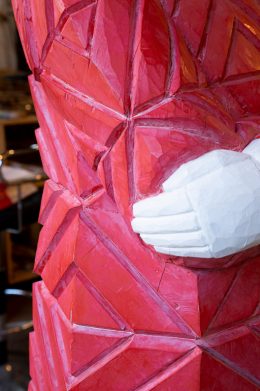
Each block of the down jacket is chamfered, facing upwards and downwards. These are not lines drawn on a flat surface.
That's why it's a sculptural work, even though it's a video. Eventually, if we can project in 8K, it will become an even larger expression of sculpture using an entire wall, which I find fascinating.
—So, the appeal of B-BOY, and B-BOY sculpture, lies in gravity and space.
TAKU OBATAAnd also "movement." When you're modeling clay inside a box and it gets bigger, the space becomes smaller. This is essentially carving space. Conversely, if you carve within the same box and the object becomes smaller, the space is being modeled. I used to feel it was a waste to throw away the wood shavings produced during sculpting, so I started burning them in an incinerator. They turn into ash and then return to nature as rain. Disposing of them is the same. The Earth's mass probably doesn't change, so I believe that everything, not just sculpture, is ultimately made of the movement of matter.
Ultimately, it's about movement. I think it's similar to considering body movement.
People who are good at the moonwalk, for example, first fix their heads in place. Parts of the body appearing to be stationary make the movement look cooler. This connects to the strange sensation of a moment suspended in space.
—Thank you. I look forward to your future works.
B-GIRL Down Jacket NAGAME
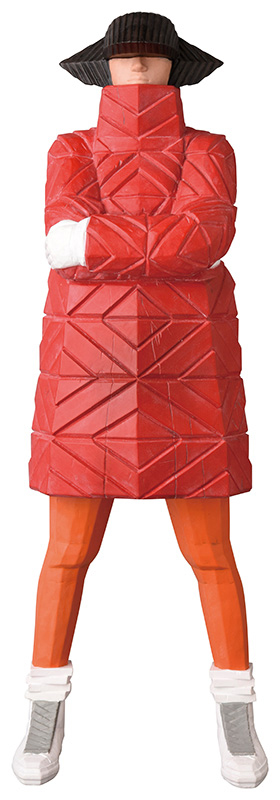
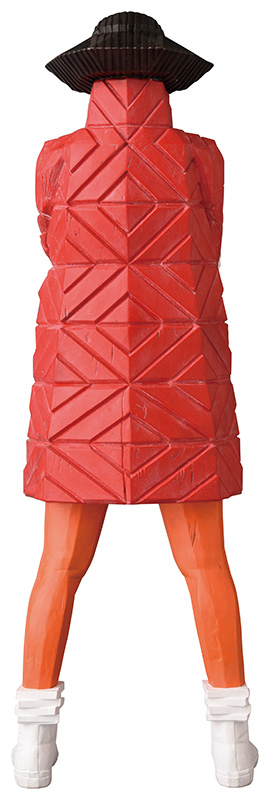
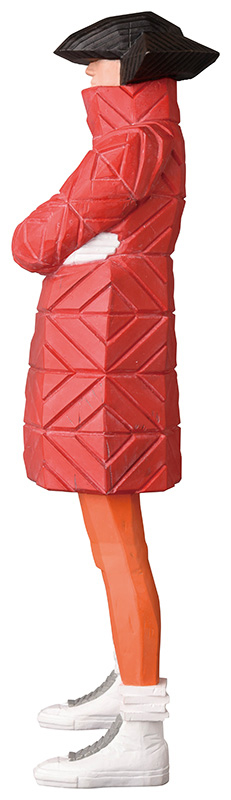
Available starting Saturday, April 20th at all Medicom Toy direct stores and online stores!
Includes limited edition numbering!
A multiple product created by 3D scanning TAKU OBATA's sculpture and scaling it down, with fine adjustments made by OBATA himself. Approximately 350mm in height. Prototype production / TAKU OBATA. Material / Polystone. Limited edition of 100 pieces sold at Medicom Toy direct stores and the Watari-um Museum Shop On Sundays. Price: 54,000 yen (tax included).
*As this is a limited quantity item, sales will end once stock is depleted.
*The product will include a limited edition number. Please note that you cannot select the edition number.
Distributor: Medicom Toy
Seller: Medicom Toy
© TAKU OBATA
Inquiries
Medicom Toy User Support
Tel. 03-3460-7555