Exploring the enduring allure of the "Sexy Robot" on its 40th anniversary | MEDICOM TOY
MEDICOM TOY | Medicom Toy
An Interview with Illustrator Hajime Sorayama (Part 1)
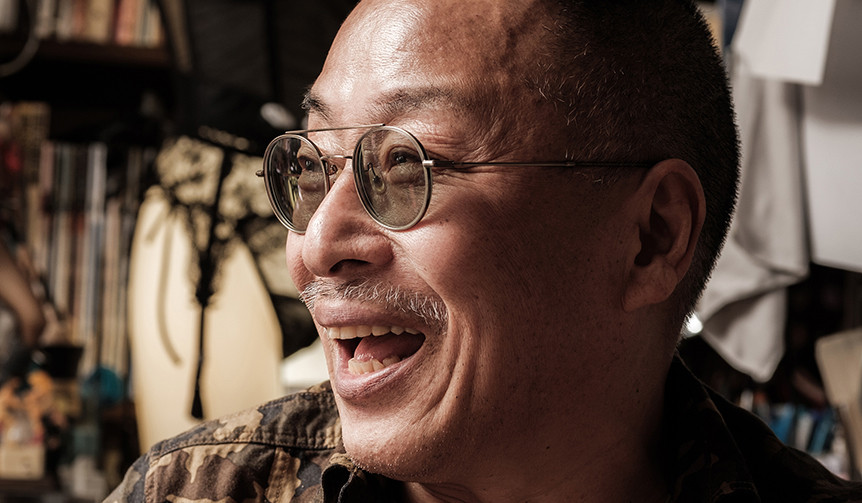
The long-awaited appearance of master artist Hajime Sorayama. "Sexy Robot," drawn in the late 1970s before digital graphic tools existed, instantly brought him to prominence. Its appeal, extending beyond mere eroticism, is evident in the fact that it continues to capture attention 40 years later. Remarkably, the artist still draws Sexy Robots with brush and paper. With various projects underway from Medicom Toy, we directly asked the artist about his current state of mind.
Photograph by Kaku OhtakiText by Kunihiko Shinno
The Origin Story of Sexy Robot
—Your signature "Sexy Robot" series began in 1978 and celebrates its 40th anniversary this year. The series remains fresh and captivates many people. What inspired you to create the first piece?
SorayamaIt was for an advertisement (Suntory). I drew them between '79 and '80. At first, they were almost rejected for being too sexy, but they were ultimately approved.
—These works were published as the art book "Sexy Robot" in '83 and became a global sensation.
Could you tell us about the background of the "Sexy Robot" title?
SorayamaThe editor-in-chief at the publishing company named it. She was a female editor and incredibly sharp.
However, calling it simply "Sexy" and "Robot" leaves no room for nuance, which feels a bit lacking. While it's easy to understand, it still makes me feel a little uncomfortable.
—How did you feel about the transition from your earlier realistic "pin-up girls" to the metallic "Sexy Robots"?
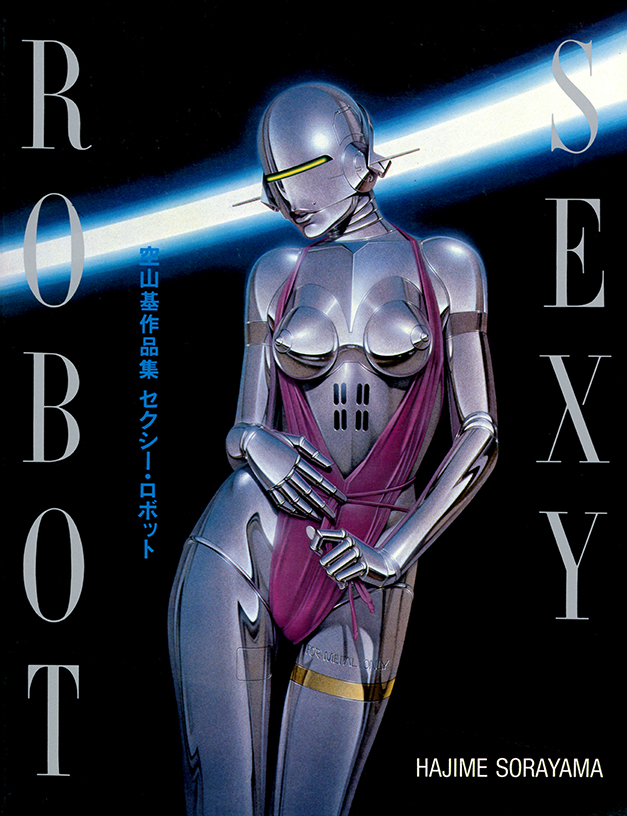
"Sexy Robot" (Hajime Sorayama)

"Pin-uP" (Hajime Sorayama)
SorayamaIt's like translating a novel from Japanese to another language; the essence remains unchanged.
—Hyperrealism was popular in America in the '70s, but you developed your own unique style, distinct from theirs.
What was the art world like at that time?
SorayamaI don't know about other artists. It just naturally became my own style.
I was so focused on drawing what was requested every day that I didn't understand the art world back then at all.
For one thing, I didn't even consider it art myself.
—Could you also tell us about your effective use of airbrush? Your use of blue is distinctive; how did you develop that technique?
SorayamaIt's a supporting role to make the motif stand out. It enhances its presence. There's no explaining that other than through intuition! (laughs)
—In '93, the art book "Gynoid," featuring elements like bondage and fetishism, was published. What is the appeal of eroticism depicted through metallic expression?
SorayamaIt's my natural state. I'm part of a small minority who finds metal sexy. I'm a pervert.
The title "Gynoid" was also given by an editor at Treville, a publisher known for its edgy projects at the time. It was apparently taken from an English novel, and the title seems to resonate better with English speakers. It also has a strong impact due to the voiced consonant sound.
—You generally don't title your works yourself. What is the reason for that?
SorayamaOnce I add words, I feel like I've lost. It's like making excuses. So, people from the publishing company give them titles arbitrarily.
If I absolutely must include text, I'll engrave it onto the robot or include it as a tattoo.
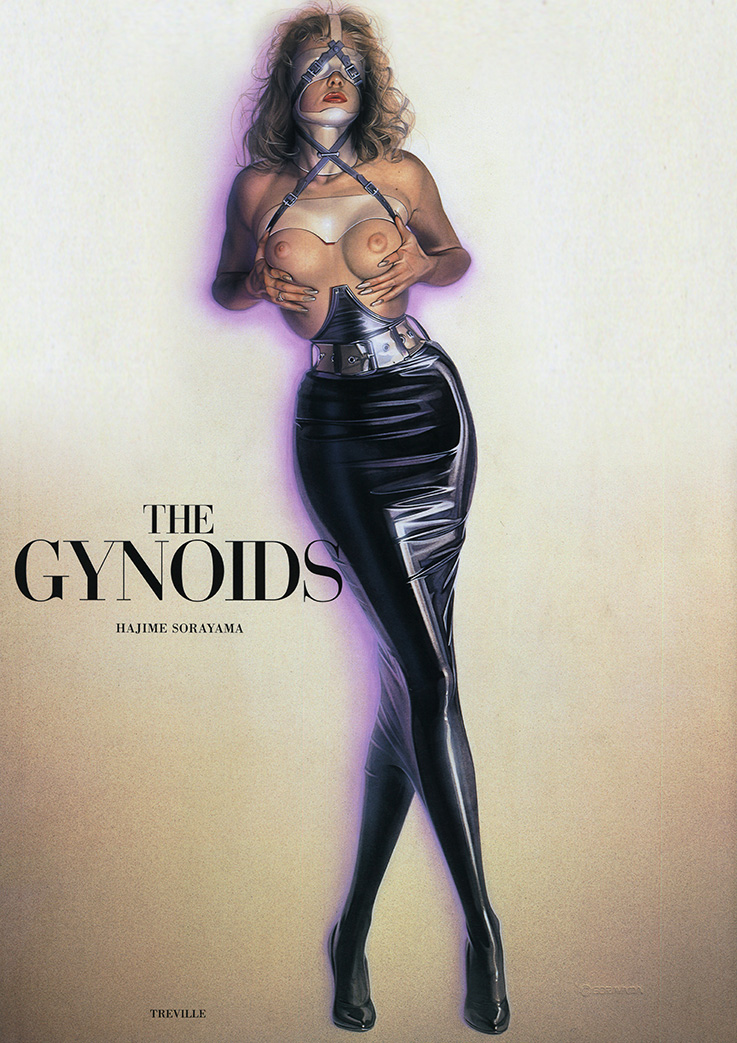
"Gynoid" (Hajime Sorayama)
—I believe many people were introduced to fetish culture through your work.
SorayamaShin Ohrui's Fiction inc. laid the groundwork for that. In the '80s and '90s, Tokyo had specialized fetish shops like the deep and AZZLO.
Young people don't really get it if I talk about that now. Recently,Kurageis a well-known shop, and it's said to be influencing Europe.
Europe and America have many restrictions due to religion and other factors, leaving them quite constrained. Surprisingly, Japan allows for more unconventional approaches.
—In the sense that humans create humans, robots are similar. I've heard that in some parts of the West, there's resistance to robots due to the Christian doctrine that one shouldn't play God. Is that true?
SorayamaHowever, recently,Boston Dynamicshas been creating bipedal and quadrupedal robots, haven't they? Seeing those makes me wonder if there really are taboos. They can jump, and they get back up no matter how many times they fall – they're just like Terminators.
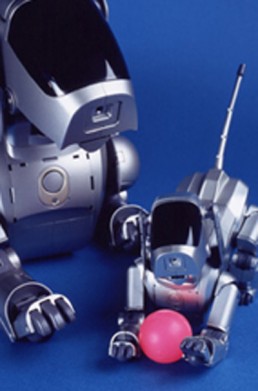
—(Laughs). Following your "Animal Robot" series, where you depicted animals in metallic form, in '99 you handled the concept design for Sony's entertainment robot,AIBO (first generation ERS-110)The first-generation AIBO won the Grand Prize at the Ministry of Economy, Trade and Industry's Good Design Award and the Grand Prize at the Japan Media Arts Festival. In 2001, it was added to the permanent collections of the Smithsonian Museum and MoMA.
Thisfigure of the first-generation AIBO, at half size,marked your encounter with MEDICOM TOY.
SorayamaSony's staff recommended MEDICOM TOY, saying they have high quality. I believe they also released smaller versions, right?
—Those were released as part of a series called B@WBRICK. This year, Sony released a new AIBO for the first time in 12 years, and we hope MEDICOM TOY will release a figure of the first-generation AIBO again.
SorayamaIt might be difficult, but if it's made, I'd prefer it to be cast in heavy die-cast metal rather than plastic this time.
Page 02.Sexy Robots Integrated into Daily Life
MEDICOM TOY | Medicom Toy
An Interview with Illustrator Hajime Sorayama (Part 2)
Sexy Robots Integrated into Daily Life
—"Sexy Robot" has also been featured on CD jackets. Recently, the works of voice actress Sumire Uesaka,'Inner Urge' ('15)andrapper Tyga's 'Kyoto' ('18)gained attention. Among them, Aerosmith's'Just Push Play' ('01)was a globally successful album. Unfortunately, due to a mistake, a reversed image of your original artwork was used.
SorayamaThe art director for the CD presented a reversed image, and once it's done, it can't be changed in the American system.
—"Sexy Robot" has also been collaborated on with apparel lines such as A BATHING APE® ('02) and STÜSSY ('14). What are your thoughts on these collaborations?
SorayamaIf it causes a stir, becomes a topic of conversation, and makes money, then anything is fine. Causing a sensation releases dopamine.
—In recent years, with XLARGE® ('16), you collaborated on a Sexy Robot wearing a camisole and depicted the XLARGE® brand icon, the "OG Gorilla," in metallic form.
SorayamaThere might be some new developments...
—You yourself have also been spending more time with Sexy Robots, releasing a series based on Marilyn Monroe. How do you perceive the current popularity of Sexy Robots?
SorayamaIt's the culmination of the strategy and conspiracy of my gallery, NANZUKA. Fools are easily flattered and get carried away.
—Your work is also popular overseas. Last year, an exhibition called"Sawasdee Sexy Robot"was held in Thailand, featuring life-sized Sexy Robots and a giant 2000% SORAYAMA SEXY ROBOT BE@RBRICK & R@BBRICK.
SorayamaA businessman in Bangkok loves art and culture and really wanted to hold an exhibition, so I agreed since he was so insistent. He's also a huge BE@RBRICK collector.
There aren't many galleries in Thailand that link to street or subculture, so I think he wants to be a pioneer in that field.
—It could be the first step towards establishing such art in Thailand.
SorayamaHe's a very wealthy man, and this spring he also opened a gallery calledEchoOne Nanzuka. I also have an exhibition scheduled at NANZUKA in Tokyo in July.
—Could you also tell us about the background of your collaboration with BE@RBRICK? When you received the offer, what were your thoughts on the BE@RBRICK design and concept?
SorayamaAt my age, just being offered something is a joy. Most artists from the baby boomer generation have disappeared, so I consider myself fortunate. It's entirely due to my own sense and skill, of course (laughs).
—By the way, are there any works that have recently influenced you?
SorayamaYour Name.was quite well-made. I've always liked meteorites and archaeoastronomy. I was obsessed with books by Peter Kolosimo and Erich von Däniken, and we'd all go to places where UFOs were sighted with beers in hand.
I once saw a fireball. I think it was a fragment of a meteor falling, but it was enormous when seen up close.
—It's surprising that you're interested in meteorites.
SorayamaI also enjoy watching videos of volcanoes. I don't like seeing them up close, though; it's dangerous.
That's why I like drone footage. It allows for a vicarious experience. I think seeing footage of icebergs breaking and falling from directly below would be eye-opening.
—You seem to appreciate things that are overwhelming.
SorayamaI want to be surprised myself.
In other words, the idea is to surprise others through my paintings. If it doesn't surprise, it's not art. That's why when I'm moved by something, I want to go home quickly and paint. Though that happens maybe once a year.
—Lastly, could you tell us about any motifs you'd like to paint in the future?
SorayamaI can't reveal the motifs I truly want to paint. I'll take them to my grave. I don't want to be arrested or end up on Interpol's blacklist.
The works I can present now are listed after NANZUKA's censorship...