In-Depth with Japan's Designers (2) Fumie Shibata
Japanese Designers Interview Series (2)
Fumie Shibata
The Art of Ingenuity in Design
Industrial designer Fumie Shibata, whose work spans a wide range of everyday items from stationery and home appliances to capsule hotels. Shibata's designs are often described with words like warmth, comfort, and gentleness. Behind these designs lies a meticulous thought process that translates the essential technology of industrial products into soft, approachable forms. Shibata aims to share wisdom for better living through design. Her work not only embodies the inherent form and strength of products but also poses questions about the role of design in society.
Text by KATO Takashi

The Genesis of Form
──Could you tell us about the formative experiences and origins of your design philosophy?
My family's home in Yamanashi was involved in weaving, so I grew up surrounded by craftspeople. In those days, everything was handmade, and it took a great deal of effort to create a single piece of fabric. Being immersed in that kind of craft has become the foundation of my current work in manufacturing.
──You've designed many products that people use in their daily lives. What do you prioritize when designing everyday items?
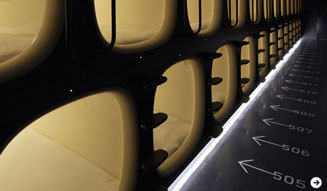
"9h/nine hours" Capsule Hotel in Kyoto, 2009
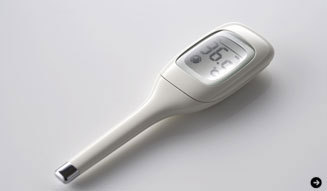
"MC-670 Thermometer" OMRON, 2004
I always strive to create designs centered around daily life, ensuring the product doesn't become the main focus. I want my designs to be unobtrusive within people's lives, allowing users the freedom to interact with them. I believe this approach ultimately leads to products being cherished and used for a long time.
──Your design work includes creating new forms as well as redesigning existing products, like OMRON's thermometer. Are there differences between these two approaches?
It's quite interesting, because while I always aim for subtlety in my designs, the thermometer, for instance, was a departure from previous models—in a way, quite avant-garde and free-spirited. Its form was dictated by the internal mechanism, yet it was perceived by many as a gentle design from a female designer. Perhaps, then, not intruding on daily life or facilitating a freer existence doesn't necessarily mean minimizing design or constraining it. If the essence of the object is captured through design, the final outline can be bold.
I may sound contradictory, saying I want to create things with subtlety while describing bold designs. However, during the design process, I believe in thinking freely to capture the essence of the design. By grasping that fundamental aspect, it becomes 'universal'.
buichi
Launched this summer, "buchi" is a brand of wooden toys for children by Sakai Sangyo. The wooden parts can be inserted into the slits on the main body, allowing for creative play, such as connecting cars to form a train or enjoying the pleasant sound of wood when dominoes fall. 2012
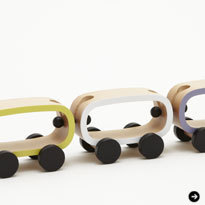
"Car" Material | Maple
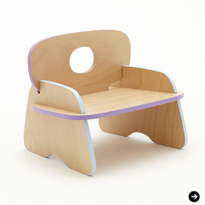
"Chair" Material | Beech Plywood
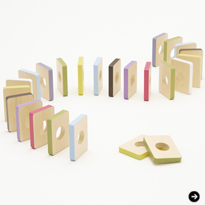
"Domino" Material | Maple
──Industrial design should benefit not only individuals but society as a whole. What does it mean for industrial design to be beneficial to society, in your view?
Firstly, I believe that anything without social relevance cannot be called design. While clients are crucial to professionals like us, they are not the most important factor in the essence of design itself.
In that sense, I believe designers possess a curious dual nature. While working for the client, we also aim to persuade them to communicate and influence the end-users and society beyond them.
It's necessary to consider how we can contribute to society together, leveraging the potential of companies and organizations. Often, the perspective narrows to what the market or competitors are doing. However, I believe we should be doing what is truly beneficial to society and the world from a broader viewpoint. The social role of design is to challenge these limitations. Ultimately, this benefits the company. Furthermore, solving societal problems is also a role of design. However, I believe design is not merely about pursuing convenience or comfort, but rather about the wisdom that helps us live more humanely.
Japanese Designers Interview Series (2)
Fumie Shibata
The Art of Ingenuity in Design
Awakening Primal Human Senses
While it might sound complex to call it 'society,' I have a desire to share, through design, the wisdom that allows people to experience the wonder of living as human beings.
──In Japan, for some reason, the word 'design' still seems somewhat inaccessible to the general public. What does design mean to you?
There's a saying that philosophy is the foundation of all academic disciplines. As a designer myself, I believe that design is the endpoint of all my thinking. In that sense, what design signifies is not exclusive to designers, and I believe that even intangible things can be considered design.
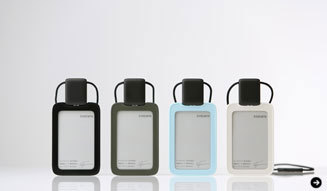
"ID Card Holder" trystrams, 2009
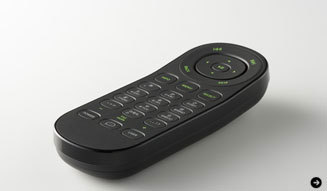
"SPIDER PRO Remote Control" A remote for SPIDER PRO, capable of automatically recording a week's worth of television programs. PTP, 2011
Design is something that even designers, after a lifetime of contemplation, may not fully grasp. So, it's not surprising if it's not always correctly understood. However, I hope that the concept of design becomes something readily available to everyone, like a tool in their pocket. In that regard, it's our responsibility as experts to communicate about good design, and education is also necessary.
──You've been involved in numerous projects. Is there a particular aspect of the design process that you hold especially dear?
Regarding the process, products are born from the involvement of many people. If we consider the design process from 1 to 10, I believe the initial stage, from zero to one, is something only I can contribute. And then there's the finishing stage. Of course, the level of involvement varies with each project, but the fundamental principle is that I won't create something I'm not convinced by.
──Could you share your thoughts on the relationship between design and technology? It seems you translate 'hard' (complex) technology into 'soft' designs imbued with human warmth. Is that accurate?
In that sense, the gentle, human-like qualities we seek in design actually have no inherent similarity to machines.
Isn't design the bridge between what humans seek from it and the enjoyment of technology? My work, I believe, is to make the latest technologies, such as machines and technology for human use, feel as natural and comfortable as human skin. While 'technology' sounds rigid, my aim isn't to develop new materials or create something novel using the latest technology. Instead, it's about using the latest technology to bring us closer to humanity. Paradoxically, it feels like an act of returning to our origins while advancing.
But when you think about it, it is rather curious that we aim for ease of use and comfort by employing the latest technology. Moving towards the future is, in essence, about satisfying the primitive senses that humans have possessed since ancient times – that's an interesting thought. In that regard, using new technology isn't about seeking new forms of expression, but rather about approaching what is natural and self-evident to human perception. Design should aim for a lack of burden in its use. Therefore, the future might actually be more primitive.
ZUTTO
While the home appliance industry typically sees model changes every six months, this series, including rice cookers, has been released with virtually unchanged designs for nine years, aside from specifications. 2004
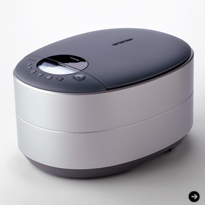
IH Rice Cooker
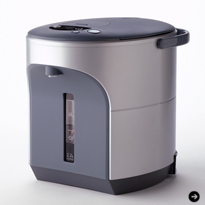
Water Heater
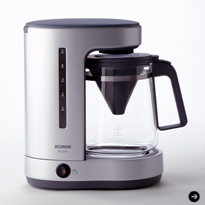
Coffee Maker
──That's fascinating.
I believe design is about transforming value. The power of design lies in its ability to provide insights or shift perspectives through form. I want to challenge myself with that. If we can achieve that, it's a victory for design.
──The pace of consumption for contemporary product design is accelerating rapidly. What are your thoughts on the product lifecycle?
I suspect this rapid pace won't continue indefinitely; I feel a pendulum swing back is inevitable. However, it's not consumers who are accelerating the product lifecycle. Of course, some products benefit from rapid cycles, and I myself, as a designer, want to challenge myself to extend product lifecycles.
I designed the "ZUTTO" series of rice cookers for Zojirushi. While home appliances typically undergo model changes every six months, this product has maintained its design for nine years, with changes only to specifications. It's incredibly difficult to sustain a product for such a long period in the home appliance market, but I believe there should be room for such longevity. As a designer, I feel this way, and it's something I consistently aim for.
Japanese Designers Interview Series (2)
Fumie Shibata
The Art of Ingenuity in Design
The Afterlife of Designed Products
──Do you find yourself curious about how the products you've been involved with are used?
Of course, I'm very curious. I once saw a "baby bath" I had designed discarded in the garbage area of my apartment building, and it was a deeply upsetting experience. I even considered taking it back. While I often see my designs on store shelves or in use, it's rare to see them later, with a bulky waste sticker, placed out for disposal. The shock of that sight was profound (laughs). However, it was a symbolic moment, reminding me that designers must design with an awareness of the product's eventual end.
──Regarding disposal, and also concerning your thermometer and name holders, there are instances where they are used in ways you didn't intend, such as being covered in stickers or decorated.
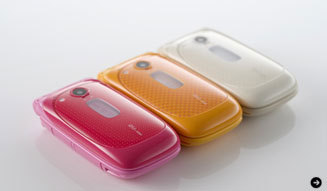
"Sweets" Children's Mobile Phone, KDDI, 2005
I'm curious to see those instances as well. I consider decorating a product a sign of affection for it. Also, some time ago, I designed a mobile phone for pre-teen girls. A student I taught at university once told me that she had used the phone I designed when she was a child. At the time of design, I intended it for children, so hearing that the girl who used it had grown up so much made me acutely aware of the passage of time. Seeing a product I designed accompany a child through their life made me realize that objects share life's journey with people.
──There's a notion circulating that design is shifting from product design to 'concept' design. What are you currently interested in or contemplating in your design work?
After over 20 years of contemplating design and working as a designer, I still haven't definitively grasped what design truly is. I believe that the continuous search for its essence is design itself. While we distinguish between 'concepts' and 'objects,' I believe there are no objects without concepts. I wonder if the appeal of an object can be created solely through concepts, as I find it difficult to separate the two. Therefore, the 'concepts' and 'objects' we speak of are merely verbal definitions. Organic forms like design cannot fully complement logical constructs like words.
Both product and concept design are things that cannot be fully articulated in words, but my long-held belief remains that design is about devising wisdom for a better way of living. Recently, while writing a book about my own designs, I realized that for a designer to write about design is, in essence, to write about how little they understand it (laughs).
──Those are profound words, especially coming from you with 20 years of experience.
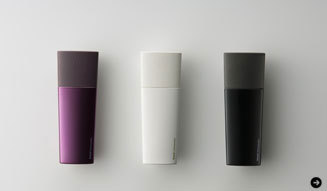
"basal" Women's Basal Thermometer, OMRON, 2012
Isn't it strange that after designing for 20 years, I still don't understand? But precisely because I don't understand, I search earnestly. The more I work and learn, the more complex it becomes, and I feel the essence of design receding. It's always a mystery.
I myself am often in a state of contradiction. My background is in a craftsman's family, yet my profession is industrial design. While practicing industrial design, I aspire to create gentle forms. I feel I am constantly creating amidst contradictions. Perhaps it is through this struggle to bring designs to life that my originality emerges.
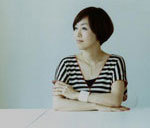
Fumie Shibata
Industrial designer. Graduated from Musashino Art University, Department of Crafts and Industrial Design in 1990. Joined Toshiba Design Center the same year. Established Design Studio S in 1994. Principal works include OMRON's electronic thermometer Kenonkun, Zojirushi's ZUTTO series (2004), KOKUYO trystrams ID card holder, capsule hotel 9h/nine hours (2009), and the next-generation vending machine acure (2010), among others. Awards include Good Design Gold Award (2010, 2011), Mainichi Design Award (2012), and numerous others.

