Feature: OPENERS' Young Japanese Architects, Part II – Vol. 5: Araki + Sasaki Architects Interview
Vol.5 ARAKI + SASAKI architects (1)
Self-Build as a Design Method
For a long time now, architecture has not been something people create, but rather something they buy. In this context, the goal often becomes having a famous architect design a house, with the original purpose—how one wants to live with whom in that particular place—being pushed aside. ARAKI + SASAKI architects (A+Sa), a group of three architects—Genki Araki, Takayuki Sasaki, and Tamaho Sasaki—views self-build as a design philosophy for their design studies. They value not only thinking about design with the mind but also engaging in thought through physical action. We spoke with them about their design methods, as they aim for "architecture without rhetoric," unafraid to reveal the architect's inner workings as they create architecture together with the user.
Interviewer, Editor: Takashi Kato
Using Hands, Building Oneself
──Please tell us how the three of you met.
Takayuki SasakiThe three of us were classmates in university, and we've known each other ever since. Our class only had 40 students, so most of us are still close.
Tamaho SasakiI didn't really know the two of them that well during our university days.
Genki ArakiSasaki and I were close from the beginning of university, and we even went abroad together to see architecture.
SasakiWithin a month of entering university, Araki started crashing at my place (laughs).
──You specialized in architecture at university, correct?
SasakiYes. I specialized in architecture at the Department of Architecture at Tokyo Metropolitan University. For the month before starting our second year, Araki and I traveled abroad to see architecture.
──Where did you go at that time?
ArakiWe toured Europe, mainly France, Italy, and Spain.
──Did you have specific buildings you absolutely wanted to see?
SasakiAt that time, I didn't really have strong preferences in architecture, so we just relentlessly visited famous contemporary buildings.
──So you were empirically observing how buildings were situated within their environment, including the surrounding context?
ArakiYes, along with the buildings themselves, there was a sense of atmosphere in the towns that you could only grasp by being there.
SasakiI hadn't seriously studied architecture yet at that point, so I couldn't analyze buildings critically. But I think it was good just to be able to experience them firsthand and be moved by them.
ArakiSasaki and the others studied abroad in London together after graduation, so perhaps you remember that more vividly? I still sometimes recall the atmosphere of Europe and feel like visiting again.
SasakiI remember being impressed by Gaudí's architecture in Barcelona, Spain, during that trip. In our fourth year, Araki joined Professor Fukao's structural engineering lab, I joined Professor Koizumi's design lab, and Tamaho joined Professor Ueno's planning lab. While all were design-focused labs, we studied different fields.
──Did you have a vision at that time of starting your own architectural firm together in the future?
ArakiNot at all back then. So, it was purely coincidental that we all went into different specialized fields.
──Thinking about it that way, it feels like a rather strange fate that the three of you came together.
SasakiAfter Tamaho and I returned from the UK and initially started our independent practices, we established Sasaki Architects as a couple, while Araki worked as Genki Araki Architectural Design for about six months. We initially collaborated on competitions, and during that process, we realized our ways of thinking were quite similar. Following that, we officially formed ARAKI + SASAKI architects, Class-1 Architects Office (A+Sa).
TamahoBefore starting ARAKI + SASAKI architects, we worked together on creating an exhibition venue. At that time, we hadn't done the construction ourselves, but when we got the estimates, they were higher than we expected. However, staying within budget would have resulted in something uninspired. So, we decided to build just the sofas ourselves. That's when I thought of Araki, a close friend from university who was skilled in construction, and reached out to him. That was the beginning.
──What were you doing at that time, Araki-san?
ArakiI was in a bit of a drifting phase then.
SasakiWhen I left NAP Architects (architect Hiroshi Nakamura's firm), where I joined after returning from the UK, Araki had also just left his previous firm, Architect Cafe (architect Mikio Tai's firm), and was working at an architectural firm in Okinawa, I believe. Because the things we actually built together then turned out well, we decided to try entering a competition as a trio. Tamaho and I studied abroad together at the University of East London for two years after graduating. Their educational approach was centered on "constructing things with one's hands," which is a concept that resonates with A+Sa's current design methodology.
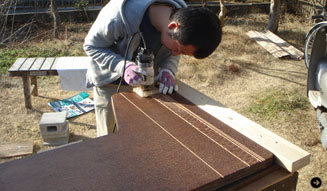
Housing Physics Design Exhibition (2008)
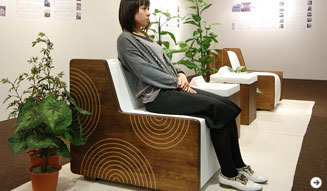
Housing Physics Design Exhibition (2008)
New Realizations Encountered in the UK
──The experiences in the UK significantly influenced A+Sa's current design methodology, didn't they?
TamahoYes, they did. Not just the design methodology, but also the way we approach running an office. There's a significant difference between atelier-style architectural firms in Japan and Europe. For instance, regarding time management alone, architectural firms in London have fixed working hours, with almost no overtime. Yet, work progresses efficiently. From that experience, I felt that similar practices could be implemented in Japan.
──Is this difference due to the level of autonomy of British and Japanese people?
SasakiYes, in a good way, they have a hands-off approach. It's easy to get into university there, but difficult to graduate, unlike in Japan where it's relatively easy to graduate once you're admitted. You can't graduate without actively seeking knowledge and applying it.
ArakiWhat I heard from the two of them after they returned from London was indeed fascinating. Their passionate discussions about design methods and materials were surprising to me, knowing them since university.
──Discussions about materials?
ArakiYes. Since university, I've been interested not only in design but also in materials and construction methods. The two of them, at that time, seemed to prioritize design over a hands-on approach, leaning towards a more pop-oriented direction. Also, I was surprised to learn about design education in overseas universities that involved handling materials with one's hands and thinking through that process.
SasakiIn terms of materials and thinking with one's hands, Araki was originally more inclined towards and skilled in those areas.
ArakiWe were always close, but when we decided to work together professionally, the fact that we could share common ground in terms of design methodology became a major catalyst for starting our firm.
──So, the reason you are now running an architectural firm together is because you share a common philosophy regarding design methodology?
SasakiOur shared perspective on design is the primary reason we started working together.
TamahoFurthermore, our individual strengths are complementary.
──So, the three of you found a good balance in your fundamental approach to architecture?
ArakiEven now, seniors who knew us back then sometimes express concern about whether our combination would work. That's how different our design orientations were in university. What Sasaki and Tamaho learned in London was incredibly significant.
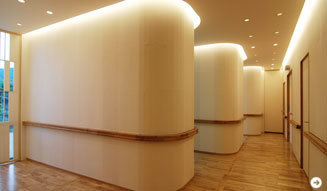
K Clinic (2009)
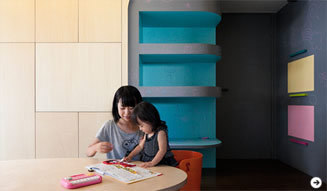
O Residence Renovation (2010) Photo by SHIMIZU KEN
Vol.5 ARAKI + SASAKI architects (2)
Self-Build as a Design Method
"Self-Build" as Design Study
──Are there any architects whom the three of you mutually respect?
SasakiAlison and Peter Smithson, British architects active mainly in the 1950s and 60s. The Smithsons are literally our idols. The philosophy of UEL, the school where we studied, is also in the lineage of the Smithsons' ideas. It's the concept of "architecture without rhetoric."
The Smithsons' idea of "honest, straightforward, and unpretentious architecture" challenged the modernist tendency to paint everything white. They found value in human daily life and focused on prominently displaying everyday equipment and materials. They aimed for "unpretentious buildings," and we are deeply influenced by them.
TamahoAs a side note, when the Smithsons signed their names, they used capital 'A' and 'P' connected by a '+', with a lowercase 's'. We adopted this for our name, 'A+Sa'.
──It seems that mirroring your objects of admiration and affection in a dual sense connects to your own affection for your activities as A+Sa. Does the admiration for the Smithsons also extend to your own activities as a couple?
ArakiSo, in the end, I'm the odd one out (laughs). Although we currently operate under the name ARAKI + SASAKI architects, I hope that eventually, 'A+Sa' will become the established name, similar to the Smithsons' 'A+Ps'.
TamahoCurrently, the three of us are the principals, but we are open to increasing the number of 'partners.' The name ARAKI + SASAKI doesn't signify putting our names front and center, but rather reflects our belief in the significance of teamwork.
──Since each member of the team has their own area of expertise, is there a division of roles where one person takes the lead on a particular project?
SasakiInitially, we had fewer projects, so the three of us worked on each one collaboratively. However, as our workload has increased, it's become more common for one person to take responsibility for a project. In such cases, the approach is for one person to lead, while the other members provide an objective perspective. That said, we still want to undertake projects where all three of us collaborate closely.
──So, the ideal situation is to have a balance within the team for individual projects, while also having opportunities where the three of you can simultaneously bring your distinct motivations to bear on larger projects?
SasakiYes, exactly. We want to pursue both simultaneously.
──"Self-build" as a design study is the core of A+Sa's design philosophy. Could you please elaborate on this design methodology?
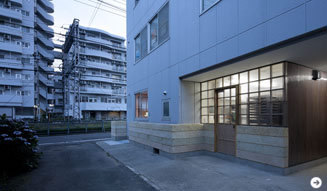
A Moment of Peace (2011) Photo by SHIMIZU KEN
ArakiWhen we first established our firm, we established several principles that we continue to uphold. One of them is valuing thought through physical action, rather than solely relying on intellectual reasoning.
Specifically, this means developing ideas through hands-on work, not just through architectural drawings or computer renderings, but by creating models and mock-ups at a near-real scale. "Self-build" at real scale is an extension of this. We call this "self-build as a design study."
Of course, we don't handle the construction for every project ourselves. However, by actually building on-site, we can develop ideas based on insights gained only at that moment, and we can modify designs accordingly. Furthermore, experiencing materials and construction methods firsthand allows us to apply that knowledge to future designs.
SasakiWe absolutely want to avoid theoretical discussions detached from reality. Our conviction as architects is that by actively engaging our hands, creating prototypes or models at a significant scale, and then building on-site, our designs will never remain mere theoretical concepts. Our insistence on touching and working with our hands has led us to "self-build as a design study."
──By engaging in self-build, you reveal aspects of the design process that architects might otherwise prefer to keep private. Do you have any reservations about this?
SasakiNot at all.
──For us, the construction process is often a black box, a part that we, as general users or clients, are curious about. In typical construction, there's no room for user initiative; things are simply completed without our direct involvement. Revealing the architect's process could provide a significant sense of security, couldn't it?
Towards Architecture Without Rhetoric
SasakiI think that's quite important. Furthermore, when residents actively participate in the construction process with their hands and bodies, it fosters a deeper sense of attachment to the finished building. As you mentioned, the feeling towards a completed building is entirely different if the process was a black box versus if one was involved. The fact that we can facilitate this feeling is one of the advantages of our self-build method.
──DIY is currently a major trend in design and art. Creating something with one's own hands is a fundamental human ability, yet it seems to be underutilized today. In the context of the recent earthquake, while legal regulations are in place, the reality is that actively building things with one's own hands in the affected areas is not encouraged. I find this situation somewhat concerning.
SasakiI agree that there's a tendency for architecture to be viewed as something to be commissioned rather than something one can actively engage with oneself.
──What are your thoughts on the idea of self-build as an alternative to modern high-tech approaches?
SasakiWe agree. Although perhaps unconsciously, we do approach self-build with that perspective in mind.
ArakiAs with "architecture without rhetoric," we've found through our own experience that the scope of what can be achieved through self-build is not that extensive. The high-tech aspects of architecture inevitably emerge as limitations when we engage in hands-on work in contemporary construction.
SasakiArchitect Osamu Ishiyama refers to this as "bricolage" (*). After the earthquake, this concept resonated deeply with me. We've ended up in our current society, for better or worse, by tackling things beyond our immediate capabilities. The famous story of Apollo 13, when a malfunction prevented them from reaching the moon or returning to Earth, involved using materials like plastic bags and cardboard found inside the spacecraft to create makeshift solutions and safely return to Earth, a testament to ingenuity in the face of technological limitations.
Ishiyama-san describes this as bricolage. The importance of creating what one can with one's own hands is something that, as architects, we should never forget, regardless of the era. For us as designers, it means trying things out when we encounter unknowns. Self-build is our practice of this principle.
──This seems to directly connect to A+Sa's concept of "architecture without rhetoric." It conveys a sense of responsibility from the architect towards the tangible aspects of architecture that people interact with.
SasakiRather than pursuing a specific goal, we believe it's important to consider what is most suitable for a given location, rather than blindly adhering to existing rules.
※BricolageMeans creating by assembling readily available materials, akin to DIY. It represents a universal form of knowledge that requires creativity and ingenuity. French anthropologist Claude Lévi-Strauss's concept was adapted by architect Osamu Ishiyama to contemporary craftsmanship.
Vol.5 ARAKI + SASAKI architects (3)
Self-Build as a Design Method
Working with Hands, Thinking with Hands
──It's possible that this approach might be perceived as a trendy craft-based method. However, you're suggesting there's a different background to it?
SasakiWe don't deny craft itself; in fact, we believe that clients developing a greater attachment through hands-on involvement is one of the benefits of self-build. However, we engage in architectural practice with the understanding that self-build encompasses more than just that. It allows for a degree of experimentation; by thinking on-site rather than solely at a desk, we constantly anticipate the emergence of new possibilities and strive for better design.
ArakiYes, while we design in response to client requests, we don't want to stop there.
SasakiIn the "A Moment of Peace" project, where we built a cafe and bakery, the client loved the sea and wanted to incorporate shells and coral they had collected to evoke a seaside atmosphere. While the finished product might appear as craft, in this instance, we used a material called "mud concrete" to create a layered texture on the walls resembling natural strata. By embedding shells and coral, we explored new possibilities for wall surfaces. We approach things from multiple perspectives, avoiding the tendency to be narrowly categorized as simply "craft." Pure experimentation alone offers no benefit to the client, and focusing solely on craft would be no different from DIY. We believe it's essential to pursue both.
ArakiSome might say this is feasible because it's a relatively small-scale renovation. However, we plan to incorporate self-build significantly in an ongoing new house project as well. We believe we can evolve our self-build approach beyond scale limitations.
──Given that you adopt "self-build" through hands-on work as your design methodology, issues of scale and architectural precision inevitably arise. However, it seems to be more about the concept of self-build as an approach to architecture and as a design study, rather than solely about scale. It's a method that might seem accessible but is ultimately not for everyone. Also, could the self-build in this context be considered akin to "open source"?
TamahoThat's certainly part of it. Additionally, having construction staff within the A+Sa team is a significant advantage for undertaking self-build projects.
──While the approach to individual projects is clear, I'm interested in how this methodology is accumulated as a concrete practice of self-build. It's not just about solving a problem for a specific site and ending there; how does it accumulate as a methodology?
SasakiWe've completed about five projects entirely through self-build. Including projects where self-build was partially involved, we are currently in the process of accumulating and organizing these specific examples.
──Are there any conditions for undertaking self-build?
SasakiWhile budget can be a factor that self-build helps to manage, time constraints are the biggest bottleneck.
ArakiProjects with strict time limitations are difficult to incorporate. Self-build projects often require longer construction periods and necessitate thorough preparation.
──As an atelier-style architectural firm in Japan, A+Sa stands out in its approach to self-build. Do you take pride in this?
SasakiWe don't necessarily feel pride, but it's true that few others are doing it. I believe the general public still doesn't see the benefits. We hope to shed light on this aspect.
Building Relationships Through Architecture
──Could you tell us about your recent projects? How about the I Residence renovation?
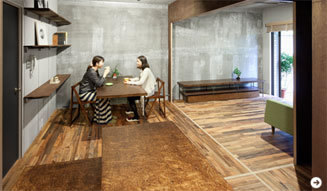
I Residence Renovation (2011) Photo by SHIMIZU KEN
SasakiSelf-build has various levels. This was a short, two-month project, so the amount of self-build involved was relatively limited. Without altering the original room layout, we focused on how to connect the living and dining areas. The client expressed a desire to host parties at home. Instead of simply creating a large open space for this purpose, we designed areas where small groups of two or three could converse in distinct zones like the living room and kitchen, while maintaining a sense of connection.
To delineate these areas, we created partial walls and side walls using thin, furniture-scale partitions measuring 40mm. This allows each room to be distinct yet form a continuous space. Correspondingly, we used paperwood, a plywood made from compressed straw, for the trim materials on the walls and floors. The exposed edges, which serve as dividers, have a dynamic quality. We envisioned that by composing the space with the 200mm concrete structural walls and these 40mm furniture-scale elements, we could achieve a sense of connection and expansion between spaces.
Additionally, we constructed the kitchen counter, dining table, and living room TV stand using harvest panels (compressed straw) and deformed reinforcing bars, which are structural materials for buildings. This project was undertaken with the core idea of eliminating conventional 100mm partition walls.
──Considering the limited living space in Japanese residences, paying attention to the nature of walls themselves and the exposed edges of elements like paperwood could be effective in ensuring spatial independence while creating plans for rooms with distinct functions. You also used paperwood in the previous "O Residence Renovation," didn't you?
SasakiThat was a renovation for a small room for a family with children. The aim was to create a space where the young daughter and mother could study together in the living room, and the father could return to that scene. With a limited budget, instead of renovating all the rooms, we focused on creating one exceptionally good space.
The I Residence project involved controlling the overall composition, while the O Residence project focused on creating a beautiful scene within a single room, each addressing different premises.
──A question common to both residences: what are your thoughts on the conventional Japanese housing format of "LDK"? While we might have a certain dissatisfaction with living arrangements like LDK, there's also the aspect of comfort derived from distinct zones for different activities and living scenarios.
SasakiThe LDK concept itself is not inherently bad, as it facilitates daily living. Rather than rethinking the LDK concept entirely, we aim to enhance it, as we did in the I Residence project.
Similar to LDK, we design by considering who we are designing for and how we should approach existing values. For example, in "A Moment of Peace," embedding not only shells but also marbles into the walls might have been visually unconventional, but seeing the children's delight made it unequivocally the better choice. For us, self-build offers the joy of discovering possibilities beyond what can be conceived at a desk.
──The strength of A+Sa's self-build approach lies not only in the spatial relationships during design and construction but also in its ability to foster human relationships. Wouldn't you agree?
ArakiWhen engaging in self-build or creating something together with clients, they tend to visit the site more frequently, and their attachment to the space grows even during the construction process.
──The relationships that emerge from architecture are truly wonderful. I believe they are particularly strong because they are grounded in a tangible entity—the building.
SasakiFrom the outset, we had a philosophy of creating something for the people who will inhabit it. However, the awareness that a space is truly complete only when people engage with it has intensified since we began self-building. Our approach to creation has shifted to a different level.
──Among A+Sa's recent projects, I particularly admire the ASABA Art Cafe renovation. What makes this project unique is the seamless integration of the original elements and the self-built components; it's difficult to distinguish between them. This space was designed to exhibit the client's doll collection, and I found it wonderful how everything blended in as if it had always been there.
SasakiThat's a very gratifying comment.
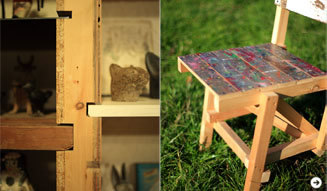
ASABA Art Cafe (2010) PHOTO by Takeshi Ijima
ArakiThe shelves at ASABA Art Square were constructed using salvaged materials from the demolition of the original room. When using such raw materials, we paid meticulous attention to the details, ensuring they would go unnoticed. Naturally, the accumulation of these subtle, unnoticed handcrafted elements contributes to the overall quality.
Furthermore, when we maintain close communication with the client, they are candid in their feedback and will point out aspects they are not satisfied with. This is surprisingly rare in architectural practice, as we've come to realize.
TamahoOne of the advantages of self-build is its flexibility, allowing for easy adaptation and execution during the construction process.
ArakiThe blurring of boundaries between old and new likely resulted from using salvaged materials from the original space and leveraging the client's enthusiasm.
Vol.5 ARAKI + SASAKI architects (4)
Self-Build as a Design Method
Towards Architecture That Connects People's Sentiments
──The earthquake exposed the vulnerabilities of cities, including energy and security. You initiated a project called "Hiroshima 2020 Design Charrette" (hereafter HODC), focusing on the city of Hiroshima. Could you tell us about HODC?
SasakiI am originally from Hiroshima, and HODC began as a project driven by a simple sense of hometown pride in response to the Hiroshima City's announcement in late 2009 to consider bidding for the 2020 Summer Olympics. I planned it with Fumimasa Ogawa from FUTURE STUDIO, a friend from my UK study abroad days.
We wanted to see if we, as young architects, could contribute in some way to revitalizing Hiroshima. In fact, this event brought together 15 emerging architectural firms active across Japan, along with architects working in Hiroshima, to contemplate the future of Hiroshima as a regional city ten years hence, using the Olympics as a catalyst.
As one of the proposers, we presented our vision for Hiroshima. Our proposal involved gradually realizing small-scale initiatives over the ten years leading up to the Olympic year. Rather than presenting a grand new vision as urban planning, we believed that accumulating achievable, albeit small, steps would be crucial for the future of cities. I believe the ideas we developed then remain relevant even after the recent earthquake.
──Radical, surgical interventions are no longer realistic for cities; it's about proposals based on a sustainable perspective, isn't it?
ArakiThis plan also involves accumulating gradual progress year by year, rather than proposing everything at once for 2020, to reach the target year. In that sense, we find more realism in gradual change over time.
──HODC, both as a design project and in its approach to urban proposal through a charrette, likely had a significant impact, however small, on the relationship between architecture and society and the direction of urban planning following this event.
SasakiYes. The charrette method adopted by HODC is highly effective as a way for everyone to participate in urban development, especially in the post-earthquake era. Furthermore, at HODC, we formed teams not only with professional architects but also with students, and each team completed a proposal. Many students also participated as operational staff from across Japan. The event itself felt like a collective creation of a city, fostering a sense of unity.
However, HODC itself, with its system and its one-day duration, had a strong festive element. While festive elements can be necessary for large groups with diverse ideas to converge towards a common goal, I don't believe earthquake recovery should be approached as a short-term festival. Nevertheless, as has been the case before, enabling people from different backgrounds, including students, to achieve a common objective, even within a single day, remains crucial.
──Have you been involved in any initiatives since the earthquake?
SasakiAs A+Sa, we haven't undertaken any specific actions. However, Araki has been involved in personal initiatives. But realistically, earthquake recovery is a matter that requires a long-term perspective of 10 to 20 years or more, rather than immediate action. At this stage, the scope of what we can do as a small firm is limited, so I'm exploring what I can do as an individual rather than solely as an architect. Six months have passed since the earthquake, and I believe there is still much to be done.
ArakiPersonally, I am participating in a project called "Mini Circus Caravan." This is a volunteer initiative that visits nursery schools and temporary housing in the disaster-stricken areas of Tohoku, conducting art-related workshops, such as drawing with children. We've visited Otsuchi Town and Ofunato, and plan to visit Rikuzentakata and Kamaishi in October. As an architect, I've been assisting with things like building small circus tents out of two-layered cardboard.
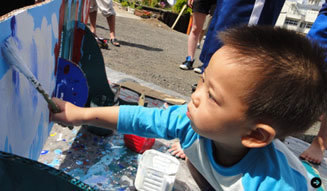
Mini Circus Caravan (2011)
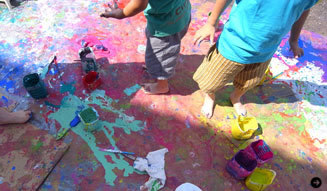
Mini Circus Caravan (2011)
A City Built Together
──It's crucial to foster an image and convey the reality that children are still living ordinary lives in areas designated as disaster-stricken. We tend to generalize them as "victims" or "disaster areas," but these communities include the elderly, young adults, and children. It's difficult to visualize their specific situations due to the biased nature of media coverage. Empathy is vital, and while our capacity to act is limited, nothing will change as long as we continue to view issues like disaster recovery or politics as someone else's problem. Araki-san, what motivated you to take action?
ArakiThere was a simple desire to do something, but ultimately, by leveraging our past experiences, such as creating cardboard tents for children, we hoped to contribute, even in a small way, to the mental well-being of the children. Indeed, the experience of witnessing the children's emotional changes and their uninhibited expressions was profoundly impactful.
However, what I realized upon actually visiting the sites is the immense scale of the disaster-stricken areas. Rather than scattering our efforts across various locations, I strongly felt the desire to establish relationships with the residents by visiting the same places consistently. Through activities like these, I believe it's natural for communities to expand and for discussions about town development to emerge. I hope to foster such organic connections.
──It would be wonderful if these initiatives could help broaden the children's vision for their future. What do you imagine the children's emotional state to be currently?
ArakiThe children are incredibly energetic (laughs). Of course, that's not entirely true. It almost seems as if they haven't been affected by the trauma of the earthquake. But as we were leaving, they would approach us, asking where we were going next, or if we were returning to Tokyo already. I felt they might perceive our presence as transient, and perhaps they harbor underlying feelings of loneliness or anxiety. We aim to provide support by continuing to engage with the children.
──We must carry forward that sentiment.
ArakiEstablishing a system to sustain this effort is also crucial.
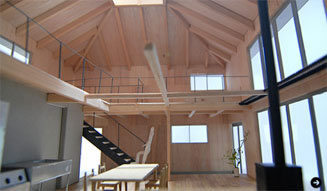
AK Residence (2011) Photo by A+Sa
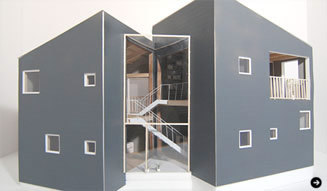
FRAK Residence (2011) Photo by A+Sa
Towards the Next Self-Build Methodology
──Finally, could you tell us about your current ongoing projects?
ArakiWe have two residential projects in progress. One is a two-family house on a slope in Yokohama. The other is a small house for a single man.
The two-family house is for a family that loves to draw and create things. Living as two families within the scale of a typical house requires careful spatial planning to create shared living areas and distinct private spaces for each family.
For the single man's house, we are attempting something quite challenging. In addition to the interior finishes, we plan to self-build the structural inner walls using structural plywood. The spatial composition is centered around a skylight. In the initial plan, the four columns supporting the skylight were obstructive, and the central area became a symbolic focal point, which felt incongruous. After consulting with a structural engineer, we decided to remove the columns that supported the chimney. However, since we had already obtained estimates, this naturally led to an increase in costs.
Until now, for safety reasons, we have operated under the premise of not altering structural elements during self-build. While the AK Residence project involved self-building wall finishes, this is the first time we will be undertaking structural self-build, with support from a construction company, ensuring thorough safety considerations.
──This is possible precisely because A+Sa has engaged in self-build up to this point. We look forward to seeing it.
ArakiWe hope to demonstrate through this project that what we have accumulated can be applied on a larger scale.
SasakiIn addition to these, we have about ten projects in progress, ranging from the renovation of a six-story pencil building to a single apartment unit.
──We eagerly anticipate your continued success. Thank you very much for your time today.
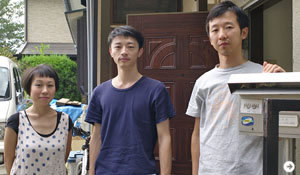
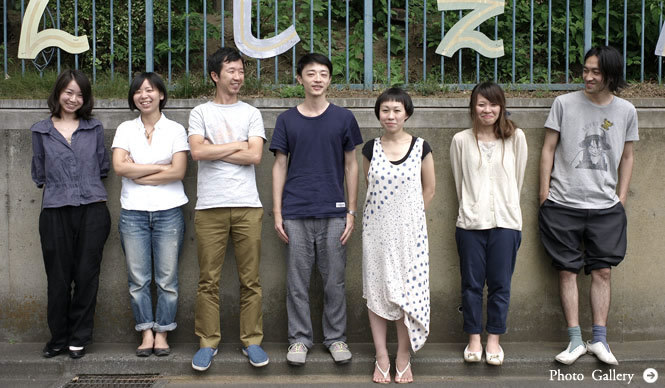
From left: Tamaho Sasaki, Takayuki Sasaki, Genki Araki
Photo by Takashi Kato
A+Sa ARAKI + SASAKI architects
Genki Araki: Born in Tokyo, 1979
Takayuki Sasaki: Born in Hiroshima, 1978
Tamaho Sasaki: Born in Toyama, 1979
Co-principals of ARAKI + SASAKI architects, Class-1 Architects Office since 2008
ARAKI + SASAKI architects Inc. since 2011