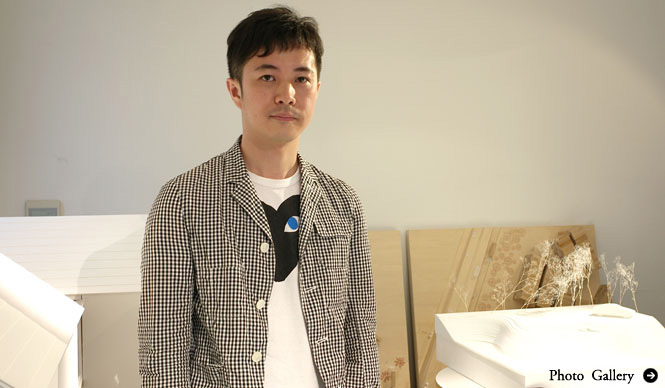
Feature: Yoshitaka Yasutaka, Part II of OPENERS' Young Architects of Japan, Vol. 3
Vol. 3 Yasutaka Yoshimura Interview (1)
Changing the Role of Architecture in Society
To consider the state of society and daily life is, at the same time, to consider the current condition of architecture. Architect Yasutaka Yoshimura states that he wants to change the role of architecture in society. This is intrinsically linked to the idea that architecture should be kind to society and people. Faced with the profound impact of the earthquake, architecture and cities revealed their fragile and ephemeral nature. We asked Mr. Yoshimura about his stance on architecture, focusing on his initiatives since the earthquake, and his thoughts on creating new value while being conscious of architectural originality and sharing it with others.
Interview and Summary by Takashi Kato
What Clues Do We Have to Build Cities Today?
—We heard that you went to the Netherlands after completing your graduate studies. I believe the way Dutch architects approached cities at that time, and their pioneering efforts in the age of information, still offer valid methodologies today. In Japan, too, since the earthquake, issues concerning cities and urban development have been discussed as social problems. With that in mind, could you tell us what you gained from your time in the Netherlands?
I went to the Netherlands in 1999, during a period of economic boom. MVRDV, where I worked, was clearly influenced by this atmosphere. When I joined, there were only about 15 staff members, and by the time I returned to Japan two years later, there were about 60. So, you can imagine the upward trend.
What impressed me most was how they effectively utilized that situation to launch numerous experimental projects. It’s been 10 years since I returned to Japan, and looking back, I realize it couldn't have been easy. For example, it's undeniable that architecture in Japan during the bubble era was experimental, but in Japan's case, it was largely confined to manipulating added value through superficial differences in architecture. In the Netherlands, however, more fundamental and bold proposals that seemed to cut into the very fabric of the city were accepted, giving me a sense of reshaping the map. It was like performing major surgery, replacing a heart, rather than cosmetic enhancement.
Furthermore, in Japan, after the bubble burst, the simplest real estate scheme—acquiring floor area for profit—came to the forefront, leading to the construction of monotonous high-rise condominiums. In contrast, Dutch architects seemed to resist being swallowed by such schemes and sought to present their own unique values. Even now, I recall the diverse approaches to urban development at that time with excitement. However, even in the Netherlands, I hear that after my return, the economy rapidly declined, and bold proposals became less accepted.
I believe Japan is currently venturing into territory the Netherlands has not experienced, yet there are still lessons to be learned. While the conditions of economic prosperity and the earthquake are vastly different, both can serve as prerequisites for urban experimentation. We have inadvertently entered a phase that demands decisions rather than research and discussion. Therefore, I feel that the capabilities of designers across all fields, not just architects, are being tested in terms of how deeply they can commit to the structures of cities and society.
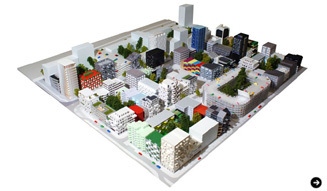
'Olympia Quarter' (2009–) Stadgenoot and MVRDV
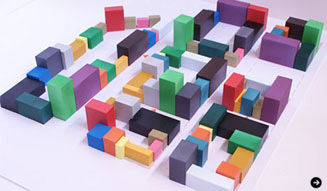
'Olympia Quarter' (2009–) Stadgenoot and MVRDV
—Are you saying that Japan is currently in a similar situation to the Netherlands, which has pursued experimental approaches while critically examining the concept of the city?
On the contrary, I believe Japan is facing a more severe situation. The Netherlands is not a large country, so it has a certain manageability, like a test tube. Japan is much larger, and it has suddenly entered the clinical stage. Isn't it a tense situation that necessitates experimentation?
—Is this a cyclical return, after half a century, to a phase where architects are turning back to the city?
Whether architects will take on that role, I'm honestly not entirely sure yet. However, I do feel that Japanese architects are earnestly engaging with this issue now, and a different kind of force seems to be at play. Architects are trained to weave visions that connect to the larger context of the city decades from now, while also attending to small conditions like the placement of outlets, the number of children's rooms, or complaints from neighbors. In this situation, where things have already started moving, they may possess the most needed capabilities.
—The Netherlands is said to be a society that emphasizes discussion with the premise of making decisions. We are currently facing a situation that could be called a national crisis. Whether this is a once-in-a-thousand-year event or a once-in-fifty-year event, perhaps we can look to the Netherlands as a model for how to prepare for the next earthquake or tsunami, despite the difference in scale.
Indeed, the Dutch are a people who have built their own land by repeatedly reclaiming it from the sea while enduring floods. The highly functional consensus-building process can be attributed to such pressing circumstances.
—This is why it's said, 'The land of the Netherlands was made by the Dutch.' They started from a point where there were no accumulated histories or contextual clues.
While Dutch polders and the tsunami-affected areas in Tohoku may seem similar at first glance, there's a significant difference in background between areas that were submerged and areas where people have lived for a long time and where traces still remain. While we can learn from systems like consensus building, we must solve more complex conditions. In a country with a rich topography like Japan, proposals drawn on a blank slate are unlikely to succeed. People cannot tolerate such monotony. In fact, the Dutch themselves regret this to some extent.
—What do you mean by that?
The social housing (a type of public rental housing) they built with good intentions in the 1970s and 80s is now dysfunctional. They are beautiful enough, but they are too monotonous and stifling. I participated in the development plan for Almere's new town, for which MVRDV was the master planner, and we invited 25 architects from around the world. Diversity was ensured through the individuality of the architects. There is a great danger in everyone facing the same direction. In Japan, too, we must create diversity by having as many architects as possible take unique actions.
—With reconstruction from the earthquake being urgent, are the individual differences and diversity inherent in our cities and lives being neglected? As you mentioned earlier, Mr. Yoshimura, I too feel a sense of crisis about the current situation where economic efficiency is prioritized, leading to the repetitive construction of the same things.
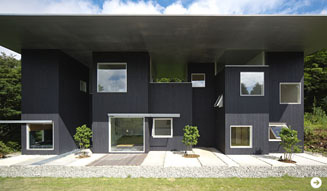
'House of Eaves' (2008) Photo by Yasutaka Yoshimura
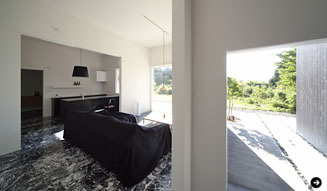
'House of Eaves' (2008) Photo by Yasutaka Yoshimura
Vol. 3 Yasutaka Yoshimura Interview (2)
Considering Design Before 'Form'
—Since the period of high economic growth, society as a whole has progressed with an upward trend. We have built our society on the assumption that major natural disasters would not occur during our lifetimes. Things that were consciously or unconsciously hidden have now come to light. The issue of nuclear power plants has also revealed that the same thing could happen anywhere in Japan from now on.
In light of this, one aspect of your work that I found particularly interesting, Mr. Yoshimura, was your research into existing cities, including architectural regulations. Until now, Japanese cities have been characterized by streetscapes that prioritize efficiency over individuality and aesthetic diversity, and are not necessarily beautiful. Therefore, the perspective of your generation, which seeks to observe the current city and architecture as they are, is very refreshing. My question is, where does your motivation as an architect come from, to start by affirming the present situation?
There must be reasons why the majority of things, or what is called mainstream, are as they are. I try to believe in those reasons first. Then, I look for points where a slight change in tuning can make a significant improvement. This is a repetitive process. For me, exploring how to make more things better is like a thesis.
This might sound obvious, but many architects tend to be more interested in making a few things overwhelmingly better. I myself received that kind of education, and I am a fan of architecture created that way. However, I am now interested in applying the methods cultivated through small-scale, limited endeavors to larger contexts and more people. Naturally, different results will emerge when the same methods are applied to different subjects, and I expect new architecture to be born from this.
I believe laws, in particular, hold the potential to change many things at once. Therefore, my research, which began with the need to study how architects and building professionals currently operate within existing regulations, forms the basis for 'The Encyclopedia of Super-Legal Architecture.' However, as I mentioned, I am interested not only in regulations but in all control forces that underpin architecture.
—What prompted your interest in the rules written behind existing architecture?
There is a book by Kiyonori Kikutake called 'Metabolism in Architecture.' It discusses the famous concepts of 'Ka,' 'Kata,' and 'Kachi,' which Kikutake associates with conception, technique, and form, respectively. Reading this book was the first time I clearly organized the stages before 'form.' 'Ka' is the 'Ka' of God, representing a transcendent vision. When 'Ta' (like in 'ta' or 'te') is added, a prototype is formed, and when 'Chi' (like in 'chi' or 'blood') is added, it becomes form. By effectively driving these three stages, a building becomes architecture.
Mies van der Rohe said, 'When two bricks are placed carefully, architecture begins.' This precisely describes the stage of 'Ka' + 'Ta.' One could say that architecture begins at the 'Kata' stage. I believe architects must engage not only with 'Form' but also with 'Kata' (i.e., rules).
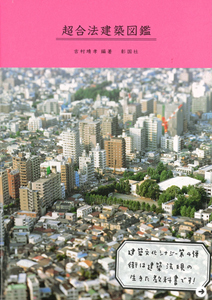
'The Encyclopedia of Super-Legal Architecture' (2006)
—So, for you, it's not about 'Form' or 'Ka,' but about 'Kata'?
'Ka,' 'Kata,' and 'Kachi' are all important. Architecture cannot exist without any of them. However, 'Kachi' is in a state of saturation, where anything goes, and the constraints have been removed. By stepping back and engaging with 'Kata' before reaching that point, I believe we can change architecture on a more fundamental level.
—It has long been said that architects find it difficult to envision large-scale projects like cities. Isn't this an era where we need to confront such large-scale issues again? Mr. Yoshimura, as an architect, how do you view large-scale entities like cities?
It is certainly conceivable that the strong individuality of one person can influence a large entity like a city, but I don't believe that anything drawn by a single person, no matter how grand, is a city.
The essential significance of a city lies in the coexistence of different individualities. A state that is sufficiently spacious so that individual interactions do not occur is not a city; therefore, density and diversity are the factors that constitute a city, and we must make them attractive at all costs. Curiously, however, things in this world tend to be replaced by the hygienic, orderly, and uninteresting. Cities and their suburbs are no exception, and indeed, many people consider clean and uniform streetscapes to be prosperous. But I do not agree. I believe that resisting such trends and living as an architect are not contradictory.
—Listening to your explanation about 'Kata' concerning rules, I imagine it connects to your current activities. Your 'C.C. House' project also seems to be about 'Kata' before 'Form,' doesn't it?
Yes. The title of the lecture accompanying the exhibition was 'How to Buy Architecture.' It's entirely about the stage before form. However, the 'C.C. House' project is an attempt to see if there's a way to connect that to form. Specifically, we distribute architectural drawings at a low cost, or even for free, and allow them to be freely modified. Users gain the ability to make new alterations to the architecture.
I am interested in the lives of the people who use architecture. I want to avoid situations where acquiring architecture becomes a major constraint on their lives. In reality, taking out a 35-year mortgage to buy a house can mean being unable to quit your job, or limiting the number of children you can have due to the house. The fact that houses become a burden on people's lives is something I, as an architect, find unbearable. When considering how to make architecture more generous and breathable, the issue of how it is purchased cannot be ignored.
※1
Kiyonori Kikutake | KIKUTAKE Kiyonori
Architect. Born in 1928. From the 1960s, along with Kisho Kurokawa and Fumihiko Maki, he advocated the architectural movement 'Metabolism,' signifying renewal. In his book 'Metabolism in Architecture,' he proposed 'Ka,' 'Kata,' and 'Kachi' as conception, technique, and form, respectively, establishing them as a methodology for architectural design. His representative works include 'Sky House' (1958) and the Edo-Tokyo Museum (1993).
Vol. 3 Yasutaka Yoshimura Interview (3)
Not 'How to Build,' but 'How It Is Used'
In the case of C.C. House, by lowering the burden of purchase and increasing the freedom of modification, we hope to eventually create architecture like traditional folk houses, which are accompanied by accumulated wisdom. This is also a question of 'What is architectural creativity?' I find it uninteresting that the only place architects can demonstrate their abilities is in finding unique solutions for unique sites and unique clients.
—Are you saying that architecture becomes a 'one-off' design that responds to a specific site and client's needs?
If we are unable to appreciate folk houses because our expression is too mild, then the problem lies with contemporary architecture, which provides the criteria for evaluation. I believe that folk houses possess not only a gentle quality but also a rich accumulation of creativity, which makes them appealing. In contrast, contemporary artists, in their pursuit of originality, often consider ideas tried by others as taboo. Even when doing creative work, the results are difficult to accumulate, in my opinion.
—How does the C.C. House project approach this issue?
I felt that the existence of copyright might be hindering the process of gradual evolution through overwriting, so I decided to utilize Creative Commons licenses. The 'CC' in C.C. House stands for Creative Commons. As you know, Creative Commons is an initiative that aims to share creative work by specifying rights, which should exist on a spectrum between full copyright protection and complete abandonment, in a segmented manner. While widely known in the fields of music and video, it has not been extensively discussed in architecture.
It would be truly groundbreaking if Creative Commons enabled open-ended design, and I hope architecture can evolve through repeated overwriting, like biological mutation.
Recently, in a panel discussion, the topic of originality versus creativity came up. Originality feels like delving inward to discover one's identity. Creativity, on the other hand, is the leap that occurs when one transcends the limits of that originality. The possibility of this leap increases by incorporating others into the design process. C.C. House is not aiming for something mediocre or boring. It does not negate architectural creativity.
While I don't believe everything we architects design should be open-sourced, I hope that by opening up even parts of it, architecture as a whole can improve.
—The idea of open-sourcing architectural design is a novel concept.
However, I believe architecture has always had this nature. Compared to fields like music and video, copyright awareness in architecture is quite lax, isn't it? It starts with inheriting the techniques of one's master, and then details that should be secret are generously revealed in magazines. The industry as a whole tends to operate copyright in a relatively relaxed manner. When Japan's copyright law was enacted in 1900, there was a clause stating, 'This law shall not apply to architecture,' and I feel that sentiment still lives on.
This sentiment has allowed architecture to gradually improve, but this state is by no means stable. It could easily collapse if someone were to object. I hope that by introducing concepts like Creative Commons before that happens, the health of architecture can be maintained. I believe there is still much wisdom to be accumulated in architecture.
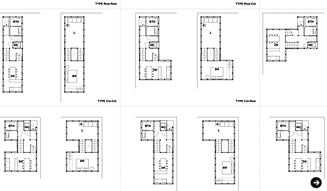
'C.C. House Drawings' (2006) Materials provided by: Yasutaka Yoshimura Architects
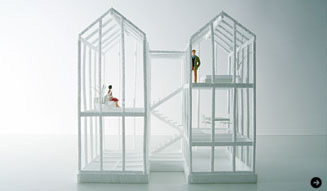
'C.C. House Drawings' (2006) Materials provided by: Yasutaka Yoshimura Architects
—The C.C. House project inherently includes a partial relinquishment of copyright, suggesting that architecture was originally like that, isn't that your point?
Yes. It also serves as a warning that overly protecting copyright can lead to problematic situations. In fact, lawsuits are beginning to be filed overseas regarding architecture appearing in films, so I believe this is an urgent matter. If we ever reach a time when architecture in news footage is pixelated, it would be truly regrettable. Of course, we must avoid mere degraded copies, but if replicating architecture can lead to obtaining more suitable sites or allow more people to experience architecture, then I believe it is worth actively trying.
—Indeed, with music, for example, attention was previously focused on not imitating the Beatles' songs out of concern for originality. However, now it's commonplace for DJs to skillfully read the atmosphere of the moment and create music that excites the crowd by sampling existing songs, while overcoming the associated issues.
Exactly. Architects only use their drawings once, don't they? This is supported by the satisfaction and confidence of creating a unique building for a unique site. However, when you think about it, if those drawings could be used for other sites, or for different clients, or with different budgets, I imagine architecture would improve even further if I had the opportunity to reuse my own drawings.
—To show new paths that lead to the next architectural endeavor, building upon the accumulation of thought, would be ideal.
In today's world, architecture is the only field where such uninhibited, one-off production is permitted. Even Ferraris are replicated.
—Have there been any instances where architectural drawings have been replicated, not through copy-paste, but in a way that leads to further development?
I've heard rumors that the drawings for Schiphol Airport were sold and an identical airport was built somewhere in Africa. There was also talk of the Ronchamp Chapel being copied in a Chinese city. While the hardware might be the same, it's questionable whether those examples have achieved truly new value simply by changing the context. I doubt they have achieved that to a great extent.
I believe it's better for them to be modified little by little, rather than being exactly the same. Replication through drawings is easier to modify than industrial replication, so in that sense, I have expectations for the replication of drawings.
—When we look at the urban landscapes we find genuinely beautiful, such as the streets of Paris, France, the individual buildings, upon closer inspection, do not differ drastically from one another. It is possible that a balanced beauty emerges in the cityscape from the aggregation of slightly different elements. In that sense, Japanese streetscapes are hard to describe as orderly, but I do feel the value of being composed of diverse elements as a whole.
The airiness of Tokyo, in particular, is a remarkable quality not found in other cities. The first article of Japan's Building Standards Act states, 'to establish minimum standards,' but this alone maximizes market desires, paradoxically outlining the law's boundaries. When I wrote 'The Encyclopedia of Super-Legal Architecture,' I had the intention of positively overcoming this.
However, even with minimum standards, architecture is an old discipline, and regulations often become a burden. In the 'Ex-Container' project, which aims to send container houses to disaster-stricken areas, I am once again realizing the immense binding power of regulations, with wall after wall.
—The Ex-Container project seems effective in times of disaster, which makes the current regulations frustrating.
I was surprised that Japanese people do not build illegal shacks even in this emergency situation. Since it is an unforeseen disaster, securing housing in an unforeseen way should be a matter of life and death. I think it would be natural for people to start building houses by gathering whatever is at hand.
—Although the scale and historical context may differ, I recall hearing that after the atomic bombings of Hiroshima and Nagasaki, buildings were quickly erected, and people started businesses, which surprised me with the resilience of humanity. After the recent earthquake, some instances in Tohoku were reportedly criticized for violating regulations. By rigidly adhering to rules in the name of social order, I feel we are stifling the buds of instinctive human needs that should be truly important.
It feels like the unpleasant aspect of laws, exerting abnormal restrictive power, has been revealed.
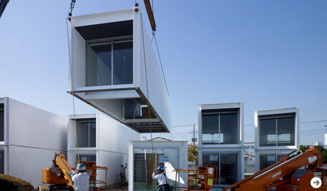
'Bayside Marina Hotel Yokohama' (2009) Materials provided by: Yasutaka Yoshimura Architects
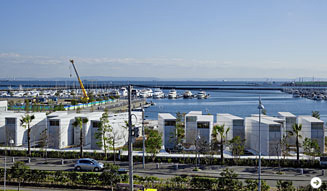
'Bayside Marina Hotel Yokohama' (2009) Photo by Yasutaka Yoshimura
Vol. 3 Yasutaka Yoshimura Interview (4)
The Necessity of Presenting a Vision for the Future
—Continuing from our previous discussion, could you tell us what you've been thinking about since the earthquake?
Immediately after the earthquake, we launched a project to send temporary housing using container standards to the affected areas. That is the Ex-Container Project.
We had been working on container projects that could be permanent and inexpensive for the past six to seven years, regardless of the earthquake, so I thought we could apply the accumulated technology to do something.
The emergency temporary housing stipulated by the Disaster Relief Act is scheduled for removal after two years and has corresponding specifications. Our goal is to improve these specifications so they can be used as permanent housing and continue to be utilized beyond the two-year period.
Ex-Containers are finished internally and externally at the factory, minimizing on-site construction. Therefore, they are easy to relocate. We plan to use them as temporary housing on school grounds or in parks initially, and after the legal two-year period, they will be sold at a low price for reuse on private land.
—Two years is also a time when people are just starting to settle into their lives there, so it might be good for the residents too.
I believe upfront investment is necessary to prevent people from becoming homeless after two years. However, due to a shortage of land and the sufficient supply capacity of the Prefabricated Construction Association, it has become difficult to have Ex-Containers accepted as emergency temporary housing.
After considering various reasons, one issue is that the scheme itself, where tax money is used to build something that is then reused as personal property, might be flawed. Japan has historically constructed a logic that these are emergency supports to be removed after two years, not tax investments to enrich personal assets. However, in my view, in the face of this disaster, there is no time for such arguments. This presents a significant hurdle.
Another hurdle may lie in the difference in specifications themselves. Ex-Containers incorporate various small ideas, such as translucent insulating walls and skylights that become stairs when stacked, but there are opinions that this could foster a sense of unfairness.
Also, this is a misunderstanding, but because they are designed for factory production, it might be perceived that local manpower is not utilized much. However, since we are an architectural design office, there is no problem if the actual construction is done by local contractors in the affected areas. Even so, the concept of being movable and permanent after two years remains intact.
Currently, we are in the process of preparing for implementation through collaborations with private support organizations and through various discussions with individuals and companies affected by the disaster.
—With your container projects, like the Ex-Container, I feel that a minimum level of hospitality for residents can be considered, given your experience with hotels. If the priority is simply having a place to live, won't we repeat the problems of isolation and lonely deaths of the elderly seen during the Great Hanshin-Awaji Earthquake? Even if it's temporary, the comfort of living should not be neglected. Perhaps delicate ideas only architects can conceive can be applied here.
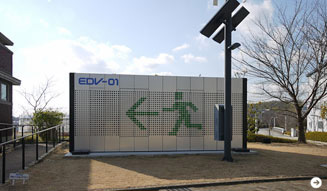
'EDV-01' (2011) Photo by Yasutaka Yoshimura
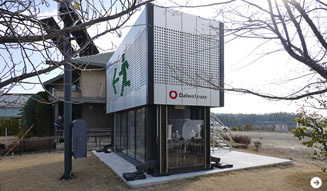
'EDV-01' (2011) Photo by Yasutaka Yoshimura
—Could you tell us about 'EDV-01,' which evolved from your container projects, an infrastructure-free concept?
This was a project to commemorate the 50th anniversary of Daiwa Lease. In areas where infrastructure was devastated by disaster, we designed containers equipped with the necessary facilities and living space for adults to live for a certain period. A key feature is a mechanism that allows it to expand into a two-story structure after being transported. This eliminates the need to transport the 'air mass' that constitutes living space.
Although we only had a prototype for presentation this time and could not use it in the disaster-stricken areas, I believe this project is useful not only for post-disaster situations but also from a disaster prevention perspective.
For example, the accident at the Fukushima Daiichi Nuclear Power Plant revealed that Tokyo Electric Power Company's electricity is generated in Fukushima. Tokyo's outline, in reality, is not the rice-grain shape we typically recognize on maps; it has very irregular 'outlying territories.' When considering how to enhance the coherence of its outline, being infrastructure-free becomes effective. Furthermore, being infrastructure-free allows for minimizing damage. If there were no damage, earthquakes and tsunamis themselves would not be disasters, so I believe this is an important theme that should be discussed more seriously.
Even with new energy supply systems utilizing natural energy, if they are centralized in one location, the entire system could stop in the event of a problem like the one we've seen. The concept is close to 'cloudifying' energy, but by minimizing the units as much as possible, and having each house be self-sufficient with its own infrastructure, wouldn't we create a state that is resilient to disasters?
—There's the idea of each household generating its own energy for individual use, storing the surplus in batteries, and selling it to the power company or sharing it with neighbors. In addition to having individual energy sources, there's also the direction of sharing them collectively. So, for my final question, what do you think is the background behind this consistent line of thought?
During my fourth year of university, the Great Hanshin-Awaji Earthquake occurred (1995). That was the year of my graduation project, and I felt helpless, unable to do anything, not even volunteer work. However, seeing the disaster-stricken areas on the news, I clearly felt the futility of architecture merely playing with 'form.'
On the other hand, architects can only create 'form.' Even so, I thought that by seriously engaging with 'Ka' and 'Kata,' I could gain a sense of substance behind the 'form.'
It wasn't that I felt pressured by the earthquake; rather, I found myself able to approach architecture with a sense of relaxation. Before that, what was I doing? I was drawing manga for school assignments and submitting them.
—For architectural design assignments?
Yes. I would draw manga or make eye masks for sleeping and submit them. I had become too fixated on 'form' due to my distrust of it, and I couldn't design buildings. My approach was whether I could evoke a rich architectural experience in someone without building walls or columns. That's why my designs never improved (laughs).
—Fundamentally, we don't live in the form of a building or its floor plan when it's built in a city, do we? Before that, what we want to do there, who we want to live with and how, and our dreams for the future are important. Form is merely a vessel for that. It's important that the vessel is beautiful, or designed by a favorite architect, and that this contributes to the richness of life.
Conversely, if we don't know how we want to live or behave there, the form we pre-emptively create could become a pipe dream.
Absolutely. Unless we change the program, the given conditions of architecture, architecture will not change. Conversely, if we simply accept the changed conditions, architecture will naturally change. In that sense, I believe there is still a significant lack of architecture that responds to the current social situation. The idea that architects are idle is absurd, don't you think?
—It seems there is still potential for society to change for the better depending on how architecture evolves. Thank you very much for your time today.
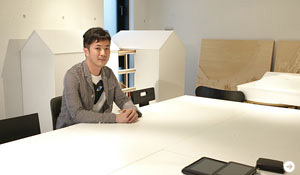
Photo by Takashi Kato
Yasutaka Yoshimura | YOSHIMURA Yasutaka
Born in Aichi Prefecture in 1972
Completed Master's program at the Graduate School of Science and Engineering, Waseda University, in 1997
Worked at MVRDV as a recipient of the Agency for Cultural Affairs' overseas training program for artists in 1999–2000
Established SUPER-OS in 2001
Established Yasutaka Yoshimura Architects in 2005
http://www.ysmr.com