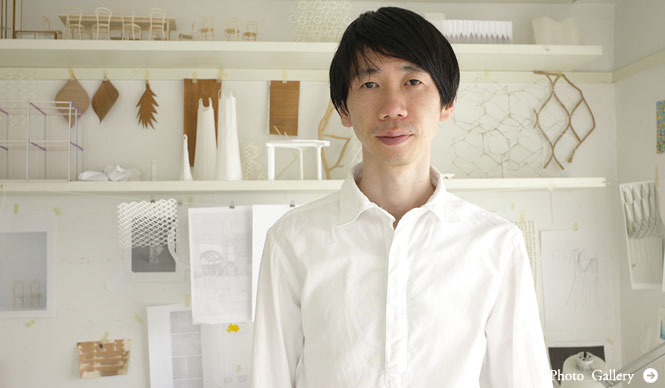
Feature: OPENERS' Young Japanese Architects, Part II – Vol. 2: Ryuji Nakamura Interview
Vol. 2: Ryuji Nakamura Interview (1)
Architecture Pursuing Comfort Through Self-Sufficiency
The repetition of ordinary forms gives rise to chairs, objects, and spaces never seen before. Ryuji Nakamura's creations expand their scale and concepts by moving between the inside and outside of the established frameworks of architecture and objects. These works, born from a thorough consideration of self-sufficiency, hint at an image of a future city where we, as individuals, relate to each other while remaining independent. From his childhood, when he would spend hours observing the subtly changing houses along his route to and from school, to his current focus on large-scale architectural thinking, Nakamura's perspective on landscapes and spaces has remained unwavering.
Interviewer and Editing: Takashi Kato
The Original Landscape of Architecture
──Could you tell us what sparked your interest in architecture?
I grew up in Ina City, Nagano Prefecture. When I was in elementary school, I enjoyed comparing the houses along my route to and from school. There were many similar houses built by local construction companies dotted around, mostly wooden houses with tiled roofs. Each one had subtle differences in roof pitch, tile texture, the shape of the decorative roof tiles, and the way the windows were placed. I was a child who enjoyed observing these details.
──How long was your commute to school?
I walked about two kilometers every day.
──So you walked a commute through a tranquil landscape where the houses and scenery barely changed?
Yes, that's right. It was a landscape with rice paddies stretching out, and houses scattered here and there, a scenery that didn't change much. However, occasionally, those old, simple buildings would be replaced by new ones, so there was change over time.
──Did you find it interesting to see this familiar landscape change occasionally, or were you disappointed that it was changing?
I found it interesting. Occasionally, houses would be demolished or built, and I watched the process with curiosity as it changed little by little each day. However, I tended to view the landscape up to the garden as a single unit, rather than the entire scenery.
──But there must be a significant distance between that and wanting to make architecture your profession in the future. What was special about that landscape to you?
I think it's normal for children to be interested in many things at once, like houses and cars. At that time, my friends were all into supercars, but I was pretty much only interested in 'houses.' Also, though I don't know how much it influenced me, when I was in the latter half of elementary school, my family rebuilt our house. I remember being very excited watching the process of the house being demolished and rebuilt.
──That must have been thrilling.
Also, my family ran a liquor store, and various craftsmen would come to our store as customers every day. There was a standing bar area inside, and it was an environment where craftsmen would stop by for a drink after work. Having those people around me might have influenced my current profession, where I think about things through architecture.
The Path to Becoming an Architect
──Did you start studying architecture professionally when you went to university?
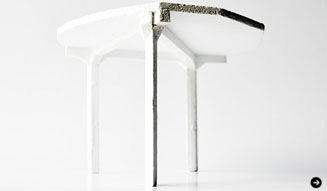
'concrete roof' (2011) Photo by Ryuji Nakamura
Yes. When I went to university, I feel like I chose the path of architecture without much doubt about the future.
──So you went into it without any hesitation, believing architecture was your path?
Normally, one might hesitate between product design and architecture, but for some reason, I didn't have much doubt.
──Did you have any architects you admired at the time?
At that time, I didn't know about the existence of architects. I thought of architects as being similar to draftsmen. So, when I later studied architecture and learned that there were architects who approached architecture with strong ideas, not just about form, I was a little surprised. But it also felt natural.
──After graduating, you joined Jun Aoki's architectural design office. Was there a particular reason for that?
At the time, my friend Yuko Nagayama was working on a project, and I saw Aoki's 'L,' a house made of concrete. Nagayama showed it to me, and that sparked my interest. I remember being struck by how the forms that belonged in a house and those that didn't were mixed in an indescribable way, making it difficult to focus on either. Also, an article by Aoki in an architectural magazine, which discussed 'not being overly accommodating,' further piqued my interest. That became a major reason for me to work under Aoki.
──What about that article interested you?
It stated that if one designs too far ahead of people's actions, the house can become cramped. Although it had a different form than a typical house, it possessed a comfortable livability. The reason for this comfort was expressed with fresh insight and clear language.
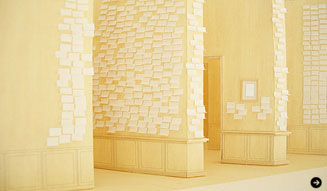
'pinup' (2007) Photo by Ryuji Nakamura
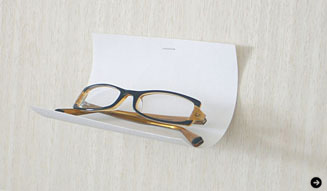
'pinup' (2007) Photo by Ryuji Nakamura
Vol. 2: Ryuji Nakamura Interview (2)
New Forms Born from Shapes
──Could you tell us about the first project you undertook after becoming independent?
It was a chair called 'Hechima.' As for spatial work, it was the interior of an eyewear shop.
──Looking at the chairs and interior designs you've created, there seems to be a strong fixation on a certain pattern of repetition. Is there something you consciously focus on?
There are many things, but for example, the problem that large objects must be made from a collection of parts, and conversely, things that are difficult to make as a single unit become possible when broken down. I find the relationship between being a single unit and being a collection very interesting. Many people might feel this way, but I particularly love the concept behind plywood, where thin layers are stacked with their grain directions changed to create a single, stable sheet. I was once completely captivated by the idea of molded plywood, which extends this concept.
Molded plywood is a technique used to create curved surfaces when making furniture. Initially, I mistakenly believed that flat plywood was forcibly bent using special chemicals or machinery. However, I later learned that it's not about forcibly bending plywood, but rather about bonding the veneers in a bent state to create the plywood, so the shape is maintained by the difference in length between the inner and outer layers. The idea of thinning the wood to a point where it can be bent without breaking, and then returning it to a thickness that prevents further bending, and the concept of utilizing the difference in length between the inner and outer sides when bending – these simple and straightforward answers to the problem of creating curved surfaces completely captivated me. I believe this concept still influences me in some way.
The Chair 'Hechima'
After that, there was a furniture design competition themed around Tenyo Mokko's molded plywood, and I conceived a chair using corrugated molded plywood. That was the chair 'Hechima.' Although it wasn't realized at the time, it was eventually realized through the 'Daikanyama Installation' competition. I created a wooden mold, bought thin veneers, and made the corrugated plywood myself.
The current 'Hechima' chair uses paper, but the initial prototype was made of wood. It's a chair made by stacking corrugated sheets, and various shapes can be created by how the corrugations are cut. This concept, inspired by plywood, suggests that the layering of corrugated sheets can create possibilities for lightness, softness, and transparency. However, it lacked sufficient strength and broke during the exhibition.
Much later, I worked on a paper-based interior for an eyewear shop called 'JINS.' The concept was to place glasses on paper that was pinned to the wall and had curled slightly. While searching for a stiff paper for this, I encountered a paper with more body and strength than usual. When I used it for a chair, the paper's characteristics of being more resilient and less prone to breaking than wood were utilized, allowing me to create a chair with sufficient strength to be sat on.
──So, your distinctive paper chairs are actually functional and strong?
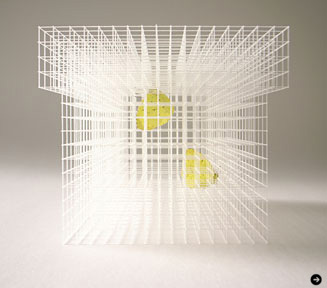
'insect cage' (2008) Photo by Ryuji Nakamura
Yes.
──So, encounters with materials expanded your expression, and your imagined concepts became tangible. Listening to you, it seems the encounter with paper was significant for you.
These chairs, with their seemingly complex structures at first glance, wouldn't be easy to produce even in a factory, would they? I imagine they are made with a system that deviates from standard practices. Did you develop the programs together with someone?
That's right. Documenting them was quite a challenging task, as much as considering the materials and the joints.
──Did you handle the documentation process yourself?
Yes. Although it was complete in my mind, realizing it in three dimensions required 3D software, so I started by learning the software. First, I created the form on the computer, then broke it down, and created the production drawings. Creating the form itself was difficult, but documenting it was also challenging. The curved surfaces were pre-divided into thin strips, and then each strip was rotated and unfolded into a plane. It was a very analog and time-consuming process, making it hard to believe a computer was being used. However, at the same time, the relationship between the individual and the collective emerged here, and I felt something becoming possible through subdivision, which was a very interesting experience.
──What about technologies like rapid prototyping?
I was aware of rapid prototyping technology at the time and could have shifted towards it, but I was so fascinated by the forms and the development of thought that could arise from the corrugated shape that I couldn't change the concept of starting with corrugated material. Perhaps I found the challenge of how to create a certain form through ingenuity to be interesting. I was interested in things like how using corrugated sheets makes it relatively easy to create truss-like structures, compared to the problem of how to join frames when trying to build a truss. I also imagined that if inexpensive molded plywood corrugated sheets were widely available as mass-produced items, everyone would be making various furniture with them. Of course, I was also interested in rapid prototyping technology, and I later used it when creating the 'insect cage.'
When trying to create something truss-like, the problem arises of how to join the frames. However, I was interested in how corrugated sheets make it relatively easy to create truss-like structures. I also imagined that if inexpensive molded plywood corrugated sheets were widely available as mass-produced items, everyone would be making various furniture with them. Of course, I was also interested in rapid prototyping technology, and I later used it when creating the 'insect cage.'
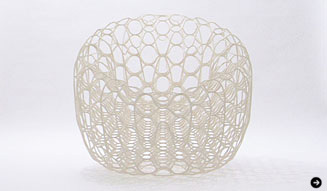
'hechima' (2005) Photo by Ryuji Nakamura
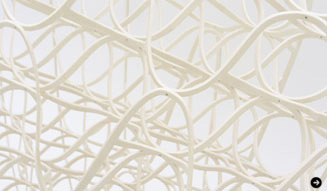
'hechima' (2005) Photo by Ryuji Nakamura
Vol. 2: Ryuji Nakamura Interview (3)
Working with Various Scales
──Last year, 2010, seems to have been a year when the concepts you've been developing evolved on a scale closer to architecture, wouldn't you say?
I believe that how to construct things when the scale increases is one of the interesting aspects of architecture. For example, with small objects like cups, it's relatively easy to create a unified form. But as the scale increases, they must be assembled from parts. Even at the level of furniture, they are often collections of parts, but with architecture, unique problems arise, such as how to fill large surfaces. For floors, we use flooring; for roofs, tiles; and for walls, tiles. We are forced to create surfaces by assembling objects of a certain size.
This can be seen as a drawback. A cup doesn't leak water because it's made of glass as a single piece, so there's no inherent need to make it from a collection of parts. Ideally, roofs would also be made as a single piece to prevent leaks, but this is not possible in architecture. While joints can be seen negatively, if we consider them as the inherent nature of architecture, they can become attractive as unique architectural forms.
For instance, one might wonder how many tiles make up a building's facade, or with flooring, we are so accustomed to it that no one notices it's made from the combination of thousands of wooden planks. If we imagine this in a different field, say art, realizing something close to the scale or volume of architecture can be quite difficult. Yet, cities are filled with such things as a matter of course. Considering this, things that would be unthinkable in architecture happen routinely. I find that fascinating.
For 'cornfield' at the National Museum of Modern Art ('Where is Architecture? 7 Installations' at The National Museum of Modern Art, Tokyo), I created a large triangular volume within the museum space. Since it was too large to be made as a single unit, it had to be constructed from assembled materials. I was interested in what would happen if we built it using paper rods.
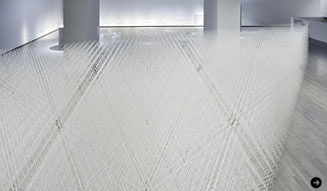
'cornfield' (2010) Photo by Ryuji Nakamura
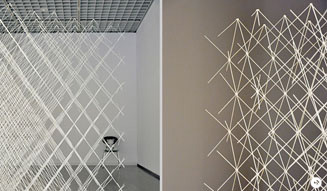
'cornfield' (2010) Photo by Ryuji Nakamura
Discoveries Made Through Realization
──While one can imagine what emerges from the repetition of the same elements, when it comes to actually building it, various challenges arise regarding size, strength, and so on. How did you determine these parameters?
For 'cornfield,' I first decided on the material, paper, and then determined the minimum structure that could stand on its own through repeated experiments with actual prototypes. For 'colorful,' I was given 3mm thick cardboard as the material, and based on that, I determined the structural size and other aspects. Although much smaller than 'cornfield,' it still required a considerable structure. I explored the minimum cross-sectional size and maximum frame pitch that could be achieved with the strength of cardboard.
When a simple square grid, which anyone can imagine, is actually realized, various things become apparent. In particular, one is struck by the multitude of surfaces that frames possess. By applying color to each of these surfaces, I aimed to highlight the characteristics of the grid. By painting surfaces facing the same direction with the same color, I created an effect where the overall color changes depending on the angle.
Coloring serves as a catalyst to reveal that the grid, which might otherwise be monotonous, possesses multiple surfaces. The sheer number of frames is immense, and when these become surfaces, their quantity multiplies several times over. When it comes to color-coding these surfaces, it becomes a considerable task. Even the term 'grid' encompasses such diverse phenomena, which I wanted to express here.
──Was the approach of using color something you had considered before?
No. I hadn't really thought about it much. Not that I never considered it, but I wasn't sure how to approach it.
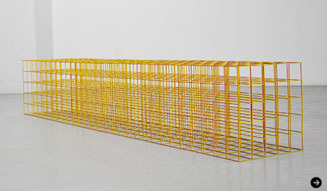
'colorful' (2010) Photo by Ryuji Nakamura
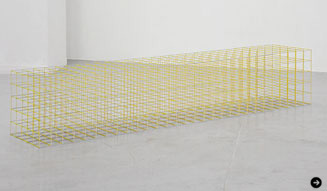
'colorful' (2010) Photo by Ryuji Nakamura
The Effects of Unification and Classification
──Considering your work before 'colorful,' this must have been a valuable endeavor.
Yes. For 'colorful' (at the exhibition 'Color and Form by Architects' at TURNER GALLERY, curated by SHA-ken), the theme was the relationship between color and form, so it was the first time I thought extensively about color. I arrived at the realization that color has a strong effect on perception, which might seem obvious. While it has many effects, I focused on two well-known ones: unification and classification.
This means that objects of different shapes can be perceived as the same if they are painted the same color, and objects of the same shape can be perceived as different if they are painted different colors. I used these two effects to highlight the characteristics of the grid. I experienced how interesting effects can be generated when color and form intersect. Therefore, I find it more interesting to view color in relation to other elements rather than in isolation. Working on 'colorful' made me realize anew that exploring the relationships between adjacent elements—materials, details, and spaces in architecture—is fascinating.
──Regardless of color, how do the relationships you considered with the grid, for example, translate into architecture and space?
It's difficult to say concretely, but I believe there is great potential. Things that were uninteresting when considered in isolation become suddenly fascinating when viewed in relation to others, which signifies that all things have value. As I mentioned earlier, large-scale architecture can only exist as a collection of parts. For example, even if a structurally inconvenient column appears, it might have the potential to transform into something positive in relation to the many other elements that constitute the building.
Vol. 2: Ryuji Nakamura Interview (4)
Aiming for Self-Sufficient Architecture in the Post-Earthquake Era
──Could you tell us about any projects currently in progress?
I am planning a renovation of a house in Kyoto. When one thinks of Kyoto, traditional townhouses come to mind, but this is a typical detached house built about 25 years ago. It's a small, charming house, and the owner seemed to like it, living comfortably while making small improvements over time. However, concerns about earthquake tremors and aging facilities prompted a comprehensive renovation. As it has undergone several modifications over time, different designs overlap or exist in parallel within the same house, creating a somewhat chaotic state.
With traditional townhouses, it's easier to work on them if the old elements are preserved as they are, serving as a backdrop. However, it's quite challenging to do anything in a context lacking such a stable background or structure. Of course, making superficial improvements might be easy, but I want to properly consider what renovation truly means and what possibilities exist beyond new construction. Therefore, progress has been slow.
──Although it's slightly different from architecture, cities and towns don't have completely untouched or authentically original places, do they? Your explanation made me feel that this way of thinking could be applied to any place, as a method of engaging with it.
Yes, that's true.
──I'm very interested in how the city accommodates the sudden appearance of large-scale structures like the Tokyo Skytree.
When people look at the Skytree, I believe they don't see it as a radio tower, but rather as a very tall tower—a pure structure. And I feel it gives people energy and hope. If you remove the function of a radio tower from the Skytree, it would normally become meaningless, but it doesn't seem to be the case. This made me realize the appeal, or rather, the power of architecture.
──What about the city that accommodates it?
Cities are complex, but perhaps we can think of the city itself as an extension of renovation. Even with the Skytree, which might seem to violently disregard the cityscape and stand out, it can also be viewed as placing a slightly taller lamp in the interior space of Tokyo. This can add charm to the city.
In this way, things are gradually placed within the city. Some are interesting, others are not. Architects simply continue to build, and the collection of these individual creations forms the city. I believe this is the only way to think about it.
Then, a photographer appears who offers a new perspective on this disparate city, suddenly making it look like a fresh ensemble, or an interesting architect emerges and connects them. Isn't that sufficient? Given the abundance of things, the amusement generated by chance combinations cannot be underestimated.
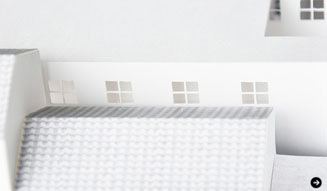
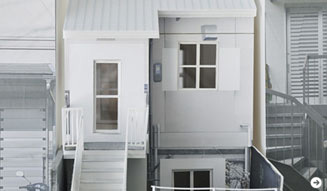
'house gh' (2011) Photo by Ryuji Nakamura
'house yi' (2011) Photo by Ryuji Nakamura
The Value of Living and Dwelling
──Could you share any thoughts you've had since the earthquake? This is because, after March 11th, the values associated with living and dwelling, whether in urban or rural areas, seem to have been shaken.
In cities, living on the top floor of a high-rise building in the bay area was once considered a status symbol, but its value has been somewhat shaken by issues of liquefaction and tsunamis. Furthermore, with the nuclear power plant disaster that occurred simultaneously with the earthquake, even the value of owning land seems to be starting to waver.
It was a small incident, but during a meeting about the Kyoto renovation, I asked the client if they wanted a dishwasher installed in the kitchen. This was around the time when electricity and water supply issues were prominent due to the earthquake. The family, who already didn't use air conditioning much and didn't watch TV, replied that they didn't want to increase their reliance on electrical equipment. They seemed to feel uncomfortable relying on things produced without their knowledge and expressed a desire to live with self-sufficient energy. While this isn't an entirely new value system, it felt different to hear it now compared to before the earthquake.
──Even with high airtightness, high insulation, and security measures, cities often feel like they lack gaps, and even the flow of air seems stagnant at times.
Previously, I thought this was something only for specific people, like naturalists, but the client's words resonated differently. It made me seriously consider that this could become a common value, just like needing a roof for a house. I felt that building architecture based on such principles might be a viable path.
However, striving for energy self-sufficiency would require a significant amount of equipment, such as solar panels on the house. Even if one desires a simple life without many appliances, the house itself becomes like an appliance. The townscape would also turn into something resembling an electronics store. It's easy to imagine that this is not good for either architecture or the city.
I don't yet know what form this will take, but I envision a future where each house is as self-sufficient as possible in terms of energy and food. Consequently, houses that depend on existing infrastructure will naturally look different from self-sufficient ones, even from the outside. The entire townscape would fundamentally change. In the current situation, I can only imagine architecture filled with appliances and equipment, like the plumbing and wiring we discussed earlier. However, this might simply be a lack of imagination, and I believe there are other possibilities.
──When building a new house or renovating, the only option until now was to rely on external energy sources. However, it seems highly likely that entirely new options will emerge, even for energy alone.
For example, I sometimes imagine if a pastoral architectural model, like the windmill houses in the Netherlands, could be realized in Japan. Architecture that is supported by very high technology yet appears simple and unadorned. Perhaps, the more advanced the technology, the more unadorned the architecture becomes. I have expectations for such technology. Ideally, I hope such technology will emerge from the inherent characteristics of architecture.
In the current state, even using a single appliance results in a tangle of wiring. To use an analogy, like with wireless LAN or cordless devices, I believe it's possible in architecture to regain comfort through self-sufficiency. Previously, comfort increased with more wiring, but perhaps in the future, comfort will increase as wiring disappears.
──It seems certain that the situation surrounding architecture is facing a fundamental shift in direction after 3/11. Thank you for your time today.
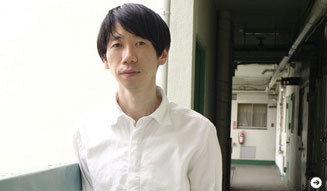
Photo by Takashi Kato
Ryuji NAKAMURA
Born 1972 in Nagano
1999 Completed Graduate School at Tokyo University of the Arts
2000–2003 Worked at Jun Aoki & Associates
2004 Established Ryuji Nakamura Architects
http://www.ryujinakamura.com