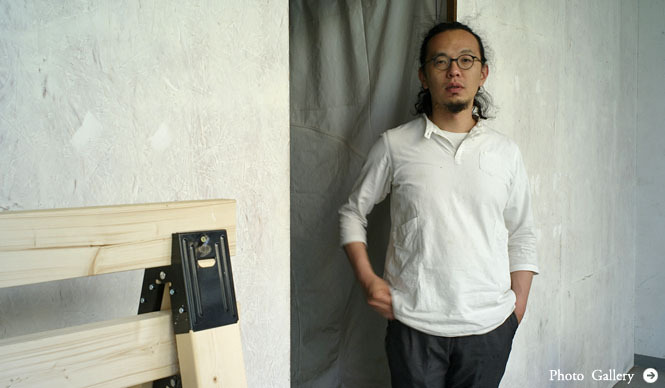
Feature: OPENERS' Young Japanese Architects, Part II – Vol. 1: Jo Nagasaka Interview
Vol. 1: Jo Nagasaka Interview (1)
The Ambiguous Space Between A and C
New value and the value of old things. In Mr. Nagasaka's creations, the beauty and earnestness of the raw state, belonging to neither, coexist. Renovations of apartments and houses, and tables reborn by pouring epoxy resin into their scarred surfaces, possess a refreshing clarity that can be called a return to the origins of making and designing. Viewing an object from a different perspective is also about discovering its preceding form and charting a path toward the future. Considering the world after 3/11, we spoke with Jo Nagasaka, who views architecture and the city from a unique perspective, on the fluctuating contemporary values before and after that event.
Interviewer, Editor: Koji Kato
A Methodology for Generously Organizing the City
──Could you tell us about "misuse," your recent area of interest?
At "LLOVE" (an exhibition of Japanese and Dutch designers held in Daikanyama in autumn 2011, for which I served as the Japanese director), the theme I was personally interested in and working on was "misuse." Since Sayama Flat, and especially after the earthquake, I've found myself thinking more about the city of Tokyo. These two threads have begun to converge rapidly in my mind, gradually taking shape into words and form.
This might be a bit of a tangent, but when I think about Tokyo, I'm reminded of Tokyo when I was in high school. I'm turning 40 this year, so that was over 20 years ago, but Tokyo felt so much more open back then. Children could go far away to play on their own, and of course, people could smoke while walking, and even on trains and planes. It felt like actions were taken with personal responsibility, with the understanding that one had to deal with the consequences.
There were more undefined spaces in the city then, places that didn't clearly belong to anyone. Especially after the bubble burst, there were vacant lots everywhere. I used those spaces as free parking lots (laughs). Also, it was implicitly allowed to cut through people's gardens to take shortcuts, so the city's overall outline felt loose and generous. Places like Shimokitazawa and Shinjuku Golden Gai, while their healthiness is debatable, had an energy that was exciting.
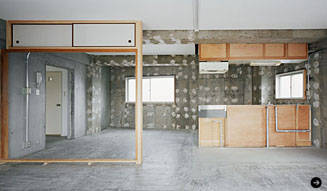
Sayama Flat (2008) Photo by Takumi Ota
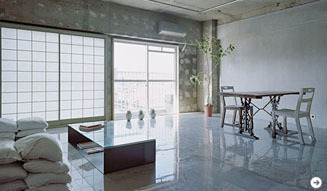
Sayama Flat (2008) Photo by Takumi Ota
──What kind of awareness did these changes bring about for you?
Around that time, with the fall of the Berlin Wall and the end of the Cold War, everyone thought a happy society was about to unfold. At least, I was idly enjoying myself. Then, incidents like the Miyazawa poisoning and the Ikeda Elementary School massacre occurred, leading to security becoming a product, and companies like SECOM rising to prominence.
During this period, with the spread of the internet and mobile phones, while individual freedoms were gained, heavy events like the Tokyo subway sarin attack and 9/11 continued, accelerating a sense of stagnation in society as a whole.
I always felt a sense of discomfort with this situation. One of the reasons I got into making things was to "break predetermined harmony." In other words, I wanted to create things not in predetermined places or situations designed to evoke emotion, but within everyday life. That hasn't changed, and with the increasing sense of stagnation, I've been making things recently, thinking about how to dismantle the frameworks that bind society.
──What do you mean by that?
While dealing with something as concrete as architecture, it might sound strange, but I've always believed that architects, in particular, should have such a vision and create things for society. And this belief has only strengthened since the Great East Japan Earthquake.
So, regarding "misuse," I once thought about what is truly new in our contemporary era, when the very idea of a "new future" has become somewhat embarrassing. The answer I found was to actually do things myself, like running a "greengrocer" or a "florist." Even if the activities themselves aren't new, they offer a new experience for the individual who engages with them.
Through this, I gain a new perspective on the world that I hadn't seen before, and it might also provide an opportunity for that field to change from its rigid, old structure by introducing different values. For me, "misuse" is precisely that.
Vol. 1: Jo Nagasaka Interview (2)
Each Misreading: The Case of LLOVE
──"LLOVE" became a major topic as a "hotel you could stay in." What led to the creation of this project?
It all started with a series of complex "mistakes," beginning with the Lloyd Hotel in Amsterdam. It's been open for over five years and is one of the most popular hotels in the Netherlands. Its wonderful concept actually originated from a "misreading" by Suzanne Oxenaar, the hotel's director, who visited Japan 25 years ago and saw love hotels. She was inspired by the idea of a hotel with a minimal front desk, rooms where guests could choose their own design for the day, and an atmosphere filled with love. While the Lloyd Hotel embodies this, it's realized in a way that you wouldn't imagine from that initial concept unless you were told. But isn't it wonderful that this fact might not have existed without Suzanne's misreading?
This "LLOVE" project began with a call from Suzanne. It was a somewhat complicated project: to actually create an "LLOVE HOTEL" in Japan for a limited month. It was led by a Dutch person who fundamentally misread Japanese love hotels, and realized by a Japanese architect who knew them well, and a Dutch designer whose head was filled with vivid images, leading to further misreadings. We didn't have a budget, but in the end, everyone contributed ideas, and it became a very interesting project.
──I saw it too, and the power to actually realize it, starting from the Dutch misreading of love hotels and with you, Mr. Nagasaka, building upon that misreading, was tremendous.
I believe that "misuse" is a powerful expressive technique in design. It's not inherently strange for either the one who misuses or the one who is misused, yet the contrast between the two creates something impactful. Projects like the High Line in New York, the Gasometers in Vienna, and the Tate Modern in London are precisely the products of great misuse. By affirming past structures and introducing new functions with strong contrast, they create a powerful impact on the city and inevitably transform the surrounding areas. When considering the metabolism of a city today, I believe misuse is a compelling methodology.
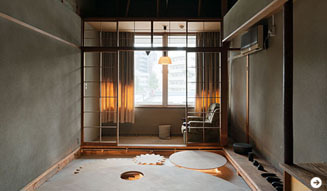
ROTATING BED (LLOVE) (2010) Photo by Takumi Ota
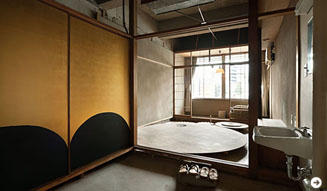
ROTATING BED (LLOVE) (2010) Photo by Takumi Ota
──Specifically, how does "misuse" manifest in your work?
This is still more of a developing path that I'm beginning to see, and there aren't yet many works where it's explicitly incorporated as an expression. However, I'm gradually getting opportunities at the level I mentioned earlier, and some of the works I've already completed can be explained in a similar way.
For example, HAPPA, where my office is located, is a prime example of misuse. People who come here never assume it was originally an office. They always ask, "What was this place before?" Also, "Okusawa House" reinterprets "British architecture" through misuse, further developing its own unique expression.
I'm attempting something similar with the Aesop Ginza store, which I'm currently working on. The new store is being built in a space that was a shoe store for about 40 years. I'm very conscious of this aspect, though I'm not sure how it will turn out.
However, there may still be few people who can positively embrace "mistakes" and find joy in expressing them. I still feel like I'm being pointed at for what I do. So, for now, I'm experimenting in my personal life, essentially as a guinea pig. One thing I've been doing recently is wearing just the sleeves of a long-sleeved shirt or T-shirt around my neck (laughs). This summer was so hot that I couldn't wear shirts, but I felt I couldn't just wear T-shirts every day, so I ended up putting my head through the collar and not wearing the rest. It looks like a scarf or a towel, but it has a unique shape like a scarf, and it can also function as a towel if I get sweaty. And if I go into a cold, air-conditioned room, I can put my arms through the sleeves for warmth.
──It seems to be a sensibility that permeates your entire lifestyle. That's fascinating.
Also, the other day, a friend visited while I didn't have a place to meet, and since my office was stuffy and it was evening, I decided to have our meeting outside with a desk. It allowed me to experience the familiar streetscape in a different way. More than that, it made me realize the obvious: that evenings in summer are pleasant outdoors. Having a space like this, not as a cafe but as my own, makes me look forward to having visitors. So, while it's still a hypothesis, if anyone shares this sentiment, I'd love to collaborate on a project.
Vol. 1: Jo Nagasaka Interview (3)
Thinking About New Value
──Could you tell us about your renovation work so far?
Fundamentally, I don't differentiate my approach whether it's new construction, renovation, furniture, or events. I want to discover something new myself, express it so that others can experience it, and then, based on that experience, I want them to expand their imagination and offer me new insights.
To explain the difference between new construction and renovation, it might be helpful to start there. New construction involves building everything from scratch on a plot of land, so the creator's intentions tend to be expressed directly, like an autobiographical novel. In contrast, renovation involves an existing personality, making it more like a conversation among multiple storytellers. In terms of space, even a single house already incorporates elements of the town. In other words, with renovation, the emphasis is more on the process than the answer, leaving room for viewers to imagine the future. Therefore, even after completion, there's a sense of leisure, thinking, "What shall I do next?" Given these characteristics of renovation, I aim to create spaces through renovation that serve as fixed points, rather than just fleeting scenery.
──What were your thoughts behind "Okusawa House," a complete renovation of a single-family home?
That was a project with a strong character. After the war, everything was stripped away, and the building was inspired by the stimulating Western civilization that suddenly appeared before its eyes. It was built by imitation without proper learning, and it had the personality of a building lived in as a status symbol. And this wasn't just about someone else; it was a project I confronted with a sense of personal recognition. Through what I considered here, I realized that I could positively engage with and design for the contrasting townscapes, the chaotic streetscapes, and that was a truly impactful project.
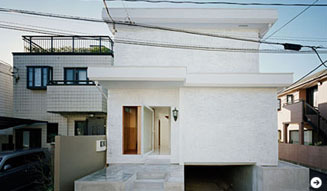
Okusawa House (2009) Photo by Takumi Ota
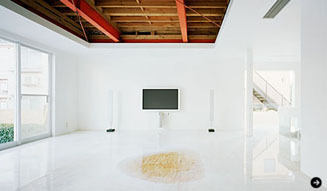
Okusawa House (2009) Photo by Takumi Ota
──What about "Sayama Flat"?
Rather, "Sayama Flat" was the project that provided the impetus for this series of realizations. It was a project designed with subtraction alone, without adding anything, to a typical apartment building symbolizing the Showa era. Furthermore, since residents could freely make modifications after moving in, the experience of it being easily overwritten by others shortly after completion, yet still affirming everything, made me think deeply about many things.
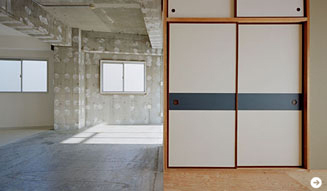
Sayama Flat (2008) Photo by Takumi Ota
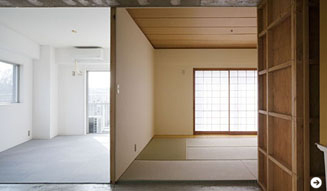
Sayama Flat (2008) Photo by Takumi Ota
──As you mentioned before, Mr. Nagasaka, both "Sayama Flat" and "Okusawa House" lack fixed, rigid rules in their original spaces, allowing them to embrace whatever comes later with great depth. I felt this was a unique existence compared to the often self-contained nature of contemporary architecture.
The thinking behind it is similar to how everyone understands there's a point B between A and C, but when you talk about B and H, the range suddenly widens, and it becomes unclear where it begins. In the case of "Sayama Flat," within a familiar format, parts that were not individually recognized became so for the first time by being selectively removed.
For example, a shoji screen and a kitchen. Between them, there was tatami, and then a carpet. Those were removed, leaving them in a state of suspension. There's already a story there, and the architect isn't participating in it; because the fundamental design code isn't determined, a story begins to unfold with whatever is introduced. For the user, there are various choices, and the question is whether new values can enter. I believe that's where richness lies.
Vol. 1: Jo Nagasaka Interview (4)
Drawing a Better Future Together
──Could you tell us about your thoughts regarding the period after 3/11?
I certainly don't expect my designs to be supported in Tohoku and to help build a new city after this earthquake. Nor do I think it's a good idea to simply reset and build a new city from scratch.
Of course, I want to help in any way I can, and more importantly, I want to see Tohoku regain its rightful, equal standing as quickly as possible. In that sense, when architects consider what they can do in this situation, if there are problems preventing architects from entering the area, I hope to improve that and create opportunities for excellent architects to do good work. To that end, I regularly meet with colleagues.
However, personally, I feel the problem lies more with Tokyo than with Tohoku. The issues surrounding nuclear power, for instance, originated from the circumstances of an oversized Tokyo. Moreover, as this earthquake has made clear, I believe Tokyo faces many issues that it must address regarding the anticipated major earthquake in the Kanto region.
However, these are closer to soft issues related to community rather than technical aspects like structure. I'm considering countermeasures to the past approach to urban development, which has degraded society by prioritizing easily quantifiable values, thereby destroying precious communities. Of course, no one has commissioned me, so it's close to fantasy, but these thoughts don't stop.
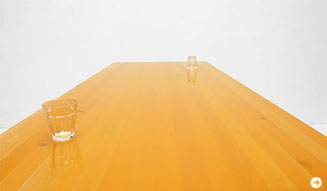
FlatTable “raftered” (2010) Photo by Schemata Architecture Office
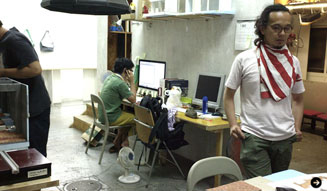
At the studio Photo by Takashi Kato
──So, if there are problems with the current state of the city, what do you believe are their causes? And what solutions do you envision?
Specifically, the overconfidence in the ability to form new communities has led to a regression of society as a whole into fragile communities that cannot support each other in times of need, driven by an economy-first mindset.
Currently, the bustling areas of Tokyo are strangely divided by stations and roads, and are spatially constrained. Take Shimokitazawa, for example. It's divided by two train lines, and by improving transportation networks, it's trying to shed its inconvenient appearance and become like any other town. Shops that loved the community in Shimokitazawa and had been operating for years have already started to move away. In other words, through overconfident urban development, the communities that were drawn to the existing connections are being destroyed.
I've always felt this was regrettable, but until now, I've brushed it off with "but there's no solution." However, since 3/11, I can no longer do that. And as an architect, I am exploring ways to protect the precious existing streetscapes and communities through design. I want to try to translate into design language the objects that I, as an architect, could only interpret superficially until now – the " indescribable streetscape and vibrancy" – and lay the groundwork for their continuation.
──I believe the form of a city is defined by its buildings and the rules within them, but I also think the behavior of the people living there plays a significant role. As you mentioned, Mr. Nagasaka, I wonder if we can approach the city in a more generous way. Thank you very much for your time today.
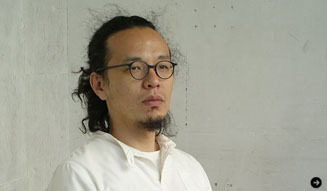
Photo by Takashi Kato
Jo NAGASAKA
Born in Osaka in 1972. Graduated from the Department of Architecture, Faculty of Fine Arts, Tokyo University of the Arts in 1998. Established Schemata Architects in 1999. Opened HAPPA in 2007.
Major works include "haramo cuprum" (2004), "haramoS1" (2006), "Sayama Flat" (2008), "Okusawa House" (2009), "PACO" (2009), and "Flat Table" (2008). Major awards include JCD Award "kitchen café cube" (2004) and Bauhaus Award 2008 2nd Prize "Sayama Flat" (2008).
http://www.sschemata.com