2011 Milan Salone Latest Report | Masato Kawai's Milan Salone Stroll Part 2
Feature: Salone Internazionale del Mobile 2011
Masato Kawai's Wandering Tour of Salone del Mobile: Part Two
This is the Salone del Mobile report from Masato Kawai, who is active as an interior stylist and journalist.
In this second installment, we focus on the exhibition by graduates of the Dutch design school DESIGN ACADEMY EINDHOVEN, which was particularly substantial this year.
We will summarize and introduce the work of brands and designers that left a strong impression (.Part One here).
Photos and text by Masato Kawai
DESIGN ACADEMY EINDHOVEN from the Netherlands, which particularly caught the eye
This year, marking its 50th anniversary, Salone featured a multitude of exhibitions as usual during its approximately one-week run.
While Italian masters like Enzo Mari, who presented furniture from Hermès, and Gaetano Pesce, who continues to release uninhibited designs for Meritalia, were present, what remained most strongly in my memory upon reflection was the DESIGN ACADEMY EINDHOVEN exhibition titled "THIS WAY," held at a venue in the city.
We experienced a diverse range of outputs from the graduates, including furniture, lighting, tableware, textiles, and video works. Each piece had a clear concept and a high degree of completion as a materialized object. Few proposed mere novelty in form or appearance; instead, many stood out for their innovative perspectives and techniques applied to the materials used and the manufacturing processes themselves, offering valuable learning experiences.
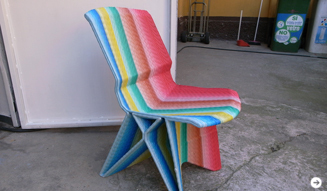
DESIGN ACADEMY EINDHOVEN: A chair by Dirk van der Kooij, featuring beautiful color gradations. Tables and rocking chairs were also exhibited.
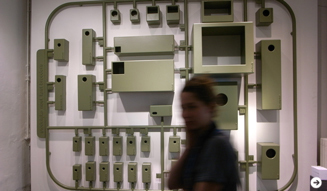
DESIGN ACADEMY EINDHOVEN: This is a collection of birdhouses resembling a giant plastic model. Titled "Bird City," it is a design by Eveline Visser.
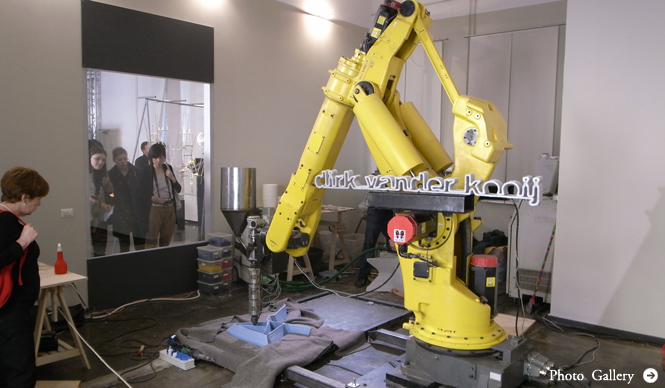
For example, there was the chair by Dirk van der Kooij, also exhibited at Rossana Orlandi. The material is melted pelletized recycled plastic. A large yellow robot extrudes it according to a program, layering it to create the form. It appears to apply rapid prototyping technology, allowing for freeform 3D shaping without molds. I was deeply impressed by the indescribable finished shape and color, which made it a captivating object.
There were also several pieces focusing on textiles, as introduced in the first part. Michelle Baggreman's design was particularly memorable. She processed used plastic bags into woven fabric, creating a novel textile. The technique of transforming cheap plastic material into a strong fabric with different properties was remarkable.
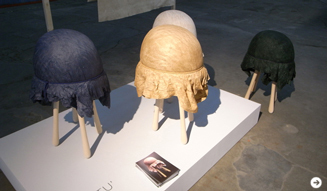
LENNEKE LANGENHUIJSEN: The stool "TUTU" by a designer from DESIGN ACADEMY EINDHOVEN, made from textiles processed from wood. This was exhibited at a different venue.
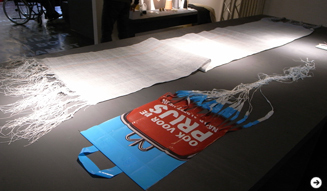
DESIGN ACADEMY EINDHOVEN: Michelle Baggreman's exhibition, which created new fabric from plastic bags.
Other highlights included Eveline Visser's "Bird City," a collection of 33 birdhouses integrated into a structure resembling a giant plastic model. The venue also featured a special kitchen where staff prepared and sold light meals like sandwiches, as well as a cafe and reading space where visitors could enjoy their purchases. The environment created for visitors to relax and engage with cutting-edge design was also commendable.
Many of the individual designs exhibited have already been picked up by galleries and manufacturers in various countries, making this a year that truly reaffirmed the high caliber of DESIGN ACADEMY EINDHOVEN.
Feature: Salone Internazionale del Mobile 2011
Masato Kawai's Wandering Tour of Salone del Mobile: Part Two (2)
Next, we will summarize this year's event by introducing prominent architects and designers, as well as designs using low-cost materials like plywood, which have been gaining attention in recent years.
Plywood was also a notable material this year
Among the prominent figures was Japanese architect Tsuyoshi Nagasaka. His tables, featuring solid wood tops finished with a flat layer of epoxy resin, garnered significant attention from visitors at the Rossana Orlandi venue where they were presented. Additionally, the Bouroullec brothers, Ronan & Erwan, who unveiled new works for renowned international brands such as Established & Sons, Flos, Magis, and Ligne Roset, and BOKJA, who showcased chairs and sofas incorporating traditional textiles like kilim and suzani across multiple venues, seemed even more active than last year.
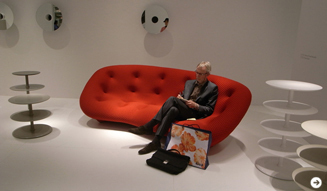
Ligne Roset: The French furniture brand Ligne Roset presented the sofa "PLOUM" by the Bouroullec brothers. This is a display from the trade fair.
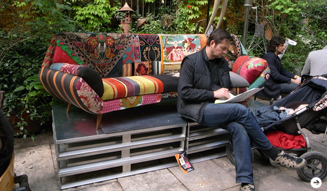
BOKJA: A sofa by BOKJA, exhibited at multiple venues including Rossana Orlandi, Lidewij Edelkoort's curated exhibition, and city shops.
To conclude, I would like to introduce furniture made from plywood, which has been a topic of discussion in recent years.
Furniture made from inexpensive sheet materials like plywood, which began appearing more frequently last year, was even more abundant this year, with multiple products presented by Magis. I particularly liked the new designs by Swiss designer Colin Schaelli and the Italian brand Danese.
Colin Schaelli's furniture is also exhibited in Japan, so many may be familiar with it. New specifications featuring melamine or walnut veneers on the tabletops of desks and shelves were unveiled, expanding the range of choices.
Meanwhile, at Danese, Matali Crasset, Marc Sadler, and Francesco Faccin presented new works using plywood. Francesco Faccin, a rising star, designed the chair "STRATOS," an exceptionally simple form assembled solely from cut plywood.
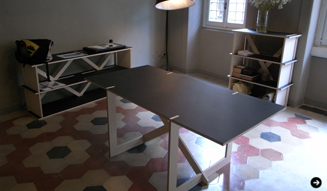
Colin Schaelli: The "con.temporary furniture" series of assembly-required furniture made from plywood, without the use of screws or nails, by young Swiss designer Colin Schaelli. This is the first exhibition in Italy.
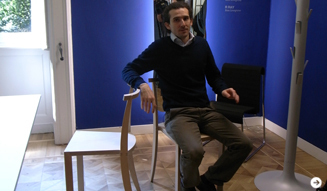
DANESE: Francesco Faccin, a young Italian designer born in 1977, sits on the chair "STRATOS" he designed.
It reminded me of the Proust chair, Jasper Morrison's breakout work. However, "STRATOS" uses even fewer components, without even wood screws. The gently curved backrest and rear leg structure demonstrate exceptional insight and sensibility in woodworking. Faccin, who previously worked in Enzo Mari's studio, currently teaches a course called "Projects, not objects" at NABA (Nuova Accademia di Belle Arti) in Milan.
The furniture primarily using plywood by Colin Schaelli and Francesco Faccin appears as unadorned designs where minimal elements dictate the visual impression and structural integrity. For this very reason, they are fascinating subjects to me, as they directly convey the designer's individuality.
Having reached its 50th year, Salone del Mobile has evolved from an Italian furniture fair into a unique event where the latest technologies from around the world converge and all manner of design information is exchanged. This year's biggest discovery was a single chair made from simple plywood, designed by Italian designer Francesco Faccin.