Feature: OPENERS' Picks of Japan's Women Architects Vol. 5: Yuko Nagayama Interview
Vol. 5 Yuko Nagayama Interview (1)
Places Just Out of Reach: The New Standard for a New Era
Unlike the era of economic growth where we created something from nothing, we have now entered a phase where we generate new standards from existing ones. New value for a new era is born by finding worth in what already exists, looking at things from an unprecedented perspective, and considering phenomena as they are. Through architecture, Yuko Nagayama extracts universal elements from disparate things to create the next generation of standards.
Interviewer and Summary: Takashi Kato
Small Scale, Large Scale
──What sparked your interest in architecture?
Actually, my grandfather aspired to be an architect. I have no memory of him, but he was in Yoshio Taniguchi's lab, the father of Yoshio Taniguchi, and apparently helped design the Shimazaki Fujimura Museum at the time. My grandfather passed away young, so I never interacted with him directly, but we had the first Japanese edition of Bruno Taut's 'Alpine Architecture' and books by Sōetsu Yanagi at home.
I was in the science track throughout high school and planned to major in biology in university. Then, I heard one of my friends was going to the architecture department. I had never considered architecture as a career path myself, but at that moment, I thought, 'There's also the direction of architecture.' It all clicked together – my grandfather, everything else – and I instantly knew my path was architecture, not biology.
──What led you to be interested in biology in the first place?
My father was a biophysicist, so it was something familiar to me. It was also a time when biotechnology was gaining attention, and I was interested in studying the small worlds within nature.
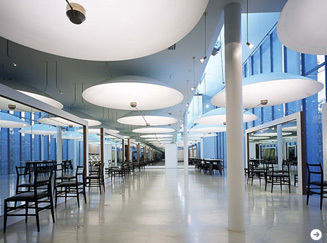
afloat-f (2002)
──Architecture, like biology which deals with microscopic worlds, seems to involve approaching the immediate vicinity of life and sometimes stepping back for a broader perspective. Is there a commonality in this oscillation?
Yes. It feels like the scale I deal with has shifted from small to slightly larger. I've always loved Charles and Ray Eames's book 'Powers of Ten' (1968). Initially, I wanted to do biology, studying the micro-world depicted in it. After starting architecture, my interest shifted to scales closer to the human scale, and then to urban scales – slightly larger than the world of biology.
──For an architect who deals with scales ranging from homes to cities, a visual like 'Powers of Ten,' which depicts scales of all existence in the world, must be very suggestive. How did you first encounter 'Powers of Ten'?
It was when I was in elementary school. It was a truly shocking encounter. My interest in similar systems and fractal worlds, depicted there, has stayed with me since then.──This might sound like a discussion of the spiritual world, so I haven't talked about it much, but when I was little, I seriously worried about why I was here, who could prove my existence in this world, why I was here, and why I could perceive it. I would lie awake unable to sleep. I think everyone questions their own existence at some point, but at that time, I felt there was nothing connecting me to this world.
──The anxiety that you weren't truly connected to the seemingly real things in this world?
Of course, my surroundings – relationships with various people and things in daily life – made me feel recognized as a real existence. But I had this thought: 'What if it's all a complete fabrication?' I was that kind of child. So, when I saw 'Powers of Ten,' I thought, 'There's another me inside me.'
The film begins and ends with the same image: the lowest layer, the world of cosmic dust and subatomic particles, is identical. This means that no matter which scale you explore, you return to the fundamental basis of existence in a circular fashion. The idea that there was someone like me living inside me, and someone else inside that person, and so on, and that my existence was part of this cyclical flow, made a strange kind of sense to me. After that, I stopped worrying about such problems.
──There's a movie called 'The Truman Show.' I've also had a similar imagination, like being watched by someone on a higher level of existence, as you mentioned. It's also about observing oneself objectively amidst many people.
The recognition that existence itself is part of a fractal structure was greatly influenced by seeing 'Powers of Ten.' If there's someone else living inside me, I have a responsibility to that person. I realized that I couldn't afford to lose even one of them. In that sense, it was very calming to feel that it showed me the meaning of my existence.
──Is it like having a part of you that's always observing, even when you're energetically playing with friends?
There was a part of me that was always observing from above. But at that time, I couldn't talk about these things with my friends, so my father would listen, or recommend books on the subject.
Vol. 5 Yuko Nagayama Interview (2)
Places Just Out of Reach: The New Standard for a New Era
Perceiving the World Through an Architectural Lens
──How did the background of your thinking connect with your path into architecture?
Yes, as I mentioned, I realized that my interest in biology meant I was oriented towards a microscopic perspective in 'Powers of Ten.' When I decided to pursue architecture, I became conscious of the shift towards a more human-scale perspective. This involves finding inspiration in the subtle changes of everyday life. I've always loved creating stories and dreamed of becoming a picture book author or storyteller. I wanted to be able to create stories within my own daily life and the scale I could perceive.
──So, you began studying architecture seriously when you entered university?
Because I changed my path so suddenly, there weren't many schools I could apply to. However, I could apply to programs related to housing, so I entered the Department of Living and Environmental Design.
──What kind of architecture interested you when you started studying it?
The first architect I admired was Friedensreich Hundertwasser, an Austrian artist and architect. Influenced by my initial interest in biology, I was very interested in nature at the time.
I felt Hundertwasser's architecture was close to nature, despite being artificial. Also, his work isn't strictly architecture, but I liked how he tried to create life very freely. As I studied architecture, I learned about Modernist architecture and various other styles. When I was a student, a new architectural movement was emerging from the Netherlands, with Rem Koolhaas at its center. He dealt with scales from vast cities to small spaces, and I was definitely influenced by him as a contemporary.
──Regarding Koolhaas, most people involved in architecture in the late 1990s would say the same thing.
Yes, Koolhaas was probably the most influential architect at that time.
──After graduating, you joined Jun Aoki's office. Did your way of thinking about architecture change through that experience?
At Aoki's office, I learned the fundamental processes of architecture, such as how to think architecturally and how to perceive my surroundings from an architectural perspective.
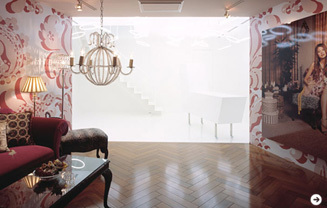
CAST (2003)
──Does it feel like what you learned at Aoki's office forms the foundation of your current thinking?
I believe it forms a foundation for my architectural thinking somewhere. The architectural thought processes I developed through academic study became firmly connected through my experience at Aoki's office. This includes how to translate various accumulated interests into the form of architecture, and how to properly shape the thought process. That's what I learned during my time at Aoki's office.
──Did you have interactions with peers at that time?
I think our generation is filled with incredibly talented people. I feel fortunate to have been part of such a strong cohort when pursuing architecture.
──In that sense, I'm impressed that architecture, more than other design fields like product or graphic design, has such strong connections among peers and across generations, even from student days. And these connections aren't just about similar tastes or hobbies; they're about being conscious of the profession of architecture itself. I think that's wonderful. Perhaps it's because architecture is so closely tied to society at its core. What do you think?
In the world of architecture, there's a practice called 'open desk' where students gain experience at architectural firms. This provides opportunities to meet people outside of school, naturally expanding one's network. Also, depending on the project, architecture generally involves a larger scale than other design fields, meaning more people are involved in creating a single piece. Even making a model can be a large undertaking, requiring human hands. This further expands the student network through encounters.
It's not all positive, but compared to when I was a student, information technology has advanced significantly. Conversely, with information being so pervasive, the work of today's students can become homogenized. When I teach at universities or am invited to critiques, I see many students who easily imitate the styles of popular architects. Being sensitive to the times, some people can become overly swayed in one direction.
Vol. 5 Yuko Nagayama Interview (3)
Places Just Out of Reach: The New Standard for a New Era
The Difference Between Architecture and Interior Design
──After that, you became independent and established your own firm. Could you tell us about your first project?
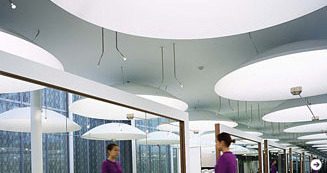
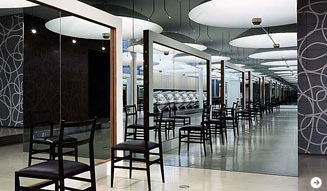
It was an interior design project for a hair salon called 'afloat-f,' which is still in Omotesando. I handled the entire space, including the lighting. Unlike architecture, I explored how to create a space freely within the constraints of an existing three-dimensional box. I manipulated the sense of volume through furniture placement, light, and reflections from mirrors to stretch the space and alter the sense of depth.
──What is the difference between being involved in the overall planning of a building and engaging with individual programs like interior design?
In either case, when creating something with an architectural mindset, I start from primitive, essential elements like light, manipulation of spatial volume, and the density of materials, rather than 'tastes' like Japanese or Western style. When building architecture from scratch, there are site conditions. For interior design, there are already three-dimensional constraints. The initial conditions differ, but the thought process itself doesn't change much for me.
Another difference is that architecture, exposed to the elements, has very high hurdles regarding weather resistance and durability, whereas interior design allows for more experimental approaches.
──You mentioned stretching space and creating a sense of depth. For architecture, this relates to the site, and for interiors, the space itself. Could you share your unique approach to this?
Regarding that, I often talk about 'places just out of reach.' I believe that spaces that affect consciousness, rather than those that offer a physical experience exceeding material limitations, might be able to transcend those physical constraints.
I believe that by intentionally creating inaccessible, unreachable places within architecture, one can feel a sense of spiritual expansion. This fosters interest in the unseen and the immeasurable. For example, in 'CAST,' created after 'afloat-f,' I designed a space that intentionally lacked depth, making it difficult to grasp at first glance.
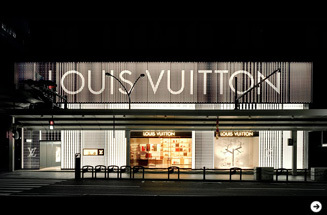
──The spaces are connected, yet they feel like separate realms.
When creating space, I consider how to transcend physical limitations and achieve spiritual freedom.
──When I visited Kyoto recently, I saw the facade of the 'LOUIS VUITTON Kyoto Daimaru' that you designed. I felt a strange dissonance between the polarizing film, a physical element, and the lattice-like appearance, which left a peculiar impression. Architecture is always destined to appear as part of the urban landscape. The 'LOUIS VUITTON Kyoto Daimaru' was designed against the strong sense of place that is Kyoto. How did you consider this sense of place?
Actually, when I first entered the competition, the location was Osaka, not Kyoto. It ended up being realized in Kyoto, and they asked me to do the same thing I had planned for Osaka. However, considering the site conditions in Kyoto, especially in a commercial area with an arcade, it simply wouldn't fit. So, I requested to reconsider the design.
──So that's how it happened.
In the revised proposal, I adopted the vertical lattice, used in Kyoto's traditional townhouses, as a design motif. Today, 'vertical lattice' is almost a symbol of Kyoto, but the reason it's used in Kyoto is its effectiveness as a visual screen for the linear movement of people walking along streets lined with machiya. The vertical lattice is a very simple and rational facade system for Kyoto. It has since become synonymous with Kyoto's aesthetic. When considering a Louis Vuitton facade in Kyoto, the motif of vertical lattices naturally emerged due to the prevalence of horizontal movement and the location along the arcade.
──I see.
I varied the patterns of these vertical lattices. In machiya, the spacing and thickness of the lattices change depending on the occupation. For this reason, if you look closely, you'll see various lattices lining the streets. The 'LOUIS VUITTON Kyoto Daimaru' has a width of 25 meters, and if the lattices were created with the same rhythm and scale, it would appear stretched. To create the rhythm of Kyoto's streetscape, I varied the width of the lattices themselves and the spacing between them.
With 'LOUIS VUITTON Kyoto Daimaru,' I considered the context of the town, its materials, and people's movements. While this is a rational approach specific to Kyoto's context, for a brand store facade, it needs to incorporate the brand's story to become a strong final message. While researching, I discovered that Louis Vuitton's historical motif includes vertical stripes. This created a beautiful narrative: reviving Louis Vuitton's historical vertical stripe pattern in the ancient capital of Kyoto.
──So, the history of Kyoto and the tradition of Louis Vuitton perfectly aligned. Furthermore, social context is crucial when considering architecture.
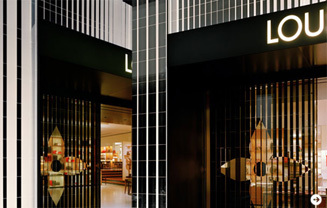
LOUIS VUITTON Kyoto Daimaru (2004)
Indeed. For a Louis Vuitton facade, it must express the brand's message to be a successful project. But beyond that, I believe it can convey a stronger message to society than just the brand's message. When something occurs that cannot be immediately understood, people stop and consider what that phenomenon is. I wanted to offer a small trigger to the daily lives of people walking along Shijo Street in Kyoto, to awaken their senses. By experiencing that sensation, I hope they can feel the reality of being here, in this moment, even if it sounds a bit exaggerated.
I feel that the potential of facade design lies in this area. Initially, I was drawn to the interesting phenomena created by the polarizing film, but as I worked on it, I began to consider what message could be left in this location. What I was careful about was not to let the physical trick of the polarizing film become merely a demonstration. A 'trick' only becomes an expression when its action reaches someone and evokes a new emotion within them. Therefore, even if the mechanism isn't fully understood, it's fine if viewers can imagine various things from this facade. If you look closely, the fact that something so thin stands six meters without moving is impossible in the natural world. One should question it, but human perception is deceptive; we tend to believe in virtual things that shouldn't exist. I found that fascinating. Ultimately, I realized that the existence of things is actually questionable.
──So, the existence of the phenomenon relies on the viewer's perception?
When I think about what it means for something to exist, it seems to be reducible to being seen. It exists because someone is looking. People accept what is reflected on their retinas as existence.
After finishing this project, I visited Entoku-ji Temple in Kyoto. When I saw the borrowed-scenery garden, I realized, 'This is exactly what I wanted to do.' It's not about 'how something is,' but 'how it is for someone.' Whether it physically exists or not is less important than what can be conveyed to the person confronting it.
In the main room of Entoku-ji, the spacing of the pillars is offset from the grid to align with the spacing of the trees in the garden. The architecture is also designed to present a specific view or picture to the observer. It's not a fixed space created by material composition, but rather how it is perceived at the moment the viewer encounters it. Entoku-ji is an incredibly interactive expression.
At 'LOUIS VUITTON Kyoto Daimaru,' the lattices create different rhythms depending on the viewing situation. It changes whether you're traveling by bus or walking, and even with the speed of movement. I feel I was able to create such phenomena.
Vol. 5 Yuko Nagayama Interview (4)
Places Just Out of Reach: The New Standard for a New Era
Places Just Out of Reach: The New Standard for a New Era
──I also think that the ability to create new histories and contexts is the charm of architecture and design.
Yes. I carefully observe various events, matters, and even unformed aspects of a place. Rather than squeezing something out from within myself, I aspire to be a high-performance converter that takes various things in, transforms them, and then expresses them (laughs). Thinking that way, I believe there are many ideas and hints all around us.
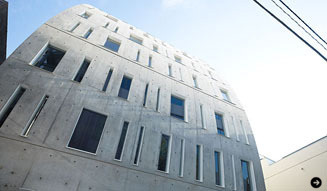
URBANPREM Aoyama (2008)
──Is it like becoming possessed by the phenomena that exist there?
Rather than possession, for my generation, it's a given that things and information are already largely available. Instead of creating something entirely new from within, I think it's valuable to show a new perspective on the existing, often chaotic, situation. I believe this is also the role of architecture, which can adopt free-scale viewpoints, from an overview to a close-up.
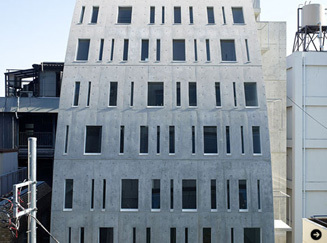
──There's the commercial building 'URBANPREM Aoyama' that you designed. It's not a particularly tall building, but it looks slightly different when viewed from up close versus from a distance. The presence of this building makes the previously existing space appear somewhat different. It has a mysterious presence, making a familiar object like a building seem unfamiliar.
I'm glad to hear that feedback.
──Discovering that building in the city was truly by chance. I was walking off the main street when I felt a strange intuition and found it. That building perfectly expresses what you often call 'places just out of reach.'
In any architecture, there are often unreachable places, like the rooftop or exterior walls. The existence of these unreachable places enriches architecture, I feel personally. I believe architecture can consciously create this richness. When you speak of 'places just out of reach,' how do you consider them?
To give a specific example, the Aoyama building is located in an area with a significant scale gap: tall buildings line the main street, while just a step behind, it suddenly becomes a residential area. This is a distinctly urban situation.
The most significant contextual element of that location was this kind of boundary. Also, as it was a rental building, essentially a skeleton, I couldn't alter the interior planning. Being in the center of the city, a high rentable area ratio was required. Therefore, rather than focusing on the building's composition, its presence within the cityscape became paramount. My first consideration was what people would think when encountering the building. Faced with a city of scale gaps, I began to think about how a building could stand without a defined scale, belonging to neither side. I wanted it to be something ambiguous, whose size couldn't be easily determined.
The facade of this building is not vertical; it bulges inward from both the top and bottom towards the middle, making the distance difficult to gauge even when looking up from below. I felt something ambiguous like this would be suitable here. What I'm attempting here is closer to an 'event' than an 'object' – it's about how people encounter architecture.
──Given the limitations in planning and interior design, wasn't it difficult to create such an 'event'?
We live our daily lives within linear time, making plans and living within a somewhat predictable flow. However, I feel there's another flow of time, distinct from our daily lives. It's like two streams of time, born from imagining what someone else is doing elsewhere at this moment. I want to create moments where one can suddenly feel a different flow of time than the one they are currently experiencing in their daily life. This is close to the feeling of contemplating 'places just out of reach.'
If there were a very simple way to divide the world's spaces into two categories, I believe they would be 'the space I am in' and 'the space I am not in.' These two spaces are opposites, yet they are always two sides of the same coin, and space is formed by their balance. By contemplating places I am not in, I can feel a sense of spiritual freedom. This feeling might be difficult to express in words, but thought can transcend physical limitations and travel far. By looking at distant mountains and contemplating them, I believe one can feel as if they have mentally traveled there. I see potential in 'places just out of reach' as a catalyst for such an effect.
Even when facing the famous rock garden at Ryoan-ji Temple, no one can step inside. However, gazing at the stones placed there allows the spirit to wander freely. Conversely, I sometimes think that being able to go anywhere might actually mean not being spiritually free. Currently, I feel that special places are being opened up too much, and the number of unreachable or inaccessible places is decreasing. Conversely, I am concerned that by preserving such places, we are losing spaces that allow for spiritual freedom, spaces that make us aware of a different flow from the everyday.
──It would be wonderful if architecture could create that.
I think so.
The City of Tokyo
──You were born in Tokyo, weren't you? You must have grown up watching Tokyo transform. What are your impressions compared to other cities around the world?
Tokyo gives me a sense of vastness compared to any other city in the world. The central areas have a certain density, which gradually spreads out, and the peripheries become so vague that it's hard to tell where they end. But if you zoom in, you find vibrant little alleys hidden like secret characters within the city, making it a mysterious place.
──Where were you born?
In a town along the Chuo Line. Outside the Yamanote Line, along the Chuo Line, it's like a borderland of the city. You have areas with amazing buildings right next to residential neighborhoods. The Chuo Line area has a unique atmosphere and cultural background.
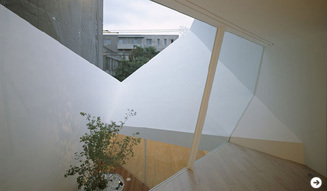
House on a Hill (2006)
──I have the impression of areas like Koenji, Ogikubo, and Nakano, where unique subcultures have taken root. Geographically, within the flat land, Ring Road 7 and 8 run radially outwards from Tokyo, and arterial roads extend across them towards the suburbs. In between, there are serene townscapes, intricate alleys, and rivers flowing.
It's an area that symbolizes a different facet of the city of Tokyo, a place with unexpected boundaries and a sense of chaos.
──While individualistic, the seemingly uniform streetscapes can also appear devoid of character. Here, one can feel watched, yet live quietly like in a deep forest on the city's edge. Conversely, if one actively engages with the city, there are activities that offer increasing enjoyment. The clear zoning here dictates how one behaves in the city, so it's a system where the city's character is shaped by its buildings. I'm very interested in how architects who create such buildings think about and view the city daily.
As you build, you realize that building codes clearly shape the cityscape. It's also a consequence of building codes that large buildings stand facing the street, with only smaller buildings behind them. If the regulations change, the cityscape can easily transform. I believe that a slight revision of regulations could lead to positive changes in the city. I wonder if architects could play a role in subtly altering the urban landscape.
──Can't individual architects make a difference?
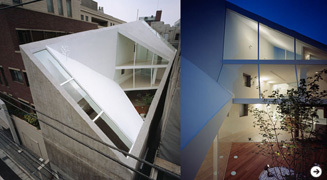
I think it's a minor impact. However, for example, the road shade line regulation was a factor that the Aoyama building's approach cleverly utilized. The facade of the building, which curves back along the road shade line, receives light in a gradient, casting a soft light onto the street below. Seeing that, I realized that the road shade line could be beneficial for people walking beneath it.
Vol. 5 Yuko Nagayama Interview (6)
Places Just Out of Reach: The New Standard for a New Era
Considering Regionality
──What about the renovation of 'Kayaba Coffee' in Tokyo's shitamachi (old downtown)?
In the case of 'Kayaba Coffee,' it was an approach close to building preservation. This project broadened my perspective. I hadn't done many renovation projects before. It was a joint project with the Taito City History Research Association, which is involved in preserving the townscape. Initially, listening to the historical, and in a sense, nostalgic stories of the place, I considered how to approach it.
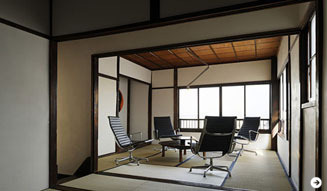
What I realized then was that I wanted to avoid simply indulging in nostalgia as a 'vessel.' If we were to re-examine the spatial characteristics that have developed within the architecture over a long period, what would we find? From that perspective, I discovered the existing contrast of light, unique to this place.
Generally, old coffee shops are dark inside, aren't they? (laughs) While looking at the dark interior and the black coffee, I noticed my reflection on the coffee's surface. When I looked up, the outside was bright, and people walking outside looked lively. I realized that this contrast of light creates the unique flow of time characteristic of coffee shops. I decided to pick up on such universal elements inherent to the place and use them as a starting point for its new beginning.
Regarding scale, I've also adjusted it to a slightly new scale suitable for contemporary people. The ceiling here is low. So, by replacing the ceiling with glass, I've expanded the space upwards not physically, but as a phenomenon through reflection. I thought this would create a space that aligns with contemporary sensibilities and scales. The lighting is finely dimmable, allowing it to balance with the light from outside the windows. The wall visible at the back is a light wall, creating a sense of depth.
This building stands on a corner facing two streets, so it's visible from both. When the lighting is off, the light wall at the back becomes a white wall, and it can be used for projecting movies, which is also clearly visible from the street. I hope it can become a space that actively communicates with the city.
──Many contemporary open cafes are physically open to the street, but traditional coffee shops often seem designed for a single person. I feel that.
Yes. Bright, modern cafes are nice, but I think it would be good to have more coffee shops that are slightly dim inside, allowing patrons to contemplate while observing the bright, colorful world outside the window from within that dim, monochrome space.
──'Kayaba Coffee' was closed for a while, and it was a landmark in the neighborhood, so everyone who knew of its existence must have worried about its future. Therefore, I believe it's wonderful for the relationship between the building, the city, and the architect that it has been passed on through your hands in a form that many people desired. Given the building's rich history and memories, the renovation must have presented many challenges, wouldn't you say?
Engaging with each memory presented many challenges, but I considered what the fundamental element generating those memories might be. Looking at the space, I discovered the 'contrast of light' inherent to this location, as I mentioned earlier. There are sunny days and cloudy days; it's bright sometimes and dark at others – the light conditions change throughout the day. The ceiling inside uses black translucent glass. When the illumination is low, the reflected scenery appears black and white, and when it's bright, it appears colorful. The reflections also change with the light. 'Kayaba Coffee' is also a joint project with SCAI (Contemporary Art Gallery). The second floor serves as the gallery's office. In the future, I hope to place artworks in the attic and have them subtly visible through the black glass. I envision a place where one can confront art without elaborate staging. In this way, I hope to create moments of subtle realization within daily life through architecture.
Vol. 5 Yuko Nagayama Interview (7)
Places Just Out of Reach: The New Standard for a New Era
Creating New Value
──Could you tell us about your current projects?
There are still some uncertain elements, but I am designing a communal facility for residences in China. Specifically, it's a project to create a public space with a Chinese-style garden for residents in an area with many apartment buildings.
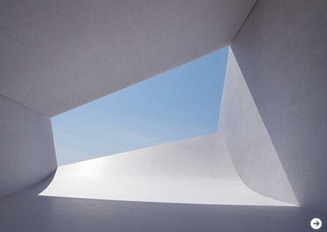
There's also a housing project. It's a small house of 75 square meters. About half of the floor is sloped. While not exactly 'places just out of reach,' I see potential in sloped floors. This is because you can't place objects on a sloped floor, so the space remains unmarred and neutral. When sunlight enters, it appears as volumes of light.
──A sloped surface can be interesting depending on how you think about it. The roof of a house is triangular and sloped, and when viewed from the inside, it can feel like a much larger space than a horizontal ceiling.
In this house, I'm also considering creating a residence in the basement that can accommodate guests. If I were to build a house now, I'd want to create something with variable elements, not just a house. It's not about 'my house,' but about creating a 'space' – a place for myself that can be used freely and connected to the city.
This is something I realized after working on 'Kayaba Coffee': architecture isn't just about demolishing and rebuilding; it's also about creating new ways of seeing, about pointing towards new perspectives. Therefore, I believe it's an interesting role for an architect to propose how unused spaces could be utilized. I think it's an interesting job for architects to suggest new uses for underutilized spaces.
Housing Project (2010)
So, I created a program for an artist-in-residence at a hotel. The location is a hotel called 'El Bosco' on the shores of Lake Nojiri in Nagano, designed by Kiyoshi Seike. When Aya Asō, who I had previously worked with and who manages this hotel, and I discussed doing something at the hotel, I came up with the idea of an artist-in-residence program. Hotel rooms are not used 24/7, 365 days a year, so we decided to lend these vacant rooms to artists as studios. Thus, 'Hotel Solitude,' an artist-in-residence program, was initiated by myself, Asō, and artist Kohei Nawa as co-founders.
The difference from a typical artist-in-residence program is that it provides 'time for contemplation.' Artist-in-residence programs usually imply providing a space for creation, but I felt there weren't many programs offering free time for thinking. Currently, we are experimentally offering long-term stays to young artists.
──The concept of gifting time for contemplation is novel. A conducive environment for thinking likely fosters new ideas.
This hotel is situated in a wonderful natural environment amidst the beautiful lakeside forest, making it an ideal setting for mental work rather than just physical creation. I feel that in today's fast-paced world, it's becoming difficult to find the time for deep contemplation, escaping the hustle and bustle of the city and freeing oneself from surrounding relationships. Furthermore, I believe this program will have positive effects on the region. By accumulating knowledge through creators staying there and drawing inspiration, a cultural lineage can be established in that place. I think this will become a valuable asset rooted in the region.
In the face of the unavoidable reality of declining regional cities, I believe one of the ways to fight back is through the cultural background of the place. For example, a town with the history of a castle town can itself become its cultural background. Conversely, for newly developed cities that lack urban history or even the background that made them cities, recovery efforts are scarce. Therefore, preserving cultural accumulation in a place is beneficial in the long run, both for artists and for regional revitalization. For this reason, this project does not obligate artists to leave behind artworks; instead, we aim to archive the act of their stay.
Due to its scale, architecture can sometimes be a forceful act upon a city or its people. That's why I'm always conscious of the responsibility that comes with what I create. I believe that the era of architects simply building more and more structures is coming to an end. As an architect, creating new perspectives is crucial. I believe proposing connections, such as linking hotels with artists, is also an architectural act, not just physically creating space.
Alongside creating new things, I want to consider redefining existing things and establishing settings where they can be created and sustained. This provides a good balance for my own creative process.
──Thank you very much.
(October 13, 2010, at Yuko Nagayama Architecture, Ogikubo)
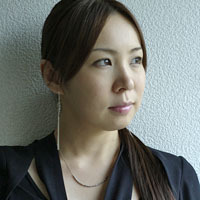
Photo by Takashi Kato
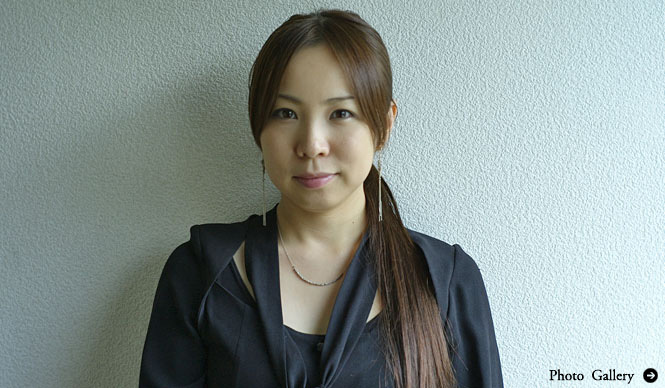
Yuko Nagayama
Born in Tokyo in 1975. Graduated from Showa Women's University, Faculty of Human Relations, Department of Environmental Design in 1998. Worked at Jun Aoki & Associates from 1998. Established Yuko Nagayama Architecture in 2002. Major works include 'afloat-f' (2002), 'CAST' (2003), 'LOUIS VUITTON Kyoto Daimaru' (2004), 'House on a Hill' (2006), 'URBANPREM Aoyama' (2008), 'Kayaba Coffee' (2009), among others.
http://www.yukonagayama.co.jp